The best eSourcing software depends on which sourcing events you run and how you want to pay for them. Market Dojo sells RFx events and eAuctions on a monthly or per-event licence. Tradogram adds RFQ and RFP events to a purchasing suite, Keelvar and Zycus focus on evaluating complex bids, Euna Procurement is built for public-sector solicitations, and Coupa, SAP Ariba and JAGGAER treat eSourcing as one module of a source-to-pay suite.
eSourcing software moves the bidding round online: a buyer invites suppliers, collects their bids in one place, compares them and awards the business. This page compares eight tools for a procurement or operations lead who runs those rounds. For each tool it says which sourcing events the vendor documents, how the award works, what the tool costs and who should skip it.
What is eSourcing software?
eSourcing software is a procurement tool that runs sourcing events online: it invites suppliers, collects their bids through a portal, lets the buyer compare them and records the award. The events fall into a few types. An RFI (request for information) asks suppliers what they can offer, an RFQ (request for quotation) asks for a price on a defined item, an RFP (request for proposal) asks how a supplier would solve a problem, and an e-auction, often a reverse auction, lets suppliers lower their prices against each other in real time.
| Event | What the buyer asks | What comes back | Typical use |
|---|---|---|---|
| RFI (request for information) | What can you supply and how | Capabilities and company data | Early market scan, before a shortlist |
| RFQ (request for quotation) | A price on a defined item, quantity and date | A price per line, plus lead time and terms | The spec is fixed and price decides |
| RFP (request for proposal) | How would you solve this problem | A written proposal with approach and price | The spec isn't fixed and quality decides |
| Reverse auction | Bid lower than the current best offer | Live prices during a timed event | Comparable goods or services with several qualified suppliers |
eSourcing comes before eProcurement. Suites that join both halves are compared in our source-to-pay software comparison. eSourcing decides which supplier gets the business and at what price, and eProcurement is the buying that follows: requisitions, purchase orders, receiving and invoices. Our guides to RFQ software and RFP software cover the two most common event types in depth, and strategic sourcing software covers the work before the event, such as spend analysis and category strategy.
Best eSourcing software at a glance
Pick by the events you run and by who has to take part. A team that runs a handful of events a year needs a licence it can buy for one event. A public agency needs sealed bids and a supplier pool, and an enterprise with complex bids needs optimization across price, risk and lead time.
 Best for a published price and one-event licencesMarket DojoRFx events and eAuctions from £500 per month billed annually, or £1,000 for a single event, with no long-term commitment on the on-demand licence (pounds sterling).
 Best for RFQs that end in a purchase orderTradogramRFQ and RFP events with weighted scoring, and the winning bid converts into a PO. Sourcing is an add-on to the $99 Essentials plan.
 Best for large bids scored beyond priceZycusRFx with BAFO rounds and eAuctions, a line-by-line bid sheet built for 6,000+ lines and AI scoring across quality, delivery, ESG and risk.
 Best for optimized awardsKeelvarMachine learning compares award scenarios across price, risk and sustainability, and agents can run events while people set the rules.
 Best when sourcing sits inside a spend suiteCoupaRFx and reverse auctions with constraint-based optimization, and winning terms pass into draft contracts and catalogs.
 Best for SAP-centered buyersSAP AribaThe widest list of documented auction formats, and supplier collaboration through SAP Business Network.
 Best for complex awards with many auction typesJAGGAERReverse, forward, Dutch, Japanese and ranking auctions, BAFO rounds and line-level split awards in one tool.
 Best for public-sector solicitationsEuna ProcurementSealed bidding, supplier self-registration by commodity code and scorecards that flag scoring gaps.
eSourcing software compared
Prices were checked on vendor pages between October 20 and November 13, 2026. Only two of the eight tools publish an amount, and the amounts aren't comparable: Market Dojo prices in pounds sterling per month or per event, and Tradogram prices a purchasing plan with the sourcing module as an add-on. The other six sell by quote, so the table shows the price status instead of a guess. Review ratings come from G2, except Coupa and SAP Ariba, whose ratings are TrustRadius scores out of 10 and aren't comparable with the G2 figures.
| Tool | Events it runs | Price status (USD unless marked £) | Review rating |
|---|---|---|---|
| Market Dojo | RFx events and eAuctions, weighted multi-scoring in a higher tier | From £500/month billed annually, or £1,000 per event on demand | No reviews yet |
| Tradogram | RFQ and RFP events, weighted scoring, award converts to a PO | $99/month Essentials plus a Sourcing RFx add-on; Premium by quote | 4.2 (36) |
| Zycus | RFx with multiple rounds and BAFO, eAuctions, AI bid scoring | Not published | No reviews yet |
| Keelvar | RFx including RFIs, e-auctions, spot quotes, optimized awards | Not published, contact the team | 4.7 (46) |
| Coupa | RFI, RFP, RFQ and reverse auctions, optimization with constraints | Custom quote | 6.9/10 (TrustRadius, 171) |
| SAP Ariba | RFI, RFP, multi-round bidding and seven auction formats | Price upon request | 7.6/10 (TrustRadius, 770) |
| JAGGAER | RFI, RFP, RFQ, five auction types, BAFO, optimization | Custom quote | 4.1 (86) |
| Euna Procurement | Public-sector solicitations with sealed bids and scorecards | Not published, tiers vary | 4.5 (13) |
 The Procurement Manager Our product | Routes renewal reviews to the business owner, Finance and IT before the notice deadline | From $49 per month, flat, no per-seat fees (Starter, up to 50 contracts) | No reviews yet |
Ratings and prices are as shown on the review and vendor pages on the dates above.
Sourcing events and where each tool stops
Every tool here runs the same five steps, and they differ in where they stop. The columns name the step, the tools in this list that document it most clearly, and the failure that shows up most often when a team moves from email to software.
- Step 1Build the event
- Zycus
- Market Dojo
Breaks when the event is rebuilt from scratch every time, so questions and scoring drift between rounds - Step 2Invite suppliers
- Euna Procurement
- Coupa
Breaks when suppliers must register or fill in a profile before they can bid, and the slow ones simply don't answer - Step 3Run the bid round or auction
- Market Dojo
- JAGGAER
- SAP Ariba
Breaks when an auction format is chosen for a market with only two or three qualified suppliers - Step 4Evaluate and optimize
- Keelvar
- Coupa
- Zycus
Breaks when the scoring lives in a spreadsheet next to the tool, so the award can't be explained later - Step 5Award and hand off
- Tradogram
- Euna Procurement
Breaks when the winning terms are retyped into the PO or the contract
How to choose eSourcing software
Choose by the event mix first and by the licence model second. The list price matters less than whether the module you need is part of the plan you'd actually buy, but that's easy to miss when the sourcing module is sold separately.
| Licence model | Tools here | What it means for you |
|---|---|---|
| Per event or per month, price published | Market Dojo | You can buy one event or a month of events and see the cost before a sales call. Prices are in pounds sterling only |
| Plan with a sourcing add-on | Tradogram | The Essentials plan is $99 per month with a Sourcing RFx add-on, and the Premium plan includes it by quote |
| Suite module, price on request | Coupa, SAP Ariba, JAGGAER, Zycus | Sourcing is bought with the suite, usually on a multi-year contract with a longer rollout |
| Specialist, price on request | Keelvar, Euna Procurement | Built for one buyer type: large enterprises with complex awards, or public-sector buyers |
An auction isn't the right event for every category. It works when several qualified suppliers can supply comparable goods or services, and it fits badly when the spec is open or only two suppliers qualify. In those cases an RFP or an RFQ with a scoring matrix is the better event, and every tool in this list runs at least one of those. Our guide to procurement software covers the suites that bundle sourcing with buying, and procure-to-pay software covers the purchasing side.
- Run one of your real events with at least ten lines and three suppliers, not the vendor's sample
- Ask which event types are in the plan you'd buy: RFI, RFQ, RFP, reverse auction, multi-round bidding
- Ask what a supplier has to do before bidding and whether they pay for access
- Ask how scoring is set up: weights agreed before bids arrive, and who can change them afterwards
- Ask how a split award across suppliers is built and approved
- Ask where the winning terms go next and who retypes them into the PO, the contract or the ERP
- Ask what the audit trail records: invitations, bids, clarifying questions, scores and the award decision
- Ask for the contract term, the renewal notice period and what each extra module costs
eSourcing software reviews
Each entry follows one sourcing event: what the tool runs, how bids are compared and awarded, what happens after the award and how the tool is licensed. We read vendor pages, help documentation and review-site listings and didn't run these products. Prices appear once per entry and in the table, so check them against the vendor before you budget.
Market Dojo
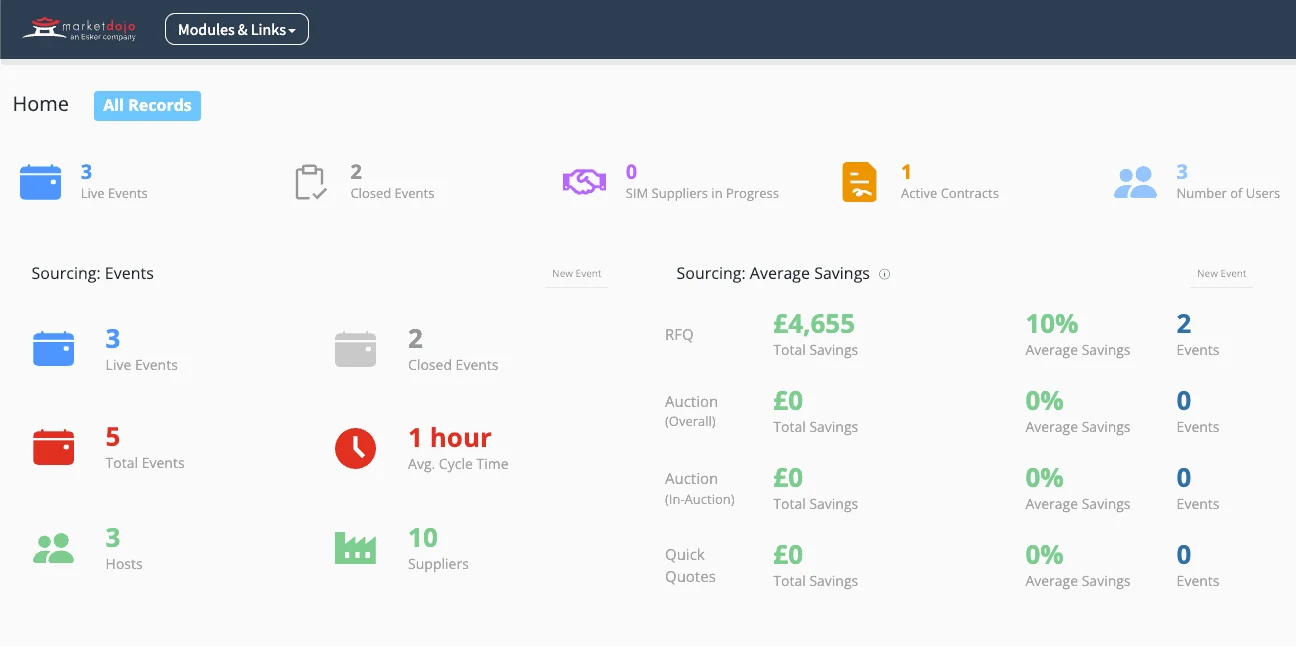
Market Dojo is an eSourcing platform that runs RFx events and eAuctions on monthly, annual or single-event licences, with weighted events and API integration in a higher tier.
Market Dojo runs RFx events and eAuctions on monthly, annual or single-event licences, so a team can buy one event without a long contract.
Events. RFx events and eAuctions run from templates and libraries, with Excel integration and live messaging with suppliers.
Award. Weighted events and collaborative multi-scoring sit in the £583-per-month annual tier. Scenario modeling isn't described on the vendor pages, so it's worth asking about.
After the award. The homepage lists a Contract Management module and supplier discovery with AI help. The steps from award to contract aren't described.
Licence. From £500 per month billed annually for simple RFx and eAuctions, or £1,000 per month or £1,000 per event on demand. Prices are in pounds sterling and no USD price is listed. No review rating is shown for Market Dojo.
- you want a published price and a licence you can buy for one month or one event with no long-term commitment
- you run a few RFx events or eAuctions a year and don't need a full source-to-pay suite
- you need a price in US dollars, because Market Dojo lists pounds sterling only
- you need documented constraint-based award optimization, because the vendor pages mention weighted events and multi-scoring but not scenario modeling
- Starting price
- From £500 per month billed annually for simple RFx and eAuctions; £1,000 per month or £1,000 per event on-demand (pounds sterling, no USD price)
- Sourcing events
- Simple RFx and eAuctions with templates and libraries, Excel integration and live messaging
- Award analysis
- Weighted events and collaborative multi-scoring in the £583 per month annual tier; scenario modeling is not described
- Supplier discovery
- The homepage lists supplier discovery and says AI helps discover and qualify suppliers
- Handoff after award
- The homepage lists a Contract Management module; the handoff steps are not described
Tradogram
Procurement and purchase order software with the lowest published entry price in this list, but requisitions and custom approvals are add-ons on that plan.
Tradogram runs RFQ and RFP events inside a purchasing suite, with a supplier response portal, weighted scoring and automatic conversion of the awarded bid into a purchase order.
Events. RFQs and RFPs are built in one place, with invitations, deadlines, requirements and response criteria set up front. Suppliers answer through a dedicated portal, so every response comes back in the same format. Reverse auctions aren't described on the vendor's sourcing page.
Award. Bids are compared side by side on price, quality, delivery and custom criteria, and weighted evaluation scores them against the same criteria.
After the award. The awarded bid converts directly into a purchase order, and the selected supplier is notified automatically.
Licence. Essentials costs $99 per month, and Sourcing RFx is an add-on on that plan. Premium includes it and is sold by quote.
- you run RFQs and RFPs rather than auctions and want the award to end in a purchase order without retyping
- you want a published entry price and a supplier portal inside a purchasing suite
- you need reverse auctions or award optimization, because the vendor's sourcing page describes neither
- you expect sourcing in the $99 plan, because Sourcing RFx is an add-on there and included in the quote-only Premium plan
- Users like
- Easy setup and personal, engaged customer service, and POs that go to suppliers automatically once approval completes.
- Users dislike
- Fields that can't be adapted, modules sold as a package, and one report of approvers being bypassed despite thresholds.
- Source: G2, 36 reviews
- Starting price
- From $99 per month (Essentials); requisitions are an add-on there
- Approval levels
- Up to 10, each with up to 5 alternates
- Extra users on Essentials
- $32 per user
- Sourcing events
- RFQs and RFPs with invitations, deadlines and response criteria set up front; suppliers answer through a response portal; reverse auctions aren't described on the sourcing page (vendor page, read 2026-11-13)
- Award analysis
- Side-by-side comparison on price, quality, delivery and custom criteria, plus weighted bid evaluation
- Handoff after award
- The awarded bid converts directly into a purchase order and the selected supplier is notified automatically
Zycus
Zycus is a source-to-pay suite whose supplier management and iRisk modules score suppliers against buyer-defined KPIs and contracted SLAs, with AI agents, risk cards and supplier corrective action requests.
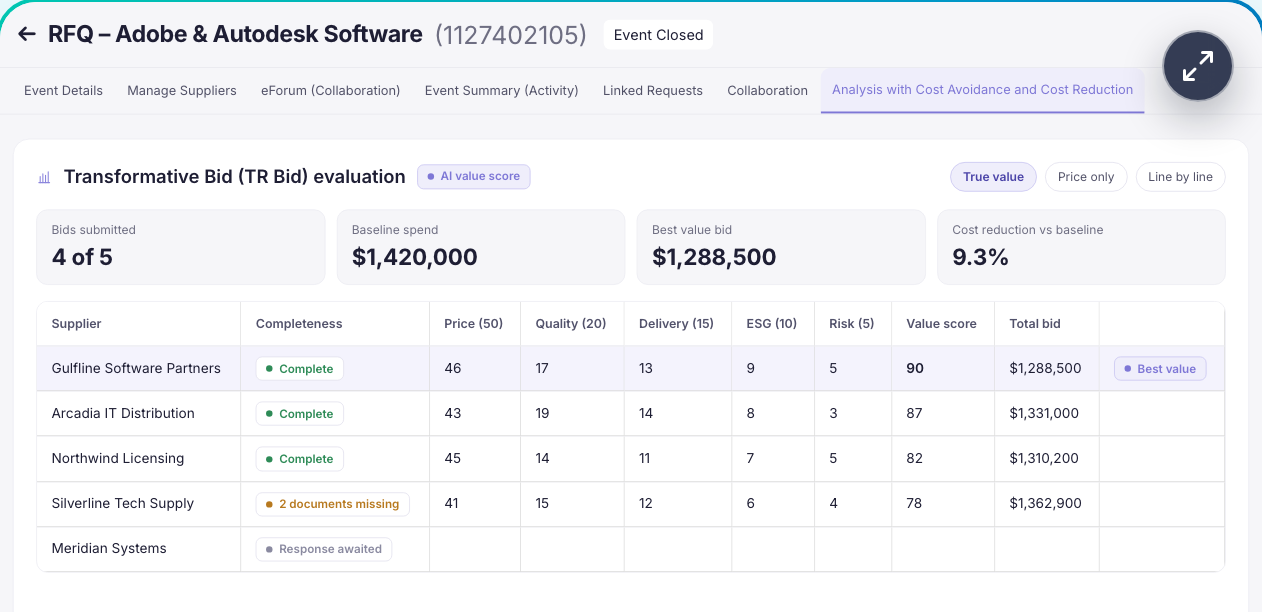
Zycus runs full RFx events with multiple rounds and best and final offer negotiation, plus eAuctions, and scores bids on quality, delivery, ESG and risk as well as price.
Events. An event starts from a template, a past event or a purchase request and can be drafted with AI from historical spend. Questionnaires are built section by section, and a bill-of-quantities app prices events line by line. The vendor states it handles 6,000+ line items, with alternates, partial bids, matrix pricing and volume breaks.
Award. Transformative Bid scoring weighs price against quality, delivery, ESG and risk, compares bids line by line across rounds and sets a single award against a split award. The justification is routed for approval.
After the award. Awards flow on to contracts and POs inside the Zycus source-to-pay suite, and connections to SAP and Oracle NetSuite are listed.
Licence. Not published.
- you run large, multi-line events where bids must be scored on more than price
- you want RFx rounds, BAFO and eAuctions in a suite that carries the award on to contracts and POs
- you want a published price or a large body of review-site ratings, because neither is available
- you run a handful of simple events a year, because the product is built for large, governed sourcing
- Starting price
- Not published
- Scoring inputs
- Internal delivery, quality and AP history plus external risk data
- Risk data partners
- Dun & Bradstreet, RapidRatings, EcoVadis
- Corrective action
- SCAR (supplier corrective action requests)
- Pricing
- Not published
- Sourcing events
- Full RFx events with multiple rounds and best and final offer (BAFO) negotiation, plus eAuctions, each with an approval workflow before it goes out (vendor eSourcing page, read 2026-11-13)
- Award analysis
- Transformative Bid (TR Bid) scoring weighs price against quality, delivery, ESG and risk, compares single and split awards line by line, and routes the justification for approval
- Large bids
- The BOQ App prices events line by line and the vendor states it handles 6,000+ line items, with alternates, partial bids and volume breaks
- Supplier discovery
- Suppliers can be shortlisted with performance, reliability and risk intelligence; each invitation is tracked from terms acceptance to confirmed participation
- Handoff after award
- Awards flow on to contracts and POs inside the Zycus source-to-pay suite; ERP connections to SAP and Oracle NetSuite are listed
Keelvar
Keelvar is an agentic sourcing platform for large enterprises, built around bid optimization and autonomous sourcing events with scenario modeling across price, risk and sustainability.
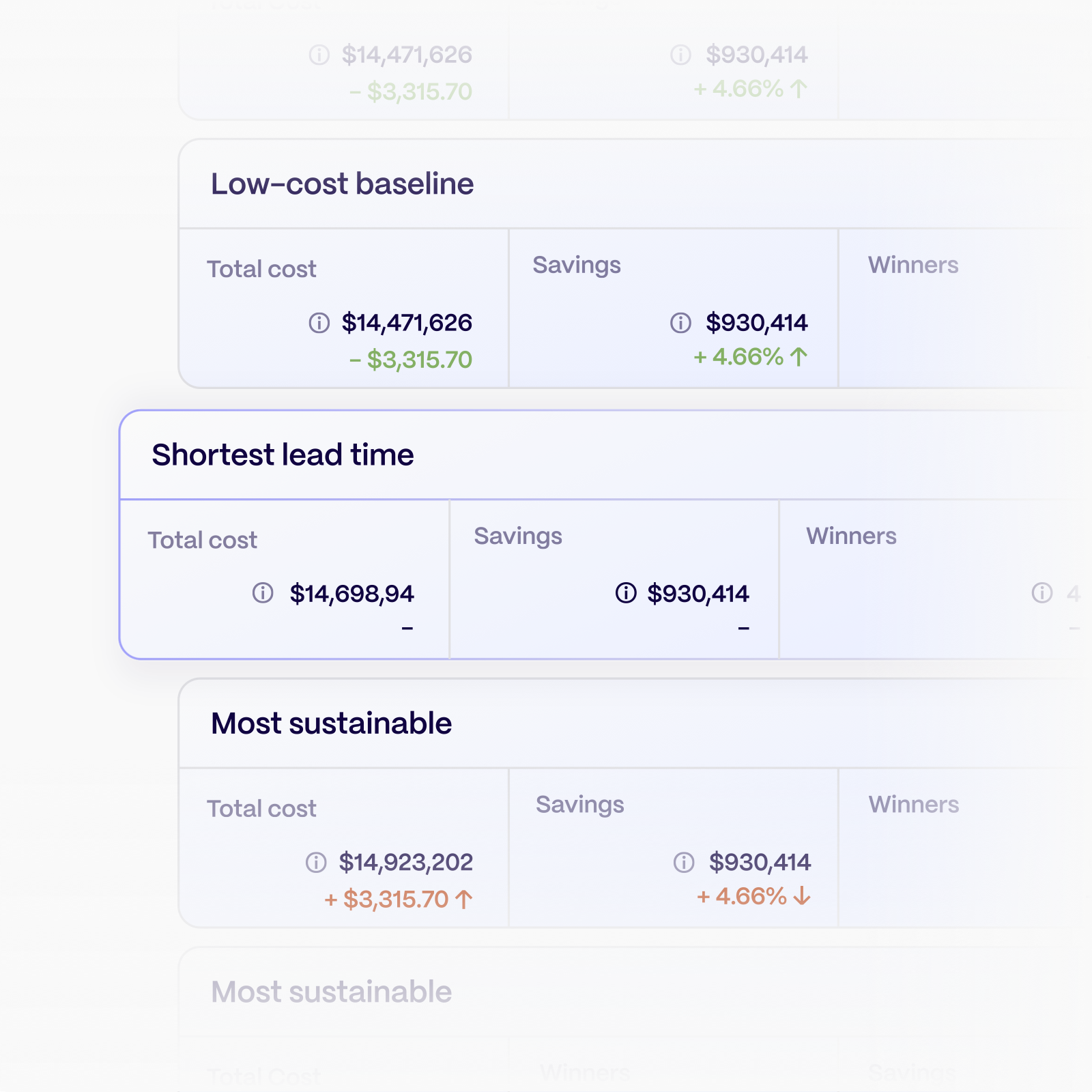
Keelvar is an agentic sourcing platform for large enterprises, built around bid optimization and agent-run events with scenario modeling across price, risk and sustainability.
Events. RFx including RFIs, e-auctions and spot quotes, configurable by spend category. An assistant called Kai recommends suppliers to approach, and agents can run events.
Award. Machine learning evaluates complex bid scenarios across price, risk and sustainability. Agents can recommend an award, while people set the rules and approve it. Rate Manager can trigger new events when rates expire or drift from benchmarks.
After the award. The published vendor pages don't describe a contract or PO handoff.
Licence. Not published. The pricing page says to contact the team.
- you run complex multi-lane or multi-category events where awards must be optimized across price, risk and sustainability
- you want rate expiry or benchmark drift to trigger new sourcing events
- you need a public price, because Keelvar's pricing page only says to contact the team
- you are a small team, because the vendor positions the product for large enterprises
- Starting price
- Not published, pricing page says to contact the team
- Sourcing events
- RFx including RFIs, e-auctions and spot quotes, configurable by spend category
- Award analysis
- Machine learning evaluates complex bid scenarios across price, risk and sustainability; agents can recommend an award while humans set rules and approve
- Supplier discovery
- An assistant called Kai recommends suppliers to approach
- Spend analysis
- Rate Manager can trigger sourcing events when rates expire or drift from benchmarks
- Handoff after award
- Not described on the published vendor pages
Coupa
Enterprise source-to-pay suite whose requisitions run through guided buying, punchout and prioritized approval chains with budget meters.
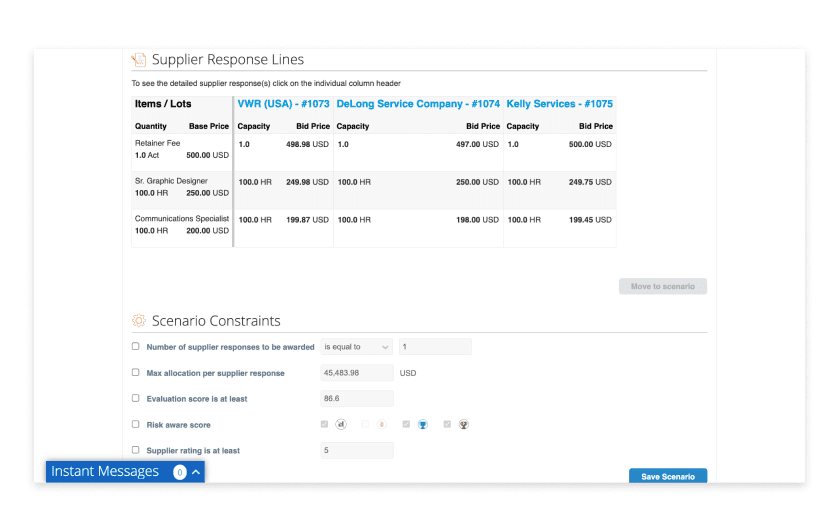
Coupa's sourcing module runs RFI, RFP, RFQ and reverse-auction events from preapproved templates and compares award scenarios with constraints such as supplier caps, geography, tariffs and freight.
Events. The vendor lists RFP, RFI, RFQ and reverse auctions, and it says routine events run from preapproved templates. Pre-rated, pre-enabled suppliers can be filtered by diversity, rating or geography, and AI suggests suppliers from category performance.
Award. Coupa Sourcing Optimization sets per-supplier caps, geography, tariffs and freight as constraints and compares scenarios side by side, with manual overrides.
After the award. Winning terms and rate cards pass into draft contracts in Coupa CLM and into catalogs on approval.
Suppliers. A buyer invitation link expires after 30 days, and the standard supplier portal is free for suppliers. Coupa Advanced is a paid supplier tier.
Licence. Custom buyer quote. Coupa lists no public rate card.
- you want sourcing, contracts and catalogs in one suite, with winning terms passing into draft contracts
- you need constraint-based award scenarios across suppliers, geography and freight
- you're a small or mid-size team that wants a published price and a rollout in weeks
- your only need is a few simple RFQs, because the suite is built for enterprise spend
- Users like
- Approval routing and spend compliance for indirect buying, with clear purchase limits per person.
- Users dislike
- Heavy integration work with ERPs such as SAP, and a supplier portal that confuses vendors asked to create profiles.
- Source: TrustRadius, 171 ratings
- Starting price
- Custom buyer quote; no public rate card listed
- Standard supplier portal
- Free for suppliers; Coupa Advanced is a paid supplier tier (SSO, API, QuickBooks and NetSuite sync)
- Buyer-side platform
- No public rate card listed
- Requisition API
- Create and submit for approval
- Process Automator
- Document events and API call outs
- Supplier join
- Buyer invitation (link expires after 30 days), self-registration or a PO email
- Budget meters
- Show remaining budget per budget item before commitment
- Hard stop
- A budget-line setting blocks requisition submission over budget
- Dashboards
- Out-of-the-box dashboards, KPI benchmarking and savings insights
- Sourcing events
- RFP, RFI, RFQ and reverse auctions are listed in the vendor FAQ; routine events run from preapproved templates
- Award analysis
- Coupa Sourcing Optimization sets per-supplier caps, geography, tariffs and freight as constraints and compares scenarios side by side, with manual overrides
- Supplier discovery
- Pre-rated, pre-enabled suppliers filterable by diversity, rating or geography; AI suggests suppliers from category performance
- Spend analysis
- Cross-platform spend visibility, automatic classification and suggested opportunities such as expiring contracts
- Handoff after award
- Winning terms and rate cards pass into draft contracts in Coupa CLM and into catalogs on approval
- Spend classification
- AI engine maps transactions to a proprietary Coupa taxonomy of roughly 60 primary categories and 1,800 sub-categories, built for category management. It classifies by supplier first, using invoice and PO descriptions. Source post dates from 2022.
- Category strategy
- Coupa Category Strategy starts from a category taxonomy built on Coupa data, uses AI-guided stakeholder interviews and the Navi assistant for recommendations, and rolls every strategy into one portfolio view using a single methodology.
- Savings tracking
- Coupa describes tracking value through stages identified, negotiated, contracted and realized, to link negotiated savings to P&L impact. Initiative value can include non-cost benefits such as supplier relationships and resilience.
- Category supplier view
- Category Strategy page says it pairs with Coupa Supplier Information & Risk Management to segment suppliers, track performance and manage risk. Sourcing suggests suppliers from category performance. Segmentation criteria are not detailed publicly.
- Supplier risk module (checked 2026-11-06)
- Coupa Supplier Risk & Performance: monitoring of outside data sources, alerts, next-step recommendations and a supplier hold that can block transactions from purchasing to invoicing
- Risk datasheet (2021)
- Standard (onboarding, monitoring, scorecards) and Advanced (multi-domain assessments, inherent and residual scoring, multi-tier, mitigation plans); fees may apply for the Coupa risk data service
- Risk Assess
- Questionnaires across domains such as InfoSec, ABAC and GDPR, with alerts when risk increases
- Supplier risk price
- Not published, demo request only
SAP Ariba
SAP's source-to-pay suite covering sourcing events with scoring and award simulation, buying and invoicing, contracts and supplier collaboration through SAP Business Network.
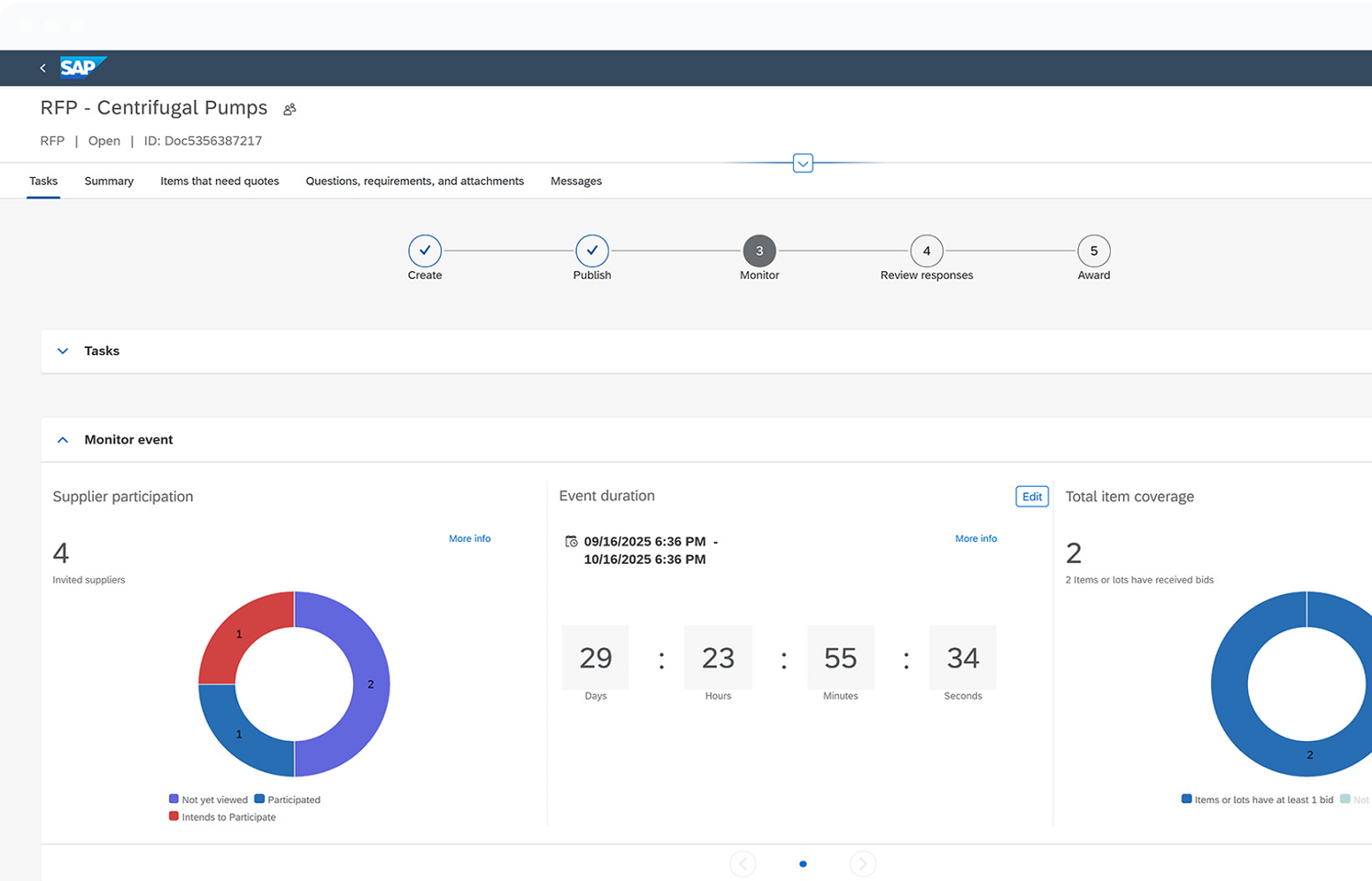
SAP Ariba Sourcing documents the longest list of auction formats in this list, and supplier collaboration runs through SAP Business Network.
Events. RFI, RFP, multi-round bidding, and English, Dutch, Japanese, total-cost, traffic-light, basket and lot auctions, according to SAP material dated May 2022. Suppliers can be found by industry, item or service in SAP Business Network Discovery, and their profiles show certifications and ESG data.
Award. Scoring and grading, a bid comparison report, award scenario comparison and one-click awarding. The product page also lists AI bid summaries and award simulation.
After the award. Follow-on documents such as POs, purchase info records and scheduling agreements go to an external system, and the product links to SAP Ariba Contracts.
Suppliers. A standard supplier account on SAP Business Network is free, with unlimited documents. Enterprise accounts pay a fixed subscription fee plus transacted volume.
Licence. Price upon request.
- your purchasing design is closely tied to SAP processes and master data
- you want a wide choice of documented auction formats, and supplier collaboration through SAP Business Network
- you want a published buyer price and a quick rollout
- you run mostly non-SAP systems, because reviewers describe hard integration with non-SAP ERPs
- Users like
- Punch-out catalogs and guided buying with approval workflows that standardize how people buy.
- Users dislike
- An outdated interface, weak reporting and hard integration with non-SAP ERPs.
- Source: TrustRadius, 770 ratings
- Starting price
- Price upon request, no public buyer rate
- Buying and Invoicing pricing
- Price upon request, priced on processed spend
- Standard supplier account
- Free on SAP Business Network, unlimited documents
- Enterprise supplier account
- Fixed subscription level fee plus transacted volume
- Supplier order flow
- PO confirmation, ship notices, PO flip invoices, invoice and payment status
- Sourcing events
- RFI, RFP, multi-round bidding and English, Dutch, Japanese, total-cost, traffic-light, basket and lot auctions (SAP slides dated May 2022)
- Award analysis
- Scoring and grading, bid comparison report, award scenario comparison and one-click awarding; AI bid summaries and award simulation on the product page
- Supplier discovery
- Search by industry, item or service in SAP Business Network Discovery; profiles show certifications and ESG data
- Handoff after award
- Follow-on documents such as POs, purchase info records and scheduling agreements in an external system; links to SAP Ariba Contracts
- Spend classification
- The newer Spend Analysis and Insights offer maps spend to UNSPSC (incl. v25) or a custom taxonomy, with a stated 95% accuracy, and ingests SAP Cloud ERP, Ariba, Fieldglass, Concur plus non-SAP data.
- Category strategy
- Guided strategy process with category profiles, hierarchy management, Kraljic, PESTLE, SWOT and Porter's Five Forces frameworks, AI-curated market intelligence (third-party content from Beroe), generative AI drafts, and approval workflow.
- Savings tracking
- Managers pick value levers, goals and KPIs per category, document initiatives with owners, timelines and estimated outcomes, and follow them in a monitoring workbench, dashboard and calendar view. Savings accounting rules are not detailed publicly.
- Category supplier view
- Category segmentation and cost structure analysis are listed features, and the Kraljic matrix segments categories or suppliers by supply risk and profit impact. Supplier performance scorecards belong to separate Ariba supplier management modules.
JAGGAER
JAGGAER is a source-to-pay suite whose supplier management module gives suppliers a portal with guided self-service onboarding, compliance checks and configurable workflows, plus automated verification of uploaded documents.
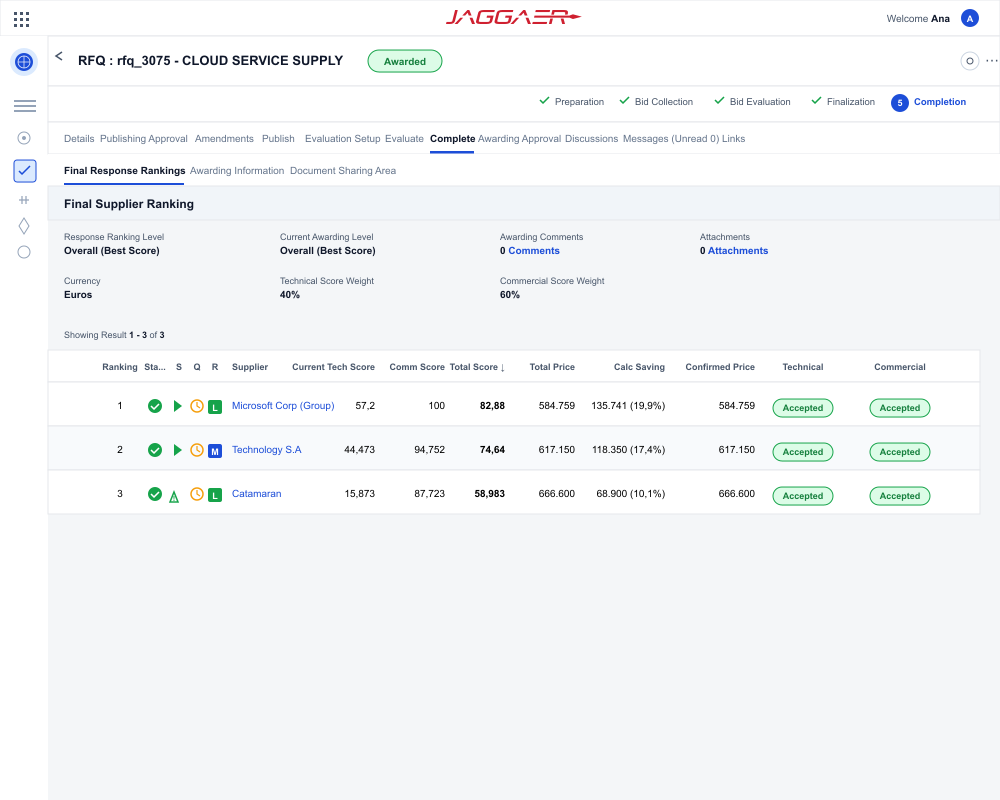
JAGGAER documents five auction types plus RFI, RFP and RFQ events, with BAFO rounds and constraint-based optimization for complex awards.
Events. RFI, RFP and RFQ events start from templates. Auctions can be reverse, forward, Dutch, Japanese or ranking auctions. AI supplier recommendations and Smart Quote suggest suppliers to invite.
Award. Weighted scorecards, BAFO rounds and constraint-based optimization with unlimited what-if scenarios, including line-level split awards.
After the award. Sourcing feeds Contracts and Procure-to-Pay on one data layer. The vendor lists 40+ pre-built integrations, including SAP, Oracle, Workday, NetSuite, Infor and JD Edwards. The handoff steps aren't detailed.
Licence. Custom quote only.
- you run complex events that need several auction types, BAFO rounds and line-level split awards
- you want sourcing, contracts and procure-to-pay on one data layer, with pre-built ERP integrations
- you want a published price, because JAGGAER sells by custom quote only
- you need a simple interface for occasional users, because reviewers describe an inconsistent interface across modules and setup complexity
- Users like
- Flexibility and configurability, strong support and consulting teams.
- Users dislike
- An inconsistent interface across modules, setup complexity and supplier-side feature limits.
- Source: G2, 86 reviews
- Starting price
- Not published, custom quote
- Supplier portal
- Guided self-service with built-in compliance checks
- Documents
- Automated document validation (JAI)
- Integration
- Integrates with existing business systems, no ERPs named on the page
- Sourcing events
- RFI, RFP and RFQ from templates; reverse, forward, Dutch, Japanese and ranked auctions
- Award analysis
- Weighted scorecards, BAFO rounds and constraint-based optimization with unlimited what-if scenarios and line-level split awards
- Supplier discovery
- AI supplier recommendations, risk flags and Smart Quote suggested suppliers
- Handoff after award
- Sourcing feeds Contracts and Procure-to-Pay on one data layer; the steps are not detailed
- Integrations
- 40+ pre-built, including SAP, Oracle, Workday, NetSuite, Infor and JD Edwards
- Spend classification
- Automatic Spend Classification uses NLP on invoice text or product numbers to predict eCl@ss codes, and the same method can predict UNSPSC. It runs on demand or in batch. No accuracy figures published. Press release dates from 2019.
- Category strategy
- Category management page lists built-in Kraljic, SWOT and Porter frameworks, a stage-gated process with standard approvals and templates, and market intelligence such as commodity, FX and price indices plus 800+ category reports.
- Savings tracking
- A savings pipeline covers idea capture, validation and tracking from identified through realized. Mapping of savings to category targets or baselines is not detailed on the page.
- Category supplier view
- Page mentions a unified view of spend, supplier performance and market data, with category risk scored across supplier, financial, ESG and geopolitical factors. Supplier segmentation per category is not explicitly described.
Euna Procurement
Bonfire was merged with IonWave, EqualLevel and DemandStar into Euna Procurement, a sourcing module for solicitations, evaluation and award. It's aimed mainly at government and other public-sector buyers.
Euna Procurement is a sourcing module for solicitations, evaluation and award, built mainly for government and other public-sector buyers.
Events. Teams reuse stored documents, templates and approved language and can co-author a solicitation in real time with changes logged. Solicitations go to a supplier network of more than 1.25 million suppliers, with a guided submission builder and sealed bidding. Suppliers self-register and pick commodity codes to receive relevant bid notices, and they can ask clarifying questions in the app before they submit.
Award. Evaluators score proposals in a shared workspace with a customizable scorecard per solicitation. The system can flag scoring gaps and offers consensus tools. Supplier pricing is tabulated and compared automatically. Weighting mechanics aren't described on the vendor page.
After the award. An awarded sourcing project can generate a contract directly, with the award information carried over.
Licence. Not published. Pricing comes in tiers and sizes aren't stated.
- you're a public-sector buyer that needs sealed bidding, supplier self-registration by commodity code and an in-app question step
- you want evaluators scoring on per-solicitation scorecards with scoring-gap flags and consensus tools, then a direct jump to a contract
- you're a private-sector team that wants a lightweight eSourcing tool, because the page centers on government customers and a wider procurement suite
- you need to confirm weighted-score setup or sourcing-specific integrations from the vendor, because weighting isn't described and only general ERP and API support is listed
- Starting price
- Not published, request pricing, tiers vary
- Building and sending the RFP
- Teams reuse stored documents, templates and approved language and can co-author solicitations in real time with changes logged. Solicitations go to the supplier network, with a guided submission builder for suppliers and sealed bidding.
- Scoring and evaluation
- Evaluators score and compare proposals in a shared workspace using customizable scorecards for each solicitation. The system can flag scoring gaps and offers consensus tools. Weighting mechanics are not described on the page.
- Comparison and award
- Supplier pricing is tabulated and compared automatically. Awarded sourcing projects can generate contracts directly with the award information carried over.
- Suppliers and Q&A
- Suppliers self-register and pick commodity codes to receive relevant bid notices, and can ask clarifying questions in the app before submitting. The page cites a network of over 1.25 million suppliers and DBE self-identification.
- Integrations
- The page cites support for more than 25 ERPs, over 150 API routes, and API and webhook capabilities. No sourcing-specific integrations are listed.
- Size and fit
- Main focus is government and the public sector, with over 3,000 public sector customers cited. Healthcare, utilities, nonprofit, education and tribal nation customers are also listed. Pricing comes in tiers, sizes not stated.
After the award: contract dates
An award ends the sourcing event, but the contract it creates has dates of its own, and they're easy to miss. A supplier that wins on price often comes with a term, an auto-renewal and a notice period, and those sit in the contract, not in the eSourcing tool. Our guides to contract renewal notice periods and contract negotiation software cover the dates to capture.
None of the eSourcing tools above tracks the renewal decision for the contract the award creates, and that's the gap The Procurement Manager is built for.
Frequently asked questions
What is eSourcing software?
eSourcing software runs sourcing events online. A buyer invites suppliers, collects their bids in one portal, compares them and records the award. The events include RFIs, RFQs, RFPs and auctions. Our guides to RFQ software and RFP software cover the two most common types.
What is the difference between eSourcing and eProcurement?
eSourcing picks the supplier and the price through bids and auctions. eProcurement is the buying that follows, from requisition and purchase order to receiving and invoice. Suites such as Coupa, SAP Ariba and JAGGAER cover both, while Market Dojo and Keelvar focus on the sourcing side.
How much does eSourcing software cost?
eSourcing software prices are published for only two of the eight tools here. Market Dojo starts at £500 per month billed annually, or £1,000 per event on demand, and Tradogram's Essentials plan is $99 per month with Sourcing RFx as an add-on. Coupa, SAP Ariba, JAGGAER, Zycus, Keelvar and Euna Procurement sell by quote.
Do suppliers pay to take part in an event?
Suppliers usually don't pay to take part in an event when they use a standard account. Coupa's standard supplier portal is free, and a standard SAP Business Network account is free with unlimited documents, but paid supplier tiers exist, such as Coupa Advanced and SAP's enterprise accounts, and they add integrations or volume-based fees.
Is there free eSourcing software?
None of the eight tools in this list has a free plan. The closest thing to no commitment is Market Dojo's on-demand licence, which it sells per month or per event in pounds sterling.
Which tool fits a small team that runs a few events a year?
Market Dojo, because it publishes a price and sells single-event licences. Tradogram is the other published option, and its Essentials plan needs the Sourcing RFx add-on. A strategic sourcing suite is more than a small team usually needs. Our guide to strategic sourcing software covers it.