The best strategic sourcing software depends on how complex your awards are and what system the award has to land in. If an award has caps, splits, bundles or lanes, Coupa, JAGGAER, Ivalua and Keelvar document scenario modeling for it. If you run SAP or Workday, SAP Ariba and Workday Strategic Sourcing carry the award on inside the same platform. If the job is a high volume of small RFQs, Fairmarkit automates the event itself.
Strategic sourcing software is the tool a buying team uses to run a competitive sourcing event: it finds what to source and who to ask, collects bids through an RFI, RFP, RFQ or auction, compares them and records the award. We compared nine tools on those four steps using each vendor's own pages, and we mark every capability a vendor doesn't document. If most of your events are RFPs, our RFP software comparison covers the tools for sending them and for answering them.
- tools compared
- 9
- event steps checked per tool
- 4
- publishes a price
- 1
- Pick by the award you run. Coupa Sourcing Optimization, JAGGAER, Ivalua and Keelvar document constraint-based award scenarios. SAP Ariba and Workday Strategic Sourcing hand the award to POs or contracts inside their own platform. Fairmarkit is built for high-volume, low-value RFQs.
- Only one of the nine publishes a price. Market Dojo lists £500 per month on an annual licence or £1,000 per event, in pounds. The other eight are a quote, a demo request or a contact form, so the first question for a vendor is what your event volume costs.
- Sourcing ends at the award. The pages we read describe the handoff into a contract or PO, but not who decides the renewal before the notice date of the contract that was just signed.
Our picks by the sourcing job
A tool that handles a thousand tail-spend RFQs is the wrong tool for a three-lane freight award, and the reverse is also true. These picks follow the job, not a score.
 Best for awards that flow into contractsCoupaConstraint-based award scenarios, with winning terms passed into draft contracts in Coupa CLM.
 Best for award optimizationJAGGAERWeighted scorecards, BAFO rounds and unlimited what-if scenarios under capacity, lead time, quality, ESG and risk constraints.
 Best for SAP-based buyingSAP AribaSeven auction formats, award scenario comparison and awards that hand off to POs and scheduling agreements in the back end.
 Best for rule-based award scenariosIvaluaNatural-language, rule-based scenarios and optimization in a Sourcing Decision Center.
 Best for Workday finance shopsWorkday Strategic SourcingSourcing events that start contract creation in Workday CLM once a supplier is selected.
 Best for agent-run eventsKeelvarAgents run events and can recommend an award while people set the rules and approve.
 Best for tail-spend RFQsFairmarkitAuto-bundling, auto-sending and auto-award by weighted rules for many low-value requests.
 Best for a published priceMarket DojoRFx and eAuctions from £500 per month billed annually, or £1,000 for a single event, with no long-term commitment on the on-demand licence (pounds sterling).
 For the contract after the awardThe Procurement ManagerRoutes the renewal decision of the contract you just signed to the business owner, Finance and IT before the notice deadline.
What strategic sourcing software does
Strategic sourcing software supports the planned part of buying, the work that happens before a contract exists. It helps a team analyze spend to decide what to source, find and shortlist suppliers, run an RFI, RFP, RFQ or auction, compare the bids and record the award. The result is a supplier choice with agreed terms, which then goes to a contract and to purchasing. It doesn't replace a contract tool or a purchasing system: of the nine tools here, six sell sourcing as one module of a wider suite and three (Keelvar, Fairmarkit and Market Dojo) focus on the event. Strategic sourcing software is also not the same as supplier discovery or spend analytics software, which some teams buy separately. Which categories deserve a sourcing event in the first place is a category-level decision, covered in our guide to category management software.
The flow below shows the four steps we used to compare the tools, which tools document something at each step and what usually goes wrong when a step is skipped. A tool can be strong at one step and silent on another, so the entries answer all four.
- FindDecide what and who
- Coupa
- SAP Ariba
- JAGGAER
- Fairmarkit
Breaks when the category list comes from last year's habits, and the same three suppliers get invited - RunRun the event
- SAP Ariba
- Ivalua
- JAGGAER
- Fairmarkit
Breaks when the format doesn't fit the category, so bids can't be compared line by line - DecideCompare and award
- Coupa
- Ivalua
- JAGGAER
- Keelvar
- Workday Strategic Sourcing
Breaks when the cheapest total price wins although the constraints (capacity, split, risk) were never modeled - Hand offContract and PO
- Coupa
- SAP Ariba
- Workday Strategic Sourcing
 GEP SMART
Breaks when the award sits in a sourcing report and the contract term and notice date are set later by someone else
Strategic sourcing vs procurement software
Strategic sourcing is the planned part of buying: choosing what to source, which suppliers compete and on what terms. Procurement is the wider function that also orders, receives and pays against those terms. Software follows the same split. Sourcing tools run the event that ends in an award. Procure-to-pay tools run the requisitions, POs, receiving and invoices after it. Many suites in this list sell both, so the useful question is how far the sourcing module goes on its own. Our procure-to-pay software comparison and spend management software comparison cover the buying side.
Supplier sourcing software
Supplier sourcing software is the narrower job of finding and shortlisting suppliers before an event, and seven of the nine tools here document some form of it. Whether it is enough depends on the limit of your problem: if you already know your suppliers, you don't need it. In this list, SAP Ariba searches SAP Business Network Discovery by industry, item or service, Coupa filters pre-rated suppliers by diversity, rating or geography, and Fairmarkit ranks vendors by their likelihood to respond. Market Dojo lists supplier discovery on its homepage. JAGGAER and Keelvar recommend suppliers to approach, and Ivalua searches your own repository or the web using the event's criteria. Keelvar's own tool list names Scoutbee for supplier discovery and Sievo for spend analytics, which shows that some teams buy those jobs as separate tools. If your problem is only finding suppliers, that's a different shortlist from the one below. Our supplier management software comparison covers the records side.
Strategic sourcing software compared
The table shows what each tool is, what it hands on, its price status and the review rating we could read. Review sources differ because G2, Capterra and Gartner blocked some direct reads, so the source and scale sit in each cell. A tool with no rating means we couldn't read a primary review source for it.
| Tool | Type | What it hands on | Price status (USD) | Review rating |
|---|---|---|---|---|
| SAP Ariba | Enterprise source-to-pay and sourcing | Award scenarios, then POs, scheduling agreements and SAP Ariba Contracts | Price upon request, no public buyer rate | 7.6/10 (TrustRadius, 757) |
| Coupa | Enterprise spend management and procurement | Winning terms into draft contracts in Coupa CLM and catalogs | Custom buyer quote; no public US rate card verified | 7.2/10 (TrustRadius, 168) |
| Ivalua | Source-to-pay suite with supplier information management | Award scenarios, then Ivalua Contract Management | Not published, quote only (a third party reports a buyer-reported floor near $150,000 per year, unverified) | No reviews yet |
| JAGGAER | Source-to-pay suite with supplier management | Award optimization, then Contracts and Procure-to-Pay | Not published, custom quote | No reviews yet |
| Workday Strategic Sourcing | Enterprise source-to-contract suite | Supplier selection starts contract creation in Workday CLM | Not published, via a Workday representative or demo | 4.5 (35) |
| GEP SMART | Source-to-pay suite with sourcing module | Awarded suppliers move into contracting | Not published | No reviews yet |
| Keelvar | Sourcing optimization and autonomous sourcing | Optimized award recommendation, handoff not described | Not published, pricing page says to contact the team | 4.7 (46) |
| Fairmarkit | Autonomous sourcing for tail spend | Auto-awarded RFQ, handoff not described | Not published, demo request only | No reviews yet |
| Market Dojo | eSourcing with on-demand licences | RFx and eAuction events, handoff not described | From £500 per month billed annually for simple RFx and eAuctions; £1,000 per month or £1,000 per event on-demand (pounds sterling, no USD price) | No reviews yet |
| The Procurement Manager Our product | Contract renewal decisions | Routes renewal reviews to the business owner, Finance and IT before the notice deadline | From $49 per month, flat, no per-seat fees (Starter, up to 50 contracts) | No reviews yet |
Prices checked on vendor pages on October 28, 2026. Rating sources and scales differ by tool: SAP Ariba and Coupa show TrustRadius out of 10, the others G2 out of 5.
Which events each tool documents
The table shows what each vendor documents about each step of a sourcing event. "Yes" means a vendor page or document describes it. "Partly" means it's mentioned without detail or sits in a separate product. "Not described" means we didn't find it on the pages we read, which isn't the same as "the tool can't do it", so treat each one as a demo question.
| Tool | RFx events | Auctions | Award scenarios | Supplier discovery | Spend analysis | Contract or PO handoff |
|---|---|---|---|---|---|---|
| SAP Ariba | Yes | Yes | Yes | Yes | Partly | Yes |
| Coupa | Partly | Partly | Yes | Yes | Yes | Yes |
| Ivalua | Yes | Yes | Yes | Partly | Partly | Partly |
| JAGGAER | Yes | Yes | Yes | Yes | Partly | Partly |
| Workday Strategic Sourcing | Yes | Yes | Yes | Not described | Not described | Yes |
| GEP SMART | Yes | Yes | Partly | Partly | Partly | Partly |
| Keelvar | Yes | Yes | Yes | Partly | Partly | Not described |
| Fairmarkit | Yes | Yes | Partly | Yes | Not described | Not described |
| Market Dojo | Yes | Yes | Partly | Yes | Partly | Partly |
How we compared the tools
We read vendor pages, datasheets and review sites between October 20 and 28, 2026, and we read the same four things for every tool and each entry answers them in the order of a sourcing event. Where a vendor page didn't show a step, the entry says so instead of guessing.
- Find: how the tool helps you decide what to source and which suppliers to invite.
- Run: which event types it documents (RFI, RFP, RFQ, auctions) and how bids are collected.
- Decide: how bids are compared and how an award is chosen, from simple scoring to constraint-based scenarios.
- Hand off: where the award goes next, a contract, a PO or nowhere the pages describe.
We also record price status, the review basis and a real skip-if for each tool. The read is documentation only: we didn't run events in any of them.
Source-to-pay suites with a sourcing module
SAP Ariba, Coupa, Ivalua, JAGGAER, Workday Strategic Sourcing and GEP SMART sell sourcing as one module of a wider platform. They are strongest when the award has to land in a contract and purchasing system you already run, and heavier than needed when you only run a few events.
SAP Ariba
SAP's source-to-pay suite covering sourcing events with scoring and award simulation, buying and invoicing, contracts and supplier collaboration through SAP Business Network.
SAP Ariba Sourcing is the sourcing module of SAP's source-to-contract suite, with the widest list of auction formats we found and awards that can hand off to POs in an SAP back end.
Find. Supplier search runs through SAP Business Network Discovery by industry, item or service, and supplier profiles show certifications and ESG data. The sourcing page itself describes sourcing pipeline and event reporting. A separate spend analysis reporting guide exists in SAP Help, so we mark spend analysis as only partly documented for sourcing.
Run. The SAP slides we could read list RFI, RFP, multi-round bidding and seven auction formats, from English reverse to traffic light and lot auctions. The slides date from May 2022, and the SAP Help Portal pages didn't render, so check the current event types in a demo.
Decide. Scoring and grading, a bid history and comparison report, advanced bid analysis and award scenario comparison are listed, with one-click awarding. The product page adds AI bid summaries and award simulation.
Hand off. Awarding can create follow-on documents such as purchase info records, POs and scheduling agreements in an external system, and the module links to SAP Ariba Contracts.
Fit with the stack. ECC and S/4HANA integration is listed. The slides mention support for 700 suppliers in direct material sourcing, and the vendor positions the module for category-wide enterprise sourcing without stating a size threshold.
- your purchasing design is tied to SAP processes and master data, so an award should become a PO or scheduling agreement in the back end
- you need many auction formats (Dutch, Japanese, traffic light, total cost) plus scoring and award scenario comparison in one tool
- you want a lightweight tool: complexity is the most frequent criticism in G2 reviews of SAP Ariba
- you need a published, self-serve price: SAP Ariba lists none, so budgeting starts with a sales quote
- Users like
- Punch-out catalogs and guided buying with approval workflows that standardize how people buy.
- Users dislike
- An outdated interface, weak reporting and hard integration with non-SAP ERPs.
- Source: TrustRadius, 757 ratings
Price and what reviewers say
SAP Ariba doesn't publish a buyer price for sourcing. On TrustRadius reviewers rate SAP Ariba 7.6 out of 10 from 757 ratings, and they like punch-out catalogs and guided buying but dislike an outdated interface, weak reporting and hard integration with non-SAP ERPs (read October 22, 2026, whole product). The G2 category listing shows SAP Ariba at 4.1 out of 5 from 800 reviews, with ease of use the most praised theme (174 mentions) and complexity the top criticism (77 mentions). Both ratings cover the whole product, not only the sourcing module.
- Starting price
- Price upon request, no public buyer rate
- Sourcing events
- RFI, RFP, multi-round bidding and English, Dutch, Japanese, total-cost, traffic-light, basket and lot auctions (SAP slides dated May 2022)
- Award analysis
- Scoring and grading, bid comparison report, award scenario comparison and one-click awarding; AI bid summaries and award simulation on the product page
- Supplier discovery
- Search by industry, item or service in SAP Business Network Discovery; profiles show certifications and ESG data
- Handoff after award
- Follow-on documents such as POs, purchase info records and scheduling agreements in an external system; links to SAP Ariba Contracts
Coupa
Enterprise source-to-pay suite whose requisitions run through guided buying, punchout and prioritized approval chains with budget meters.
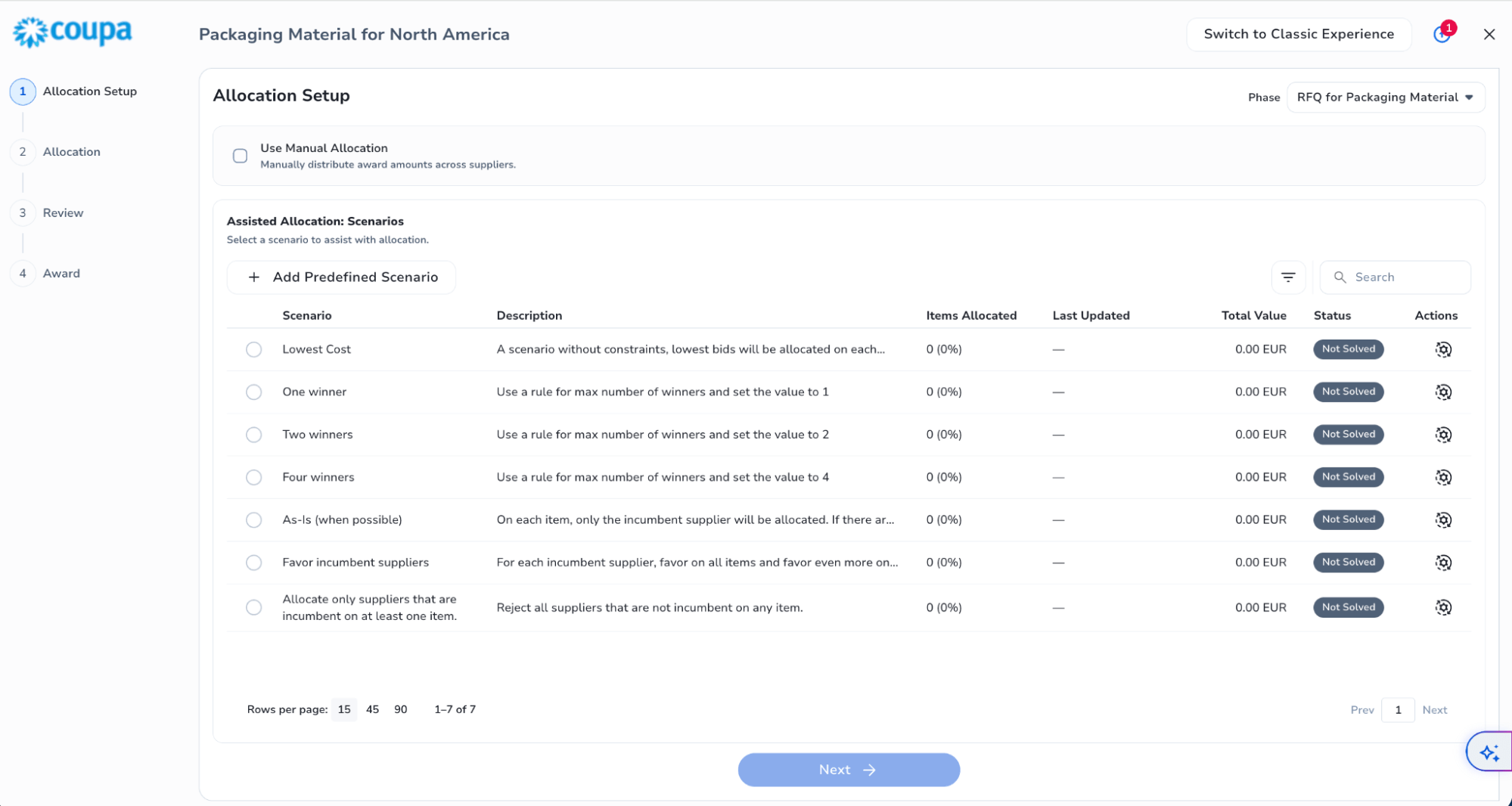
Coupa Sourcing runs routine events with preapproved templates and offers Coupa Sourcing Optimization for complex awards, and it's the entry here that documents spend analysis, supplier discovery and the contract handoff together.
Find. Coupa shows cross-platform spend visibility across Coupa, ERP and other systems, classifies spend automatically and suggests opportunities such as expiring contracts and large requisitions. Buyers can browse pre-rated, pre-enabled suppliers filtered by diversity, rating or geography, and AI suggests suppliers from category performance or past participant lists.
Run. The FAQ lists RFP, RFI, RFQ and reverse auctions, but the answer text was collapsed on the page we read, so we mark event types as partly documented. Routine events use preapproved templates with automatic supplier invitations.
Decide. Coupa Sourcing Optimization is the advanced path: it sets constraints such as per-supplier allocation caps, geography, tariffs and freight, compares scenarios side by side and allows manual allocation overrides. Expressive bidding accepts alternative specs and bundles. It's aimed at high-stakes direct material, freight and services events.
Hand off. On approval, winning bid terms, rate cards and service levels pass into draft contracts in Coupa CLM and into procurement catalogs, and invoices are later validated against the contracted rates.
Fit with the stack. Item master integration and ERP spend data feed events, and supplier risk, ESG and performance data from Coupa supplier management inform event design. Specific ERP connectors aren't listed on the pages we read.
- you have complex direct, freight or services categories where per-supplier caps, geography and tariffs shape the award
- you want awards to flow straight into contracts and catalogs, with winning terms landing in Coupa CLM
- you only need basic RFx for simple purchases: Coupa Sourcing Optimization targets high-stakes, multi-constraint events
- you need a published price: Coupa lists none, so cost requires a sales quote
- Users like
- Approval routing and spend compliance for indirect buying, with clear purchase limits per person.
- Users dislike
- Heavy integration work with ERPs such as SAP, and a supplier portal that confuses vendors asked to create profiles.
- Source: TrustRadius, 168 ratings
Price and what reviewers say
Coupa doesn't publish a buyer price. Its standard supplier portal is free for suppliers, while Coupa Advanced is a paid supplier tier (checked October 24, 2026). On TrustRadius reviewers rate Coupa 7.2 out of 10 from 168 ratings, praising approval routing and spend compliance for indirect buying and criticizing heavy ERP integration work and a confusing supplier portal (read October 20, 2026, whole product). The G2 category listing shows Coupa at 4.2 out of 5 from 570 reviews, with ease of use the top praise (24 mentions) and "not user-friendly" the top criticism (12 mentions). Both ratings cover the whole product.
- Starting price
- Custom buyer quote; no public US rate card verified
- Sourcing events
- RFP, RFI, RFQ and reverse auctions are listed in the FAQ (answer text not visible); routine events run from preapproved templates
- Award analysis
- Coupa Sourcing Optimization sets per-supplier caps, geography, tariffs and freight as constraints and compares scenarios side by side, with manual overrides
- Supplier discovery
- Pre-rated, pre-enabled suppliers filterable by diversity, rating or geography; AI suggests suppliers from category performance
- Spend analysis
- Cross-platform spend visibility, automatic classification and suggested opportunities such as expiring contracts
- Handoff after award
- Winning terms and rate cards pass into draft contracts in Coupa CLM and into catalogs on approval
Ivalua
Ivalua is a source-to-pay suite whose supplier management module runs a branded supplier portal for onboarding and compliance and adds a supplier information management offering that cleanses supplier records and updates ERP records in bulk.
Ivalua's eSourcing module covers RFI, RFP and RFQ events, multi-lot auctions and a Sourcing Decision Center that models award scenarios with natural-language rules.
Find. Suppliers can be found in your own supplier repository or on the web using the event's criteria, with agent-enriched supplier profiles. Spend Analysis is a separate Ivalua product, and the sourcing pages say only that spend insights feed sourcing strategies and contract decisions.
Run. Events start from smart templates and can run multiple RFx rounds. Multi-lot auctions in Dutch, English, Japanese and other formats can be launched from an RFQ or from scratch.
Decide. The Sourcing Decision Center evaluates bids, constraints and supplier data with AI and mathematical optimization. A prebuilt scenario library covers common cases, and you can write rule-based scenarios in natural language. Awards are optimized across cost, risk, performance and quality.
Hand off. The module links natively to Ivalua Contract Management and shares sourcing, contract and P2P data. The pages we read don't describe creating a PO from an award.
Fit with the stack. Pre-built ERP connectors are listed for SAP, Oracle and Microsoft Dynamics. The vendor cites 500+ companies and shows large enterprise logos without stating a target size.
- you are a large enterprise that wants RFx, auctions and award optimization in the same suite as contracts and P2P
- you run multi-lot events and want to write award scenarios as rules in natural language
- you are a small or mid-size team that needs a published price: Ivalua publishes none and a third party reports a buyer-reported floor near $150,000 per year
- you want a quick standalone sourcing tool: the reviews cited mention complex setup and a steep learning curve
Price and what reviewers say
Ivalua sells by quote only. CostBench, a third-party site, reports a buyer-reported floor near $150,000 per year, which is an unverified estimate and not an Ivalua price. CostBench also cites a 4.3 out of 5 rating from 102 G2 reviews and lists implementation challenges, a steep learning curve, complex setup and integration issues among the reported complaints. We couldn't read G2 directly, so treat the rating as secondary.
- Starting price
- Not published, quote only (a third party reports a buyer-reported floor near $150,000 per year, unverified)
- Sourcing events
- RFI, RFP and RFQ from templates with multi-round RFx; multi-lot Dutch, English and Japanese auctions
- Award analysis
- Sourcing Decision Center uses AI and mathematical optimization, a scenario library and natural-language rule-based scenarios
- Supplier discovery
- Search the supplier repository or the web using the event's criteria
- Handoff after award
- Native link to Ivalua Contract Management; PO creation from an award is not described
JAGGAER
JAGGAER is a source-to-pay suite whose supplier management module gives suppliers a portal with guided self-service onboarding, compliance checks and configurable workflows, plus automated verification of uploaded documents.
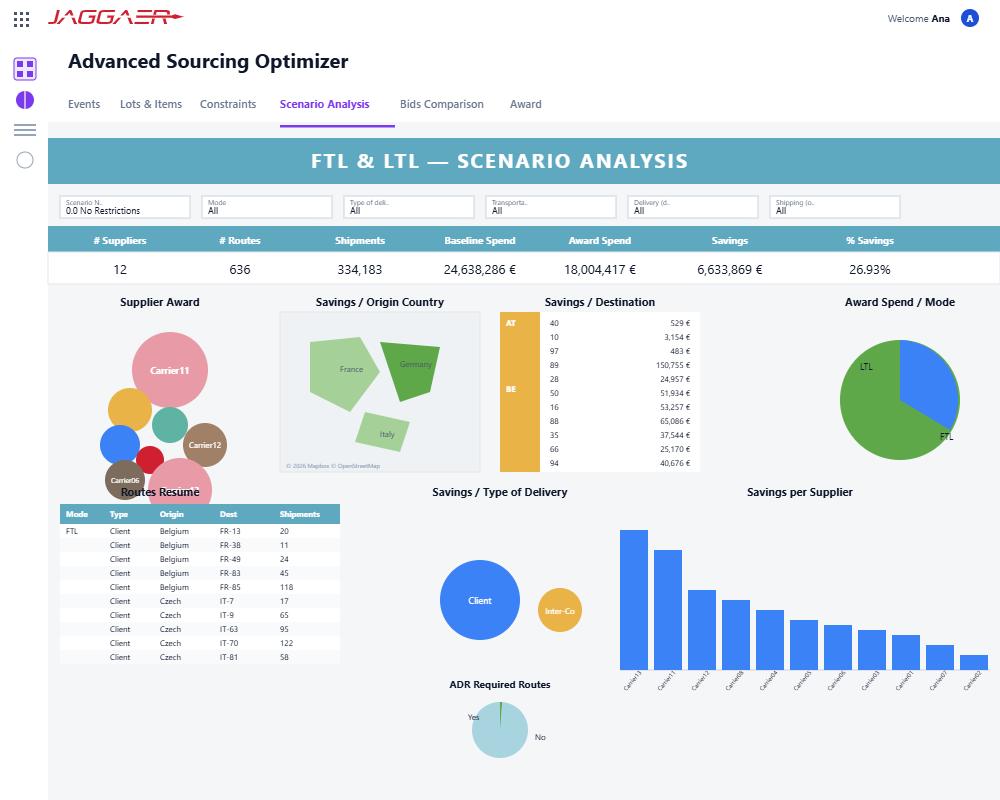
JAGGAER One covers RFI, RFP and RFQ events, a long list of auction types and an Advanced Sourcing Optimizer for scenario-based awards, aimed at complex, large-scale sourcing.
Find. Supplier recommendations and scoring use AI, with risk flags from network, news and ESG sources and suggested suppliers inside Smart Quote. Self-service onboarding brings new suppliers in. Spend Analytics is listed as a Source-to-Contract module, but the page gives no detail on how it finds sourcing opportunities.
Run. RFI, RFP and RFQ events start from reusable templates with multi-round negotiation and stage-gated approvals. Auction types include reverse, forward, Dutch, Japanese and ranked.
Decide. Bids can be split into commercial and technical envelopes and scored on weighted scorecards covering price, quality, lead time, ESG and risk, with BAFO rounds. The optimizer adds constraints such as capacity, lead time, quality, ESG and risk, compares unlimited what-if scenarios side by side and supports line-level split awards.
Hand off. Sourcing feeds Contracts and Procure-to-Pay on one data layer, and awarded bids flow to execution through Advanced Rates. The handoff steps themselves aren't detailed on the pages we read.
Fit with the stack. More than 40 pre-built integrations are listed, including SAP, Oracle, Workday, NetSuite, Infor and JD Edwards. The vendor cites typical deployments of 8 to 12 weeks, which is a vendor claim.
- your awards have many variables, such as bills of materials, logistics lanes, bundles or volume tiers, and you need constraint-based optimization with side-by-side scenarios
- you want a broad menu of auction formats plus BAFO rounds in one tool
- you need a published price: neither the sourcing page nor the optimization page gives one
- you have a simple RFQ-only need: the engine is built for complex events
Price and what reviewers say
JAGGAER sells by custom quote and its /pricing page returned a 404. We couldn't read a primary review source (G2, Capterra and Gartner were blocked), and an aggregator rating we found is AI-summarized, so we don't quote it. Ask for references from a team that runs your kind of event.
- Starting price
- Not published, custom quote
- Sourcing events
- RFI, RFP and RFQ from templates; reverse, forward, Dutch, Japanese and ranked auctions
- Award analysis
- Weighted scorecards, BAFO rounds and constraint-based optimization with unlimited what-if scenarios and line-level split awards
- Supplier discovery
- AI supplier recommendations, risk flags and Smart Quote suggested suppliers
- Handoff after award
- Sourcing feeds Contracts and Procure-to-Pay on one data layer; the steps are not detailed
- Integrations
- 40+ pre-built, including SAP, Oracle, Workday, NetSuite, Infor and JD Edwards
Workday Strategic Sourcing
Workday's sourcing application covers intake, RFP, RFI and RFQ events, reverse auctions, side-by-side bid comparison and scenario modeling, with contract creation starting once a supplier is selected.
Workday Strategic Sourcing runs RFx events and reverse auctions with scenario modeling, and contract creation starts in Workday CLM once a supplier is selected.
Find. The pages we read describe a supplier onboarding portal, risk scoring and compliance workflows, but not finding new suppliers. A project dashboard tracks savings against targets and spend alerts warn before approved thresholds. A standalone spend cube or category analysis isn't described.
Run. RFPs, RFIs and RFQs are built from templates with questionnaires and pricing controls, and reverse auctions let suppliers compete in real time. A higher-education page also mentions sealed bids.
Decide. AI-assisted response summaries and side-by-side supplier comparison help reviewers, and scenario modeling tests factors and constraints against savings targets. Pricing visibility can be restricted so that technical evaluation isn't anchored on price.
Hand off. Contract creation begins when a supplier is selected, through Workday CLM with Microsoft 365 for drafting. The datasheet claims visibility from the sourcing event through to the purchase order inside the Workday platform.
Fit with the stack. It's part of the Workday source-to-pay platform and positioned for enterprise procurement teams. G2 lists Workday Financial Management and Oracle PeopleSoft as integrations.
- you already run Workday for finance or HCM and want sourcing events to flow into Workday CLM and on to purchasing
- you need scenario modeling and reverse auctions tied to tracked savings targets
- you need a public price: none is published
- you need documented supplier discovery or standalone spend analysis: neither is described on the pages we read
Price and what reviewers say
Workday doesn't publish a price and sells through a representative or demo. On G2 the product shows 4.5 out of 5 from 35 reviews. The review text didn't load for us, so we can't report what reviewers praise or criticize. G2's profile lists an average implementation time of about one month.
- Starting price
- Not published, via a Workday representative or demo
- Sourcing events
- RFP, RFI and RFQ from templates with questionnaires and pricing controls; reverse auctions
- Award analysis
- AI-assisted response summaries, side-by-side comparison and scenario modeling against savings targets; price visibility can be hidden during technical evaluation
- Supplier discovery
- Onboarding portal and risk scoring are described; finding new suppliers is not
- Handoff after award
- Contract creation starts in Workday CLM when a supplier is selected; the datasheet claims visibility through to the purchase order
GEP SMART
GEP's source-to-pay platform, presented under the GEP Quantum Intelligence brand, runs RFx events and e-auctions in one place and moves awarded suppliers into contracting.
GEP SMART, now presented under the GEP Quantum Intelligence brand, runs RFx events and e-auctions in one place and moves awarded suppliers into contracting.
Find. Supplier intelligence covers new and existing suppliers across categories and regions, and a Supplier Discovery Agent uses performance and public data. A Spend Analysis Agent surfaces anomalies and inefficiencies, but it's described outside the sourcing page.
Run. The sourcing page lists structured RFx events including RFPs, plus e-auctions and live auctions, launched, compared and awarded in one place.
Decide. AI agents organize bids, score suppliers against value drivers, show side-by-side comparisons and model price, risk and performance tradeoffs for award scenarios. Field-level scoring setup isn't shown, so we mark scenario modeling as partly documented.
Hand off. Awarded suppliers move directly into contracting, with a Contract Management module and a contract drafting agent. PO handoff isn't described.
Fit with the stack. The page names ERPs and S2P suites such as SAP Ariba, Coupa, Ivalua, SAP, Oracle and Microsoft Dynamics as connections. It cites 100+ enterprise deployments in regulated industries without a size statement.
- you want RFx, e-auctions and contracting from one vendor, since awarded suppliers flow into contracting
- you already run SAP Ariba, Coupa or an ERP and want a sourcing layer that GEP lists as integrating with them
- you need a public price: GEP shows none on the pages we read
- you need detailed scenario award modeling documented: the public pages describe it only at agent-summary level
Price and what reviewers say
GEP doesn't publish a price. G2 returned a 403 when we tried to read it, so we have no rating and no review themes for GEP SMART and won't guess. Ask for references and for the scenario modeling in a live demo.
- Starting price
- Not published
- Sourcing events
- RFx events including RFPs, plus e-auctions and live auctions
- Award analysis
- AI agents score bids against value drivers and model price, risk and performance tradeoffs; field-level setup is not shown
- Supplier discovery
- Supplier intelligence across categories and regions; a Supplier Discovery Agent uses performance and public data
- Handoff after award
- Awarded suppliers move into contracting; PO handoff is not described
- Integrations
- ERPs and S2P suites such as SAP Ariba, Coupa, Ivalua, SAP, Oracle and Microsoft Dynamics
Sourcing specialists
Keelvar, Fairmarkit and Market Dojo don't sell a full suite. They focus on the event itself: one optimizes complex awards, one automates many small RFQs and one sells RFx and eAuction licences by the month or the event. We found no contract or PO handoff described for any of them.
Keelvar
Keelvar is an agentic sourcing platform for large enterprises, built around bid optimization and autonomous sourcing events with scenario modeling across price, risk and sustainability.
Keelvar is an agentic sourcing platform for large enterprises, built around bid optimization and agent-run sourcing events with scenario modeling across price, risk and sustainability.
Find. An assistant called Kai recommends suppliers to approach, and agents engage suppliers during events. Rate Manager centralizes rates and can trigger sourcing events when rates expire or drift from benchmarks, with SpendHQ named as a partner. No spend cube is described.
Run. Keelvar supports RFx including RFIs and e-auctions, configurable by spend category, and its agents can also run spot quotes.
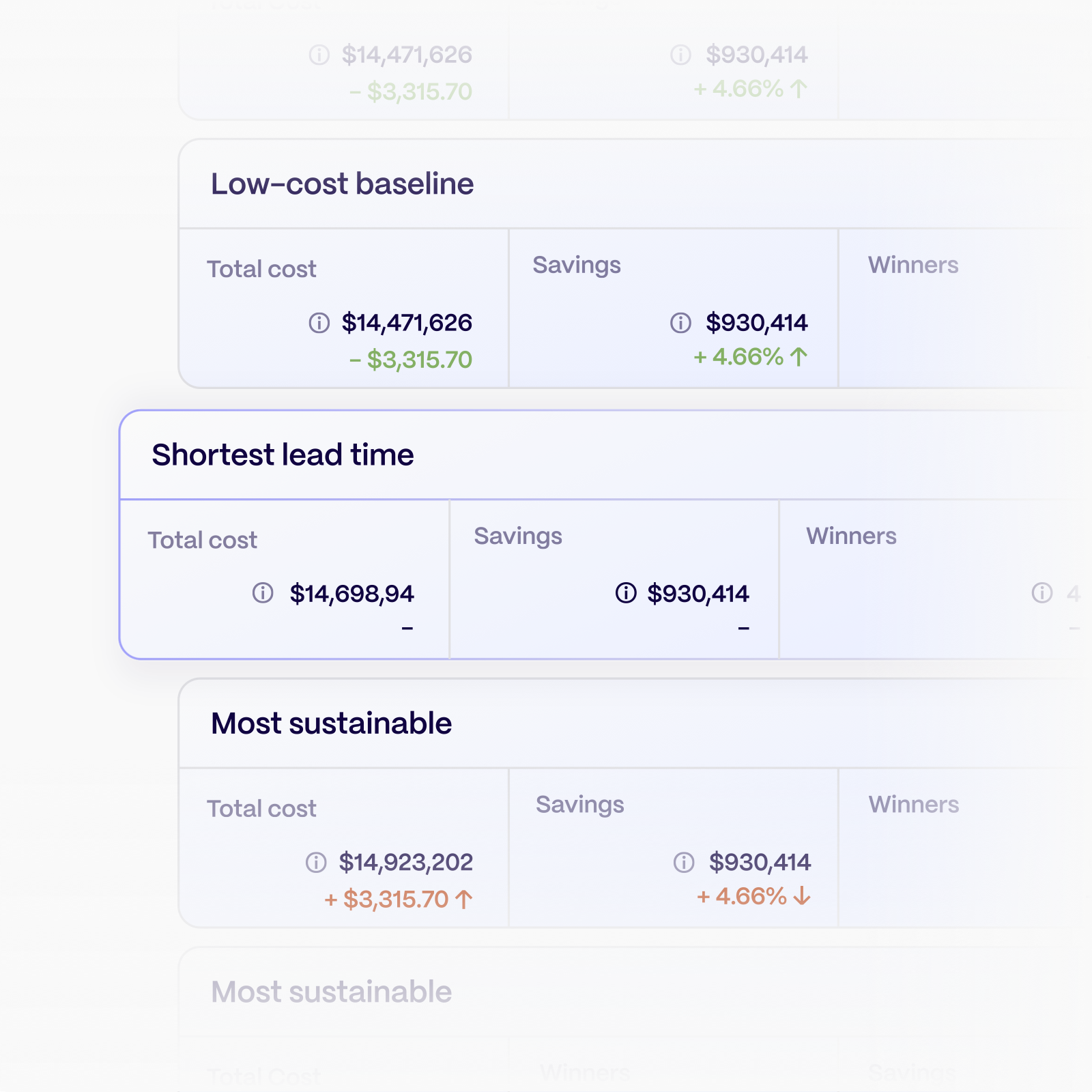
Decide. Machine learning evaluates complex bid scenarios that weigh price, risk and sustainability. Agents can recommend an award, while people set the rules and approve it.
Hand off. The pages we read don't describe a contract or PO handoff.
Fit with the stack. Named partners include SpendHQ, Xeneta, Oracle and SAP S/4HANA, and the vendor says no rip-and-replace is needed. It's positioned for large enterprises with complex supply chains.
- you run complex multi-lane or multi-category events where awards must be optimized across price, risk and sustainability
- you want rate expiry or benchmark drift to trigger new sourcing events
- you need a public price: Keelvar's pricing page says to contact the team
- you are a small team: the vendor positions the product for large enterprises
Price and what reviewers say
Keelvar doesn't publish a price. A comparison tile on a G2 page shows 4.7 out of 5 from 46 reviews. Keelvar's own G2 page, Gartner and TrustRadius returned a 403, so we have no review themes.
- Starting price
- Not published, pricing page says to contact the team
- Sourcing events
- RFx including RFIs, e-auctions and spot quotes, configurable by spend category
- Award analysis
- Machine learning evaluates complex bid scenarios across price, risk and sustainability; agents can recommend an award while humans set rules and approve
- Supplier discovery
- An assistant called Kai recommends suppliers to approach
- Spend analysis
- Rate Manager can trigger sourcing events when rates expire or drift from benchmarks
- Handoff after award
- Not described on the pages we read
Fairmarkit
Fairmarkit runs tactical RFQs, strategic RFx and reverse auctions, with AI that bundles similar RFQs, matches suppliers and can auto-award by weighted rules. It is built around high-volume, low-value requests.
Fairmarkit runs tactical RFQs, strategic RFx and reverse auctions, with AI that bundles similar RFQs, matches suppliers and can auto-award by weighted rules, built for high-volume, low-value requests.
Find. AI ranks vendors by their likelihood to respond, bundles similar RFQs and uses preferred supplier groups. Auto-sending matches suppliers on a schedule and can consider diversity goals. Spend analysis to decide what to source isn't described on the pages we read.
Run. The docs list tactical and tail-spend RFQs, strategic RFx from templates, multi-line bids in Lots, and reverse auctions in Dutch, English and Japanese formats.
Decide. Multi-row bids are structured with blended price and total cost of ownership calculations, and reviews and approvals are shared with an audit trail. Auto-awarding picks the response closest to buyer-defined weighted rules, and it needs enablement through a Customer Success Manager.
Hand off. The pages we read don't describe a handoff to a PO or contract. The navigation mentions bi-directional ERP and P2P sync without detail.
Fit with the stack. The docs describe a fit for teams with defined buyer roles, clean item descriptions and many high-volume, low-value requests.
- you run many low-value RFQs and want auto-bundling, auto-sending and auto-award by weighted rules
- you need Dutch, English or Japanese reverse auctions plus multi-line Lot bids in one tool
- you need spend analysis to find what to source: the pages we read describe none
- you need a documented handoff to a contract or PO: the pages we read describe none
Price and what reviewers say
Fairmarkit doesn't publish a price and asks for a demo. G2 lists 17 reviews for Fairmarkit. We read two review texts, one praising easy setup and one noting poor-fit supplier matches, which isn't enough to call a pattern. The docs say auto-bundling addresses the earlier complaint about bundling different requests.
- Starting price
- Not published, demo request only
- Sourcing events
- Tactical and tail-spend RFQs, strategic RFx from templates, multi-line Lots and Dutch, English and Japanese reverse auctions
- Award analysis
- Blended price and TCO calculations, shared reviews and approvals with an audit trail; auto-award to the response closest to weighted rules, enabled with a Customer Success Manager
- Supplier discovery
- AI ranks vendors by likelihood to respond, bundles similar RFQs and sends them to matched suppliers on a schedule
- Handoff after award
- Not described on the pages we read
Market Dojo
Market Dojo is an eSourcing platform that runs RFx events and eAuctions on monthly, annual or single-event licences, with weighted events and API integration in a higher tier.
Market Dojo is the only tool here that publishes a price: RFx and eAuctions from £500 per month on an annual licence, or on-demand by the month or by the single event.
Find. The homepage lists supplier discovery, opportunity analysis and spend analysis as modules and says AI helps discover and qualify suppliers. The pages we read give no detail on how any of them works.
Run. The base licence launches live events and runs simple RFx and eAuctions with templates and libraries, Excel integration and custom fields, user management and live messaging. The page prices it per user, per supplier or per contract count, and asks for a quote above five users.
Decide. A higher tier adds collaborative multi-scoring with supplier participation, weighted events, API integration and a dedicated account manager. Scenario modeling or constraint-based award optimization isn't described on the pages we read.
Hand off. The homepage lists a Contract Management module. The handoff from an award to a contract or PO isn't described.
Fit with the stack. The vendor describes the product as built for mid-market and enterprise teams and offers a free trial and a sandbox. Prices are in pounds sterling, so a US team has to convert and confirm in a quote.
- you want a published price and a licence you can buy for one month or one event with no long-term commitment
- you run a few RFx events or eAuctions and don't need a full source-to-pay suite
- you need a price in US dollars: Market Dojo lists pounds sterling only
- you need documented constraint-based award optimization: the pages we read mention weighted events and multi-scoring but not scenario modeling
Price and what reviewers say
Market Dojo's pricing page lists £500 per month billed annually or £1,000 per month on-demand for the base licence, and £1,000 per event as a one-off payment. The weighted-events tier lists £583 per month billed annually, £1,500 per month on-demand and £1,500 per event. The page says discounts apply by number of users and licence duration. We didn't read a review source for Market Dojo, so we show no rating.
- Starting price
- From £500 per month billed annually for simple RFx and eAuctions; £1,000 per month or £1,000 per event on-demand (pounds sterling, no USD price)
- Sourcing events
- Simple RFx and eAuctions with templates and libraries, Excel integration and live messaging
- Award analysis
- Weighted events and collaborative multi-scoring in the £583 per month annual tier; scenario modeling is not described
- Supplier discovery
- The homepage lists supplier discovery and says AI helps discover and qualify suppliers
- Handoff after award
- The homepage lists a Contract Management module; the handoff steps are not described
Scoring isn't optimization
Comparing bids and optimizing an award are different things, and the vendors use the words loosely. Scoring ranks bids against weighted criteria such as price, quality and lead time. Optimization solves for the best combination under constraints, such as a cap per supplier, a minimum volume per lane or a split award by line item.
How much does strategic sourcing software cost?
Only one of the nine tools publishes a price, so most strategic sourcing software costs whatever the vendor quotes for your scope. Market Dojo lists £500 per month on an annual licence and £1,000 for a single event, in pounds sterling. The other eight sell by quote, demo request or contact form, and the only number we found for them is a third-party estimate for Ivalua, which we label as unverified.
| Tool | What the vendor publishes (USD or GBP as stated) | What we found on cost (USD or GBP as stated) |
|---|---|---|
| SAP Ariba | Price upon request | Suppliers have a free standard account on SAP Business Network, and an enterprise supplier account costs a fixed subscription fee plus transacted volume (checked October 24, 2026) |
| Coupa | Custom quote | The standard supplier portal is free for suppliers, and Coupa Advanced is a paid supplier tier (checked October 24, 2026) |
| Ivalua | Quote only | A third party reports a buyer-reported floor near $150,000 per year, an unverified estimate |
| JAGGAER | Custom quote | Nothing on the sourcing or optimization pages |
| Workday Strategic Sourcing | Via a representative or demo | Nothing published |
| GEP SMART | Not published | Nothing on the pages we read |
| Keelvar | Contact the team | Positioned for large enterprises |
| Fairmarkit | Demo request only | Docs describe a fit for many high-volume, low-value requests |
| Market Dojo | £500 per month billed annually; £1,000 per month on-demand; £1,000 per event (pounds sterling) | Number of users, suppliers or contracts, and tier: weighted events start at £583 per month annually |
Because eight of nine have no list price, compare the quotes on the same scope. Ask each vendor what the quote covers: sourcing events only or also optimization and contracts, how many internal users and events it assumes, whether suppliers pay a fee, and what implementation costs. Two quotes are only comparable when they include the same modules.
How to choose strategic sourcing software
Choosing strategic sourcing software starts with the award you run most often. Write down how many events you run per year, how many suppliers bid, and whether the award is decided on price alone or on constraints. A team that runs 20 complex events a year and a team that runs 2,000 small RFQs need different tools, and a team that runs a handful may already have enough in its P2P suite.
How long does implementation take?
Implementation time is the least documented number in this category. JAGGAER cites typical deployments of 8 to 12 weeks, which is a vendor claim. G2's Workday profile lists an average implementation time of about one month. The reviews cited for Ivalua mention complex setup and a steep learning curve, and G2 reviewers most often flag complexity for SAP Ariba. For Coupa, GEP SMART, Keelvar and Fairmarkit we found no stated duration. Ask each vendor for a plan that names who builds the event templates, who loads the supplier list and who connects the ERP, because those steps decide how long the rollout takes in practice.
Questions to settle before a demo
- How many sourcing events do we run per year, and how complex is the typical award?
- Which event types do we need: RFI, RFP, RFQ, reverse auction?
- Is the award decided on price alone, or on caps, splits, bundles and risk?
- Is scenario modeling in the module we're quoted, or in a higher tier?
- Which ERP or P2P system do we run, and does the award land in it as a PO or contract?
- Who runs events: procurement only, or business owners too?
- Do suppliers pay a fee, and what does the quote cover at our event volume?
- Where does the awarded contract go, and who tracks its notice date?
A rough split works for a first shortlist. If you run SAP or Workday, start with the suite that carries the award on inside your platform. If your awards have many constraints, start with the tools that document optimization. If most of your work is small RFQs, start with Fairmarkit. If you only need to find suppliers, start with the supplier discovery tools in the section above.
From award to renewal decision
An award ends the sourcing event, but it starts a contract with a term, a notice period and a renewal date. Ariba, Coupa, Workday and GEP describe the handoff into a contract or PO. The pages we read don't describe who decides the renewal before the notice date, and a contract can roll into the next term simply because nobody saw the date. The Procurement Manager is a small tool for that one job: it routes each contract renewal to the business owner, Finance and IT and produces one decision packet with the exact dates and source evidence before the notice deadline. It doesn't run sourcing events, read contracts or cancel anything on its own. Use it next to a sourcing tool if awarded contracts are where your savings leak. Our contract renewal notice period guide and contract lifecycle management software comparison cover the contract side. Once the contract is running, the supplier relationship itself is a separate job, covered in our comparison of supplier relationship management software.
Frequently asked questions
What is strategic sourcing software?
Strategic sourcing software is a tool that supports the planned part of buying. It helps a team analyze spend, find suppliers, run RFI, RFP, RFQ or auction events, compare bids and record the award before a contract is signed.
What is the difference between strategic sourcing and procurement?
Strategic sourcing chooses what to source, which suppliers compete and on what terms. Procurement is the wider function that also orders, receives and pays against those terms. Sourcing software runs the event, and procure-to-pay software runs the buying after it.
How much does strategic sourcing software cost?
Strategic sourcing software costs a quote for eight of the nine tools here. Only Market Dojo publishes a price: £500 per month billed annually, or £1,000 for a single event, in pounds sterling. SAP Ariba, Coupa, Ivalua, JAGGAER, Workday Strategic Sourcing, GEP SMART, Keelvar and Fairmarkit sell by quote, demo or contact form, so compare quotes on the same modules and event volume.
Do I need award optimization or is scoring enough?
Scoring is enough when the award is decided on a few weighted criteria, such as price and lead time. Optimization matters when the award has constraints like supplier caps, split awards, bundles or lanes. Coupa, JAGGAER, Ivalua and Keelvar document constraint-based scenarios.
Can a small team use strategic sourcing software?
A small team can use strategic sourcing software if it picks the right kind. Most of these tools are built for enterprise buying: Keelvar positions itself for large enterprises, and a third party reports a buyer-reported floor near $150,000 per year for Ivalua. Market Dojo is the exception, with a published £500 per month annual licence and a £1,000 single-event licence. Fairmarkit's docs describe teams with defined buyer roles and many small requests.
What are the alternatives to SAP Ariba for sourcing?
Coupa, Ivalua, JAGGAER, Workday Strategic Sourcing and GEP SMART all document sourcing modules with RFx events and auctions, and Keelvar and Fairmarkit cover optimization and tail-spend RFQs. The right alternative depends on the ERP the award has to land in and on how complex your awards are.
What happens after the award?
The award goes into a contract and a PO. Coupa, SAP Ariba, Workday and GEP describe that handoff, while Keelvar and Fairmarkit don't on the pages we read. The contract then has a term and a notice date that someone needs to own before it renews.