The best RFP software depends on which side of the RFP you sit on. If you write, send and score RFPs, SAP Ariba, Ivalua, JAGGAER, RFP360, Euna Procurement and Market Dojo document that work. If you answer RFPs from customers, Loopio, Responsive, Iris and Qvidian are built for it. The pages that rank for this keyword in our check cover only the second group, so a buyer searching it mostly finds tools for the other side.
RFP software is a tool that manages the request for proposal process. For a buyer it builds the RFP, invites suppliers, scores the responses and records the award. For a supplier it imports the buyer's questionnaire, drafts answers from approved content, routes them to experts for review and exports the result. We compared ten tools, six for buyers and four for responders, using each vendor's own pages, and we mark every step a vendor doesn't document.
- tools compared
- 10
- buyer-side and response-side
- 6 + 4
- publish a price
- 2
- Pick by your side of the RFP. JAGGAER and Ivalua document weighted scoring and award scenarios for buyers, Euna Procurement targets public-sector solicitations, and Loopio, Responsive, Iris and Qvidian answer incoming RFPs.
- Only two of the ten publish a price. Responsive lists its Emerging edition from $10,000 and Market Dojo lists £500 per month on an annual licence, in pounds. The other eight are a quote, demo request or contact form.
- An RFP ends at the award, but the contract that follows has a notice date. The pages we read describe how an award becomes a contract, not who decides the renewal.
Our picks by side of the RFP
A tool that drafts answers to a security questionnaire can't score the bids you receive, and the reverse is also true. These picks follow the job, not a score.
 Best for scoring and awarding complex RFPsJAGGAERWeighted scorecards, BAFO rounds and optimization scenarios with capacity, lead time, quality, ESG and risk constraints.
 Best for SAP-based buyingSAP AribaRFI and RFP events with scoring, award scenario comparison and awards that hand off to POs in an SAP back end.
 Best for public-sector solicitationsEuna ProcurementSealed bids, supplier self-registration by commodity code, scorecards and a direct jump from award to contract.
 Best for one vendor on both sidesRFP360Buyer-side RFx building and evaluation, sold by the company behind Responsive's response platform.
 Best for a published buyer priceMarket DojoRFx and eAuctions from £500 per month billed annually, or £1,000 for a single event, in pounds sterling.
 Best for a maintained answer libraryLoopioLibrary-driven answers with SME routing, reminders and a confidence score on AI drafts.
 Best for security questionnairesResponsiveStandard Excel questionnaires such as SIG and CAIQ import with automatic configuration, from a published $10,000 price floor.
 Best for cited AI draftsIris AIDrafts with citations, a confidence score and locked approved answers, from content and deal context.
 For the contract after the awardThe Procurement ManagerRoutes the renewal decision of the contract you just signed to the business owner, Finance and IT before the notice deadline.
What RFP software is and which side you're on
RFP software is software for the request for proposal process, and an RFP is a document a buyer sends to suppliers to ask for a priced proposal against stated requirements. It comes in two kinds, and the same word covers both. Buyer-side tools help a procurement team write the RFP, send it, collect responses and score them against weighted criteria. Response-side tools help a supplier's sales or proposal team answer the RFPs, RFIs and security questionnaires they receive.
Most procurement teams need the first kind and occasionally meet the second, because their own company gets sent questionnaires by customers. To know which list to read, decide whether you send the RFP or answer it. If you send it, start with the buyer entries. If you answer them, skip to the response entries. The RFP software for procurement teams we cover below sits inside the wider sourcing process, which our strategic sourcing software comparison covers from spend analysis to award.
The flow below shows the four RFP steps we compared, which tools document something at each step and what usually goes wrong when a step is weak.
- BuildBuild and send the RFP
- RFP360
- Euna Procurement
- JAGGAER
- Market Dojo
Breaks when every RFP starts from a copy of the last one, so old requirements and weighting carry over unchecked - AnswerImport and answer it
- Loopio
- Responsive
- Iris AI
 Upland Qvidian
Breaks when answers are pasted from old responses, and the buyer's question is matched to the wrong one - ScoreScore the responses
- SAP Ariba
- JAGGAER
- Euna Procurement
- RFP360
Breaks when evaluators score on different scales, and price anchors the technical score - AwardAward and hand off
- SAP Ariba
 Ivalua
- Euna Procurement
- JAGGAER
Breaks when the award sits in a report and the contract term and notice date are set later by someone else
RFP software compared
The table shows what each tool is, what it hands on, its price status and the review rating we could read. Review sources differ because G2, Capterra and TrustRadius blocked several direct reads, so the source and scale sit in each cell. A tool with no rating means we couldn't read a primary review source for it.
| Tool | Type | What it hands on | Price status (USD or GBP) | Review rating |
|---|---|---|---|---|
| SAP Ariba | Buyer side, source-to-pay suite | Award scenarios, then POs, scheduling agreements and SAP Ariba Contracts | Price upon request | 7.6/10 (TrustRadius, 757) |
| Ivalua | Buyer side, source-to-pay suite | Award scenarios, then Ivalua Contract Management | Quote only | No reviews yet |
| JAGGAER | Buyer side, source-to-pay suite | Weighted scoring and award optimization, then Contracts and Procure-to-Pay | Custom quote | No reviews yet |
| Market Dojo | Buyer side, eSourcing | RFx and eAuction events, handoff not described | From £500 per month (pounds) | No reviews yet |
| RFP360 | Buyer side, request management | Side-by-side comparison and a decision report | Not published | No reviews yet |
| Euna Procurement | Buyer side, public sector | Scorecards, then a contract generated from the award | Request pricing | 4.5 (13) |
| Loopio | Response side, library and AI | Answers exported to Excel, Word or HTML | Custom quote | No reviews yet |
| Responsive | Response side, response management | Answers exported in the buyer's file or a template | From $10,000 (Emerging) | No reviews yet |
| Iris AI | Response side, AI drafting | Approved answers with an audit trail | Per-user quote | 4.9 (85) |
| Upland Qvidian | Response side, content library | Word and PowerPoint documents from the library | Contact sales | 8.0/10 (TrustRadius, 41) |
| The Procurement Manager Our product | Contract renewal decisions | Routes renewal reviews to the business owner, Finance and IT before the notice deadline | From $49 per month, flat, no per-seat fees (Starter, up to 50 contracts) | No reviews yet |
Prices checked on vendor pages on October 24 to 30, 2026. Rating sources and scales differ by tool: SAP Ariba and Qvidian show TrustRadius out of 10, Euna Procurement and Iris show G2 out of 5.
Which RFP steps each tool documents
The tables show what each vendor documents about each step. "Yes" means a vendor page or document describes it. "Partly" means it's mentioned without detail or sits in a separate product. "Not described" means we didn't find it on the pages we read, which isn't the same as "the tool can't do it", so treat each one as a demo question.
| Buyer tool | RFP building | Weighted scoring | Award scenarios | Contract or PO handoff |
|---|---|---|---|---|
| SAP Ariba | Yes | Yes | Yes | Yes |
| Ivalua | Yes | Partly | Yes | Partly |
| JAGGAER | Yes | Yes | Yes | Partly |
| Market Dojo | Yes | Partly | Not described | Partly |
| RFP360 | Partly | Partly | Partly | Not described |
| Euna Procurement | Yes | Partly | Yes | Yes |
| Response tool | Imports the questionnaire | Drafts answers | Review | Export |
|---|---|---|---|---|
| Loopio | Yes | Yes | Yes | Partly |
| Responsive | Yes | Yes | Yes | Yes |
| Iris | Partly | Yes | Yes | Not described |
| Qvidian | Partly | Yes | Yes | Partly |
How we compared the tools
We read vendor pages, help pages and review sites between October 24 and 30, 2026. We read the same things for every tool in one side's list, and each entry answers them in the order of the RFP.
- Buyer tools: how the RFP is built and sent, how responses are scored, how an award is compared and chosen, and where the award goes next.
- Response tools: how a questionnaire is imported, how answers are drafted from a library or AI, how experts review them, and how the result is exported.
- Both: price status, the review basis and a real skip-if for each tool.
The read is documentation only: we didn't run an RFP in any of them. The review rating, where we show one, covers the whole product.
RFP software for buyers
SAP Ariba, Ivalua and JAGGAER sell RFP events as one module of a wider sourcing suite. RFP360 and Euna Procurement are narrower: RFP360 for request management, Euna Procurement for public-sector solicitations. Market Dojo is an eSourcing platform with licences you can buy for one event.
SAP Ariba
SAP's source-to-pay suite covering sourcing events with scoring and award simulation, buying and invoicing, contracts and supplier collaboration through SAP Business Network.
SAP Ariba Sourcing is the sourcing module of SAP's source-to-contract suite, and its RFP events carry scoring, award scenario comparison and a handoff to POs in an SAP back end.
Build and send. The SAP slides we could read list RFI, RFP, multi-round bidding and several auction formats, and supplier search runs through SAP Business Network Discovery by industry, item or service. The slides date from May 2022 and the SAP Help Portal pages didn't render, so check current event types in a demo.
Score. Scoring and grading, a bid history and a comparison report are listed, and the product page adds AI bid summaries.
Award and hand off. Award scenario comparison and one-click awarding are listed. Awarding can create follow-on documents in external systems such as purchase info records, POs and scheduling agreements, and the module connects to SAP Ariba Contracts.
- your purchasing is tied to SAP processes and master data, so an RFP award should become a PO or scheduling agreement in the back end
- you want scoring, bid comparison and award scenarios in the same tool that runs the event
- you want a lightweight tool: complexity is the most frequent criticism in G2 reviews of SAP Ariba
- you need a published, self-serve price: SAP Ariba lists none, so budgeting starts with a sales quote
- Users like
- Punch-out catalogs and guided buying with approval workflows that standardize how people buy.
- Users dislike
- An outdated interface, weak reporting and hard integration with non-SAP ERPs.
- Source: TrustRadius, 757 ratings
Price and what reviewers say
SAP Ariba doesn't publish a buyer price for sourcing. On TrustRadius reviewers rate SAP Ariba 7.6 out of 10 from 757 ratings, and they like punch-out catalogs and guided buying but dislike an outdated interface, weak reporting and hard integration with non-SAP ERPs (read October 22, 2026, whole product). The G2 category listing shows SAP Ariba at 4.1 out of 5 from 800 reviews, with ease of use the most praised theme (174 mentions) and complexity the top criticism (77 mentions).
- Starting price
- Price upon request, no public buyer rate
- Buying and Invoicing pricing
- Price upon request, priced on processed spend
- Standard supplier account
- Free on SAP Business Network, unlimited documents
- Enterprise supplier account
- Fixed subscription level fee plus transacted volume
- Supplier order flow
- PO confirmation, ship notices, PO flip invoices, invoice and payment status
- Sourcing events
- RFI, RFP, multi-round bidding and English, Dutch, Japanese, total-cost, traffic-light, basket and lot auctions (SAP slides dated May 2022)
- Award analysis
- Scoring and grading, bid comparison report, award scenario comparison and one-click awarding; AI bid summaries and award simulation on the product page
- Supplier discovery
- Search by industry, item or service in SAP Business Network Discovery; profiles show certifications and ESG data
- Handoff after award
- Follow-on documents such as POs, purchase info records and scheduling agreements in an external system; links to SAP Ariba Contracts
Ivalua
Ivalua is a source-to-pay suite whose supplier management module runs a branded supplier portal for onboarding and compliance and adds a supplier information management offering that cleanses supplier records and updates ERP records in bulk.
Ivalua's eSourcing module runs RFI, RFP and RFQ events from smart templates and adds a Sourcing Decision Center that models award scenarios with natural-language rules.
Build and send. RFI, RFP and RFQ events start from smart templates and can run multiple rounds. Suppliers can be found in your own supplier repository or on the web using the event's criteria.
Score. The Sourcing Decision Center evaluates bids, constraints and supplier data with AI and mathematical optimization. The pages we read don't describe how evaluator scorecards or weights are set, so we mark weighted scoring as partly documented.
Award and hand off. A prebuilt scenario library covers common cases and you can write rule-based scenarios in natural language, with awards optimized across cost, risk, performance and quality. The module links natively to Ivalua Contract Management, but PO creation from an award isn't described.
- you're a large enterprise that wants RFP events, award optimization and contracts in one suite
- you run multi-lot events and want to write award scenarios as rules in natural language
- you're a small or mid-size team that needs a published price: Ivalua publishes none and a third party reports a buyer-reported floor near $150,000 per year
- you want a quick standalone RFP tool: the reviews cited mention complex setup and a steep learning curve
Price and what reviewers say
Ivalua sells by quote only. CostBench, a third-party site, reports a buyer-reported floor near $150,000 per year, which is an unverified estimate and not an Ivalua price. CostBench also cites a 4.3 out of 5 rating from 102 G2 reviews and lists implementation challenges, a steep learning curve, complex setup and integration issues among the reported complaints. We couldn't read G2 directly, so treat the rating as secondary.
- Starting price
- Not published, quote only (a third party reports a buyer-reported floor near $150,000 per year, unverified)
- Supplier portal
- Branded portal for onboarding, compliance and document sharing
- Record cleanup
- On-demand cleansing with a review workbench, bulk updates to ERP supplier records
- Approvals
- Smart approval workflows for governance
- Sourcing events
- RFI, RFP and RFQ from templates with multi-round RFx; multi-lot Dutch, English and Japanese auctions
- Award analysis
- Sourcing Decision Center uses AI and mathematical optimization, a scenario library and natural-language rule-based scenarios
- Supplier discovery
- Search the supplier repository or the web using the event's criteria
- Handoff after award
- Native link to Ivalua Contract Management; PO creation from an award is not described
JAGGAER
JAGGAER is a source-to-pay suite whose supplier management module gives suppliers a portal with guided self-service onboarding, compliance checks and configurable workflows, plus automated verification of uploaded documents.
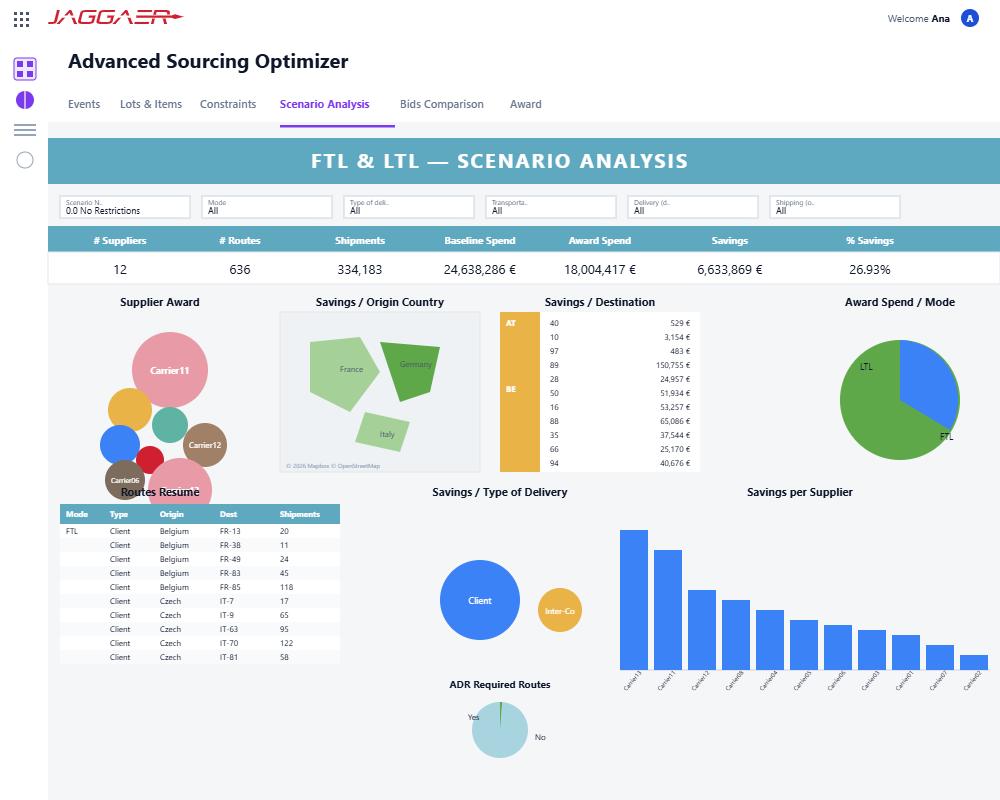
JAGGAER One runs RFI, RFP and RFQ events from reusable templates, scores responses on weighted scorecards and adds an optimizer for scenario-based awards.
Build and send. RFI, RFP and RFQ events start from reusable templates with multi-round negotiation and stage-gated approvals. AI recommends suppliers to invite and flags risk from network, news and ESG sources.
Score. Responses can be split into commercial and technical envelopes and scored on weighted scorecards covering price, quality, lead time, ESG and risk, with BAFO rounds.
Award and hand off. The optimizer adds constraints such as capacity, lead time, quality, ESG and risk, compares unlimited what-if scenarios side by side and supports line-level split awards. Sourcing feeds Contracts and Procure-to-Pay on one data layer, though the handoff steps aren't detailed.
- your RFPs carry many variables, such as bills of materials, logistics lanes or volume tiers, and you want weighted scoring plus constraint-based scenarios
- you want commercial and technical envelopes and BAFO rounds in one tool
- you need a published price: neither the sourcing page nor the optimization page gives one
- you have a simple RFQ-only need: the engine is built for complex events
Price and what reviewers say
JAGGAER sells by custom quote. We couldn't read a primary review source (the major review sites were blocked), and an aggregator rating we found is AI-summarized, so we don't quote it. Ask for references from a team that runs your kind of RFP.
- Starting price
- Not published, custom quote
- Supplier portal
- Guided self-service with built-in compliance checks
- Documents
- Automated document validation (JAI)
- Integration
- Integrates with existing business systems, no ERPs named on the page
- Sourcing events
- RFI, RFP and RFQ from templates; reverse, forward, Dutch, Japanese and ranked auctions
- Award analysis
- Weighted scorecards, BAFO rounds and constraint-based optimization with unlimited what-if scenarios and line-level split awards
- Supplier discovery
- AI supplier recommendations, risk flags and Smart Quote suggested suppliers
- Handoff after award
- Sourcing feeds Contracts and Procure-to-Pay on one data layer; the steps are not detailed
- Integrations
- 40+ pre-built, including SAP, Oracle, Workday, NetSuite, Infor and JD Edwards
RFP360
RFP360 was bought by RFPIO (now Responsive) in August 2021 and is positioned as its strategic sourcing and request management offering for buying teams. The old rfp360.com domain now redirects to responsive.io, whose main focus is vendors answering RFPs; Upland Software does not own RFP360.
RFP360 is a buyer-side request management tool that Responsive, the response-software company, bought in 2021, and its old domain now redirects to responsive.io.
Build and send. Responsive says an RFx (RFP, RFQ or RFI) can be built and distributed in minutes in one cloud tool, and reusable RFP, RFI and DDQ templates sit in a central library. The pages we read don't name question types.
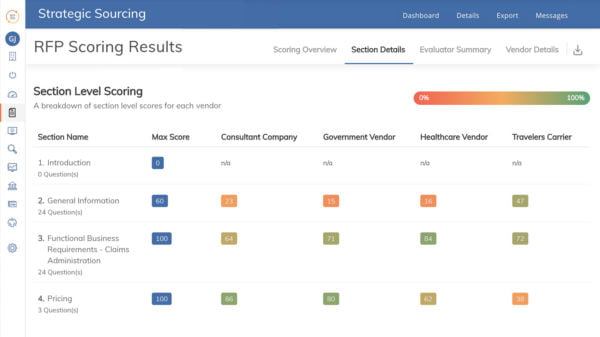
Score. Buyers choose evaluators and set scoring criteria, weights and defaults, then run side-by-side evaluations. Evaluator roles and permissions aren't defined on the pages we read.
Award and hand off. Proposals are compared side by side, and the platform generates a final report that documents the decision process and recommendations. No award or contract workflow is described, and the pages name no integrations.
- you want buyer-side RFx building from reusable templates, evaluator selection with criteria and weights, and a decision report
- your team also answers RFPs and could use one vendor for both sides, since Responsive owns RFP360 and sells the response platform too
- you need published pricing: Responsive's pricing page covers the response product only
- you need a documented award, contract or ERP handoff: the pages we read describe none
Price and what reviewers say
Responsive doesn't publish a price for RFP360. We couldn't read a review page for it: G2 returned a 403, the product URL redirected to a category page without an RFP360 entry, and the other review sites were blocked, so we show no rating and use no search snippets. We found no help or docs page for it, so the scoring facts come from Responsive's product and blog pages.
- Starting price
- Not published for RFP360
- Building and sending the RFP
- Responsive says a project can be set up and an RFx (RFP, RFQ or RFI) built and distributed in minutes in one cloud tool. Reusable RFP, RFI and DDQ templates sit in a central library. Question types are not named.
- Scoring and evaluation
- Buyers choose evaluators and set scoring criteria, weights and defaults, then run side-by-side evaluations. The procurement page itself does not mention weighting, and evaluator roles and permissions are not defined on either page.
- Comparison and award
- Proposals are compared side by side with data-driven views, and the platform generates a final report documenting the decision process and recommendations. No award or contract workflow is described.
- Suppliers and Q&A
- Buyers can manage vendor contacts, track vendor progress, build shortlists and see whether vendors submitted questions. No reusable supplier pool or formal Q&A round is described.
- Integrations
- Not described on the pages we read
- Size and fit
- Not described on the pages we read
Euna Procurement
Bonfire was merged with IonWave, EqualLevel and DemandStar into Euna Procurement, a sourcing module for solicitations, evaluation and award. It is aimed mainly at government and other public-sector buyers.
Euna Procurement, formerly Bonfire, is a public-sector e-sourcing suite where teams write solicitations, evaluators score on scorecards and an award can generate a contract.
Build and send. Teams reuse stored documents, templates and approved language and can co-author solicitations in real time with changes logged. Solicitations go to a supplier network with a guided submission builder, and the page lists sealed bidding. Suppliers register by commodity code and can ask clarifying questions in the app before they submit.
Score. Evaluators score and compare proposals in a shared workspace with customizable scorecards for each solicitation, and the system can flag scoring gaps and offers consensus tools. Weighting mechanics aren't described on the page.
Award and hand off. Supplier pricing is tabulated and compared automatically, and an awarded sourcing project can generate a contract with the award information carried over.
- you're a public-sector or similar buyer that needs sealed bidding, supplier self-registration by commodity code and in-app clarifying questions
- you want evaluators scoring on per-solicitation scorecards, then a direct jump to a contract after award
- you need a published price: Euna lists none and asks you to request pricing
- you're a private company without public bidding rules: the page is aimed mainly at government and public-sector buyers
Price and what reviewers say
Euna Procurement doesn't publish a price and says tiers vary. The G2 page we read in a browser shows 4.5 out of 5 from 13 reviews (listed as Euna Procurement), and the review text didn't load, so we can't report what reviewers praise or criticize. The page cites a network of over 1.25 million suppliers and more than 3,000 public-sector customers, which are vendor claims.
- Starting price
- Not published, request pricing, tiers vary
- Building and sending the RFP
- Teams reuse stored documents, templates and approved language and can co-author solicitations in real time with changes logged. Solicitations go to the supplier network, with a guided submission builder for suppliers and sealed bidding.
- Scoring and evaluation
- Evaluators score and compare proposals in a shared workspace using customizable scorecards for each solicitation. The system can flag scoring gaps and offers consensus tools. Weighting mechanics are not described on the page.
- Comparison and award
- Supplier pricing is tabulated and compared automatically. Awarded sourcing projects can generate contracts directly with the award information carried over.
- Suppliers and Q&A
- Suppliers self-register and pick commodity codes to receive relevant bid notices, and can ask clarifying questions in the app before submitting. The page cites a network of over 1.25 million suppliers and DBE self-identification.
- Integrations
- The page cites support for more than 25 ERPs, over 150 API routes, and API and webhook capabilities. No sourcing-specific integrations are listed.
- Size and fit
- Main focus is government and the public sector, with over 3,000 public sector customers cited. Healthcare, utilities, nonprofit, education and tribal nation customers are also listed. Pricing comes in tiers, sizes not stated.
Market Dojo
Market Dojo is an eSourcing platform that runs RFx events and eAuctions on monthly, annual or single-event licences, with weighted events and API integration in a higher tier.
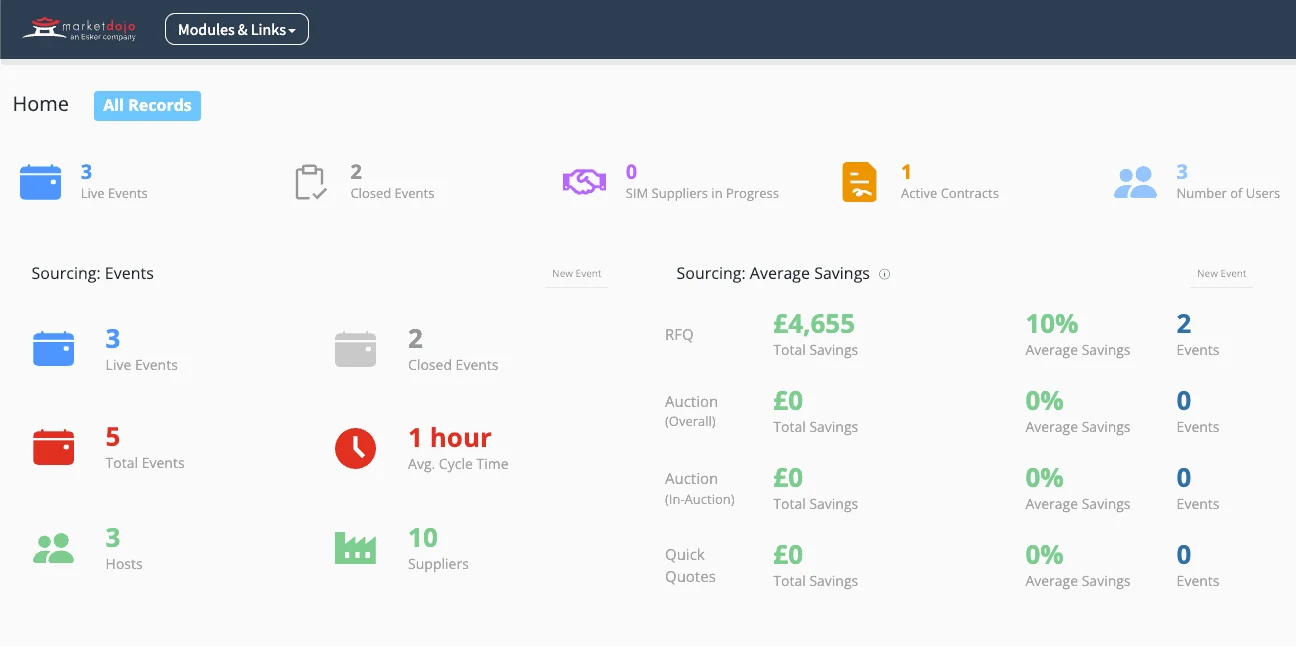
Market Dojo is an eSourcing platform that runs RFx events and eAuctions on monthly, annual or single-event licences, and it publishes the only buyer-side price in this list.
Build and send. The base licence launches live events and runs simple RFx and eAuctions with templates and libraries, Excel integration and custom fields, user management and live messaging. The homepage lists supplier discovery and says AI helps discover and qualify suppliers, without detail.
Score. A higher tier adds collaborative multi-scoring with supplier participation and weighted events. Scenario modeling isn't described on the pages we read.
Award and hand off. The homepage lists a Contract Management module. The handoff from an award to a contract or PO isn't described.
- you want a published price and a licence you can buy for one month or one event with no long-term commitment
- you run a few RFx events or eAuctions and don't need a full source-to-pay suite
- you need a price in US dollars: Market Dojo lists pounds sterling only
- you need documented constraint-based award optimization: the pages we read mention weighted events and multi-scoring but not scenario modeling
Price and what reviewers say
Market Dojo's pricing page lists £500 per month billed annually or £1,000 per month on-demand for the base licence, and £1,000 per event as a one-off payment. The weighted-events tier lists £583 per month billed annually, £1,500 per month on-demand and £1,500 per event. The page says discounts apply by number of users and licence duration. The vendor offers a free trial and a sandbox. We didn't read a review source for Market Dojo, so we show no rating.
- Starting price
- From £500 per month billed annually for simple RFx and eAuctions; £1,000 per month or £1,000 per event on-demand (pounds sterling, no USD price)
- Sourcing events
- Simple RFx and eAuctions with templates and libraries, Excel integration and live messaging
- Award analysis
- Weighted events and collaborative multi-scoring in the £583 per month annual tier; scenario modeling is not described
- Supplier discovery
- The homepage lists supplier discovery and says AI helps discover and qualify suppliers
- Handoff after award
- The homepage lists a Contract Management module; the handoff steps are not described
RFP software for responders
Loopio, Responsive, Iris and Qvidian are for the team that receives the RFP. They differ in how they get an answer: from a maintained library, from AI drafts with citations, or from governed documents. None of them issues or scores an RFP, and every vendor page we read says so by what it leaves out.
Loopio
Loopio is a response-side platform for supplier teams that answer RFPs, RFIs and security questionnaires from a maintained content library with AI drafting. It is sold in three tiers (Foundations, Enhanced, Enterprise) on custom quotes.
Loopio is a response-side platform that imports an RFP, fills it from a maintained content library and uses AI agents to draft first answers, sold in three tiers on custom quotes.
Import. Questions are imported from a document or web portal, organized and filled from the library. A Help Center summary, which we couldn't open directly, describes import from Word, Excel and PDF with answer fields confirmed on import.
Answer. The library is fed by connectors for SharePoint, Google Drive and websites. AI agents draft first answers from approved knowledge, a TRACE score rates AI answers and source citations are shown.
Review. Questions can be assigned to subject matter experts with automated reminders, and milestones show progress. Per-project access levels run from No Access to Full Access, and multi-step reviews are listed from the Enhanced tier up.
Export. The same Help Center summary lists export to Excel, Word or HTML.
- your team wants a maintained answer library with expert routing and reminders, since questions are filled from the library and assignable
- you need Salesforce or Highspot connections, which Loopio lists as add-ons next to Microsoft and Google storage connectors
- you need a public price to budget against: no tier shows one and every tier is a custom quote
- you want to buy or score RFPs: Loopio is built to answer incoming ones
Price and what reviewers say
Loopio's pricing page lists three tiers, Foundations (10 seats), Enhanced and Enterprise, all on custom quotes. We couldn't read a review page: the major review sites returned a 403 and we used no search snippets, so we show no rating.
- Starting price
- Custom quote, not published
- Response project
- Questions are imported from a document or web portal, organized and auto-filled from the library. Questions can be assigned to SMEs with automated reminders; project milestones show progress.
- Library and AI
- Library is fed by connectors (SharePoint, Google Drive, websites). AI agents draft first answers from approved knowledge; a TRACE Score rates AI answers and source citations are shown.
- Collaboration and review
- @mentions and comments, scheduled content review triggers. Per-project access levels: No Access, Participant, Creator, Full Access. Multi-step reviews are listed from the Enhanced tier up.
- Import and export
- Help Center (seen only via a search summary, page itself returned 403): import from Word, Excel and PDF, with answer fields confirmed on import; export to Excel, Word or HTML.
- Integrations
- Lists Microsoft tools (SharePoint, Teams, OneDrive, Word, PowerPoint), Google Drive, Confluence, Box, Slack, Salesforce, HubSpot, Dynamics 365, Seismic, Highspot, Okta and Azure SSO. Salesforce and Highspot are priced add-ons.
- Size and fit
- Foundations (10 seats) is aimed at smaller sales-led proposal teams; Enhanced and Enterprise at larger teams, business units and sandboxes. No headcount range stated.
Responsive
Responsive is a response-side platform for supplier teams that answer RFPs, RFIs and security questionnaires, with import mapping, AI first drafts and templated export. Pricing is an annual platform fee plus user licenses and add-ons.
Responsive, formerly RFPIO, imports RFPs and questionnaires, drafts answers with AI and exports in the buyer's format, and it's the only response tool here with a published starting price.
Import. A project starts from scratch or a template, with sections added manually, from section templates or by uploading xlsx, xls, docx or pdf files. Standard Excel files such as SIG or CAIQ configure automatically, and others need manual mapping.
Answer. You can reuse approved answers or generate first drafts with built-in prompts, choose which sources the AI draws from and translate responses. The page we read doesn't describe how the library is structured.
Review. Authors and reviewers are assigned per section, and review order can be Any, All or Sequential.
Export. You choose the file name, the type (the source file, a default Excel file or a template) and the sections, and the export can take a few minutes.
- you receive many standard security questionnaires such as SIG or CAIQ, because standard Excel versions import with automatic configuration
- you want a stated price floor and flat usage: the lowest published edition has unlimited projects and responses
- your budget is far below $10,000 a year, because the lowest published edition starts at that figure
- you want to buy or score vendor RFPs: it's built to answer incoming requests, and Responsive sells RFP360 for the buyer side
Price and what reviewers say
Responsive's pricing page lists an Emerging edition from $10,000, with Growth and Enterprise by quote, and says pricing is an annual platform fee plus user licenses and add-ons. The page shows no per-RFP fees. We couldn't read a review page: the major review sites returned a 403 and we used no search snippets, so we show no rating. The tool name changed from RFPIO to Responsive, which matters when you search review sites.
- Starting price
- Emerging edition from $10,000; Growth and Enterprise by quote
- Response project
- Create a project from scratch or a template, then add sections manually, from section templates or by uploading xlsx, xls, docx or pdf. Standard Excel files such as SIG or CAIQ configure automatically; others need manual mapping.
- Library and AI
- Reuse approved answers or generate first drafts with built-in prompts; you control which sources the AI draws from and can translate responses. Library structure itself was not described on the page read.
- Collaboration and review
- Authors and reviewers are assigned per section; review order can be Any, All or Sequential. Email notifications can be queued into one combined email.
- Import and export
- Export from the Projects menu: choose file name, type (source file, default Excel or a template) and sections; the file can take a few minutes. Import accepts Word, Excel and PDF.
- Size and fit
- Pricing page lists Emerging, Growth and Enterprise editions, with no per-RFP fees (unlimited projects and responses). No headcount range stated.
- Integrations
- Not described on the pages we read
Iris AI
Iris is a response-side platform that drafts answers to RFPs, RFIs, DDQs and security questionnaires from your approved content and deal context. It suits sales engineering and bid teams that answer buyer documents, not buyers who issue them.
Iris is an AI response platform that drafts answers to RFPs, RFIs, DDQs and security questionnaires from your approved content and deal context, with citations on every answer.
Import. An analyzer extracts questions, requirements and compliance clauses from long RFPs and scores go or no-go fit, which the vendor page describes only in part. The pages we read don't describe upload steps.
Answer. Drafts use deal data, prospect research and a knowledge map, and each answer has citations and a confidence score. Locked approved answers insert legal or security text verbatim, and missing context is flagged as insufficient rather than invented.
Review. Assignments route to experts with an SLA timer, comments and @-mentions sit on single answers, and an audit trail records each change, person, time and prior version.
Export. The pages we read don't describe export formats. Evidence files such as SOC 2 reports can be attached and carried into the submission.
- your team answers many RFPs and security questionnaires and wants citations plus a confidence score on every drafted answer
- you want drafts tied to CRM and call data, since the integrations page names Salesforce, HubSpot and Gong
- you need a public price: Iris prices per active user by quote
- you need documented export formats: the vendor pages we read don't list them
- Users like
- Ease of use (43 mentions) and time savings (36) in G2's pros summary; reviewers describe a thorough first draft.
- Users dislike
- Lack of features (5 mentions); reviewers say human review is still needed, the interface is hard to navigate and implementation was clumsy for one team.
- Source: G2, 85 reviews
Price and what reviewers say
Iris doesn't publish a price and prices per active user. The pricing page lists one full-platform bundle with unlimited RFPs, DDQs and questionnaires. On G2, which we read in a browser, Iris has 4.9 out of 5 from 85 reviews. Ease of use (43 mentions) and time savings (36 mentions) lead the praise, and the top criticism is lack of features (5 mentions). Reviewers also say human review is still needed. Many of the reviews are vendor-invited, so read the rating with that in mind.
- Starting price
- Not published, per active user, quote only
- Response project
- Analyzer extracts questions, requirements and compliance clauses from long RFPs and scores go/no-go fit. Answers can be approved, edited, reassigned or regenerated, each logged. A G2 reviewer describes automatic field mapping when starting a response.
- Library and AI
- Drafts use deal data, prospect research and a knowledge map. Each answer has citations and a confidence score. Locked golden answers insert approved legal or security text verbatim. Missing context is flagged as insufficient rather than invented.
- Collaboration and review
- Assignments route to experts with an SLA timer. Comments and @-mentions sit on single answers. An audit trail records each change, person, time and prior version.
- Integrations
- Named: Salesforce, HubSpot, Gong, Slack, Teams, SharePoint, Google Drive, Confluence, Notion, Highspot, Seismic, Vanta, Drata, plus MCP access for ChatGPT, Claude and Gemini. SSO via Okta, Microsoft, Google.
- Size and fit
- Pricing page lists one full-platform bundle with unlimited RFPs, DDQs and questionnaires, SSO/SAML/SCIM and a customer success manager. G2 profile shows reviewers from small to over 1,000 employee companies.
- Import and export
- Not described on the pages we read
Upland Qvidian
Qvidian is a long-running response-side platform built around a governed content library and Word and PowerPoint document automation, with an AI Assist add-on. Status: active on Upland's site as of the check date, not discontinued.
Upland Qvidian is a long-running response platform built around a governed content library and Word and PowerPoint document automation, with an AI Assist add-on.
Import. Upland says the product parses documents to find headings and questions and suggests answers, and a technology page says questionnaires are imported and answered automatically. The training pages cover RFP projects and Word and PowerPoint document types.
Answer. A central library holds all content used in RFP projects, including tables and images. AI Assist generates and revises content and queries documents, and machine learning suggests answers.
Review. The vendor lists task assignment, workflows and permissions, in-product message threads, audit tracking, multistep review and approval, and custom user types and roles.
Export. Word templates format the output. Export formats aren't listed on the pages we read.
- your proposals live in Word and PowerPoint and you want template-driven document automation
- governance matters to you: multistep approvals, roles and audit tracking are listed
- you want self-serve pricing or a quick start: Qvidian lists no price and G2 shows an average implementation time of 4 months
- you want a modern interface: reviewers describe the interface as dated
- Users like
- Fast, Google-like content search and Microsoft Word integration for editing records.
- Users dislike
- Slow Word integration and lag, weak Excel functionality, and a dated interface; most written reviews are from 2014 to 2022.
- Source: TrustRadius, 41 ratings
Price and what reviewers say
Qvidian is quote only. On TrustRadius, which we read in a browser, reviewers rate it 8 out of 10 from 41 ratings. They praise fast content search and Microsoft Word integration, and criticize slow Word integration, weak Excel functionality and a dated interface, and most written reviews are from 2014 to 2022. G2 shows 4.3 out of 5 from 166 reviews, but its review text didn't load. Upland's site lists Qvidian as an active product.
- Starting price
- Not published, quote only
- Response project
- Vendor says it parses documents to find headings and questions and suggests answers. Technology page says questionnaires are imported and answered automatically. Training covers RFP projects and Word and PowerPoint document types.
- Library and AI
- Central library holds all content used in RFP projects, including tables and images in records. AI Assist generates and revises content and queries documents. Machine learning suggests answers.
- Collaboration and review
- Assign tasks, set workflows and permissions, in-product message threads, audit tracking, multistep review and approval, custom user types and roles.
- Import and export
- Word templates format output and Word and PowerPoint automation are taught as courses. A TrustRadius reviewer reports Excel functionality needing improvement. Export formats are not listed.
- Size and fit
- Vendor cites ISO 27001, SSAE 16 Type II and GDPR. G2 average implementation time is 4 months. It positions for tech startups to larger firms and has Upland Analytics for custom reports.
- Integrations
- Not described on the pages we read
How much does RFP software cost?
Only two of the ten tools publish a price, so most RFP software costs whatever the vendor quotes for your scope. Responsive lists its Emerging edition from $10,000, and Market Dojo lists £500 per month on an annual licence or £1,000 for a single event, in pounds sterling. The other eight sell by quote, demo request or contact form, and the only number we found for them is a third-party estimate for Ivalua, which we label as unverified.
| Tool | What the vendor publishes (USD or GBP as stated) | What we found on cost (USD as stated) |
|---|---|---|
| SAP Ariba | Price upon request | Suppliers have a free standard account on SAP Business Network (checked October 24, 2026) |
| Ivalua | Quote only | A third party reports a buyer-reported floor near $150,000 per year, an unverified estimate |
| JAGGAER | Custom quote | Nothing on the sourcing or optimization pages |
| Market Dojo | £500 per month billed annually; £1,000 per month on-demand; £1,000 per event (pounds sterling) | Discounts by number of users and licence duration |
| RFP360 | Not published | Responsive's pricing page covers the response product only |
| Euna Procurement | Request pricing, tiers vary | Nothing published |
| Loopio | Custom quote | Three tiers: Foundations (10 seats), Enhanced, Enterprise |
| Responsive | Emerging edition from $10,000; Growth and Enterprise by quote | An annual platform fee plus user licenses and add-ons, with no per-RFP fees |
| Iris | Per active user, quote only | One full-platform bundle with unlimited RFPs, DDQs and questionnaires |
| Qvidian | Quote only | Nothing published |
Because eight of ten have no list price, compare quotes on the same scope. Ask each vendor what the quote covers: how many seats or users, whether it includes AI features and integrations, whether suppliers pay a fee, and what implementation costs. Two quotes are only comparable when they include the same modules.
The cost of running an RFP itself is mostly staff time. We found no sourced figure for what an RFP costs a buyer, so we don't quote one. Count the evaluator hours and the supplier hours spent on responses before you decide an RFP is worth it for a small purchase. A request for quotes is usually enough when the requirements are simple and the decision is on price, which our purchase requisition software comparison touches on from the intake side.
How to choose RFP software
Choosing RFP software starts with your side of the RFP and your volume. Write down how many RFPs you send or receive per year, how many people touch each one and where the final answer or award has to land. A team that sends a handful of RFPs a year may need a template and a scoring sheet more than a platform, while a team that answers hundreds of questionnaires a year has a library problem.
Does RFP software integrate with your ERP?
RFP software integrates with an ERP only in some buyer tools, and the integrations pages differ a lot. Ivalua lists pre-built ERP connectors for SAP, Oracle and Microsoft Dynamics, and JAGGAER lists more than 40 pre-built integrations including SAP, Oracle, Workday, NetSuite, Infor and JD Edwards. The SAP slides we read mention ECC and S/4HANA integration for SAP Ariba, and Euna Procurement cites support for more than 25 ERPs and over 150 API routes. For RFP360 and Market Dojo we found no named ERP integrations. The response tools connect to content and CRM systems instead: Loopio lists SharePoint, Google Drive, Confluence, Salesforce and HubSpot, with Salesforce and Highspot as paid add-ons, and Iris names Salesforce, HubSpot, Gong and SharePoint. Responsive and Qvidian name none on the pages we read, so ask for the list.
How long does RFP software take to implement?
Implementation time is the least documented number in this category. JAGGAER cites typical deployments of 8 to 12 weeks, which is a vendor claim, and G2 shows an average implementation time of 4 months for Qvidian. The reviews cited for Ivalua mention complex setup and a steep learning curve, and G2 reviewers most often flag complexity for SAP Ariba. For the other six tools we found no stated duration, so ask each vendor who builds the templates, who loads the library or supplier list and who connects the systems.
What should the demo cover?
The demo should run your own sample RFP and name what isn't included in the quote. Use the checklist below, which separates the questions for buyers and for responders.
- Which side of the RFP am I on: do we send the RFP or answer it?
- How many RFPs do we send or answer per year, and how many people touch each?
- Buyers: how are evaluator weights set, and can price be hidden during technical scoring?
- Buyers: where does the award land: a PO, a contract or a report?
- Responders: which file types import, and which formats export?
- Responders: where does the answer come from, a library, AI drafts or both, and what is cited?
- Is the feature we need in the quoted tier, or in a higher one?
- What does the quote cover at our volume, and what does implementation cost?
A rough split works for a first shortlist. If you issue RFPs inside an SAP landscape, start with SAP Ariba. If your awards have many constraints, start with JAGGAER or Ivalua. If you're a public body, start with Euna Procurement. If you answer questionnaires, start with the response tools and ask about Excel import and review order first.
After the award: from RFP to renewal decision
An RFP award ends the sourcing event, but it starts a contract with a term, a notice period and a renewal date. SAP Ariba, Ivalua, JAGGAER and Euna Procurement describe the handoff into a contract or PO in some form. The pages we read don't describe who decides the renewal before the notice date, and a contract can roll into the next term simply because nobody saw the date. The Procurement Manager is a small tool for that one job: it routes each contract renewal to the business owner, Finance and IT and produces one decision packet with the exact dates and source evidence before the notice deadline. It doesn't issue RFPs, score bids, read contracts or cancel anything on its own. Use it next to an RFP tool if awarded contracts are where your savings leak. Our contract renewal notice period guide and contract lifecycle management software comparison cover the contract side.
Frequently asked questions
What is RFP software?
RFP software is a tool that manages the request for proposal process. Buyer-side tools build and send the RFP and score the responses. Response-side tools help a supplier import the questionnaire, draft answers from a library or AI, route them to experts for review and export the result.
What is the difference between buyer-side and response-side RFP software?
Buyer-side software is used by the team that sends the RFP, and it scores and compares the responses it receives. Response-side software is used by the team that answers it. Most pages that rank for this keyword cover only the response side, so check which side a tool is built for before a demo.
How much does RFP software cost?
RFP software costs a quote for eight of the ten tools here. Responsive lists its Emerging edition from $10,000, and Market Dojo lists £500 per month billed annually or £1,000 for a single event, in pounds sterling. SAP Ariba, Ivalua, JAGGAER, RFP360, Euna Procurement, Loopio, Iris and Qvidian sell by quote, demo or contact form, so compare quotes on the same scope.
How much does an RFP cost?
An RFP costs mostly staff time: the evaluators who read and score the responses and the suppliers who write them. We found no sourced figure for what an RFP costs a buyer, so we don't quote one. For simple purchases decided on price, a request for quotes is usually enough.
Can a small team use RFP software?
A small team can use RFP software if it picks the right kind. Market Dojo publishes a £500 per month annual licence and a £1,000 single-event licence, and Responsive publishes a $10,000 starting price for responders. Ivalua has a third-party reported floor near $150,000 per year. A team that sends only a few RFPs a year may manage with a template and a scoring sheet.
What happens after the RFP is awarded?
The award goes into a contract or a PO. SAP Ariba, Ivalua, JAGGAER and Euna Procurement describe that handoff in some form. The contract then has a term and a notice date that someone needs to own before it renews.