A contract renewal notice period is the advance warning a party must give to prevent a contract from renewing, or to exercise another renewal-related right. It isn't the same as the renewal date. For procurement teams, the operational deadline is the last date a valid notice can reach the correct recipient under the agreement's rules.
There isn't one universal notice period for US business contracts. A signed agreement might call for 30, 60 or 90 days, a number of months, or a separate window. Start with the actual clause, calculate the notice deadline and move your internal decision well ahead of it. Don't wait for the vendor's renewal invoice.
- The notice period is a duration; the notice deadline is a calendar date.
- Start with the signed order form, amendments and the notice clause, not a generic 30-day rule.
- Calculate from the correct contract event, then check delivery and receipt requirements.
- Set review milestones before the notice deadline, not just before contract expiration.
- Keep a named decision owner and evidence that the notice was delivered correctly.
What is a contract renewal notice period?
A contract renewal notice period is the amount of advance notice required by an agreement before a renewal-related action takes effect. The notice deadline is the resulting last day for that action. Procurement needs both fields because a renewal date alone doesn't tell the team when its ability to exit or renegotiate may change.
Consider a fictional software subscription that ends on December 31, 2026 and requires written non-renewal notice at least 90 calendar days before the end of the term. Under a straightforward date-subtraction convention, the provisional deadline is October 2, 2026. The procurement review must finish early enough for the authorized sender to give notice using the specified method.
Non-renewal and termination aren't interchangeable. A non-renewal notice usually prevents a new term from starting; termination may end the current term under a separate clause. An agreement can have different rules for termination for cause, termination for convenience and non-renewal. The heading on the clause doesn't replace reading its actual words.
Notice period versus renewal date
The renewal date is when the next term would begin. The notice period is the interval required before the event identified by the clause, while the deadline is the calendar date produced by that rule. A vendor's reminder date is another thing entirely and shouldn't be treated as the contractual cutoff.
| Contract concept | What procurement records | Why it matters |
|---|---|---|
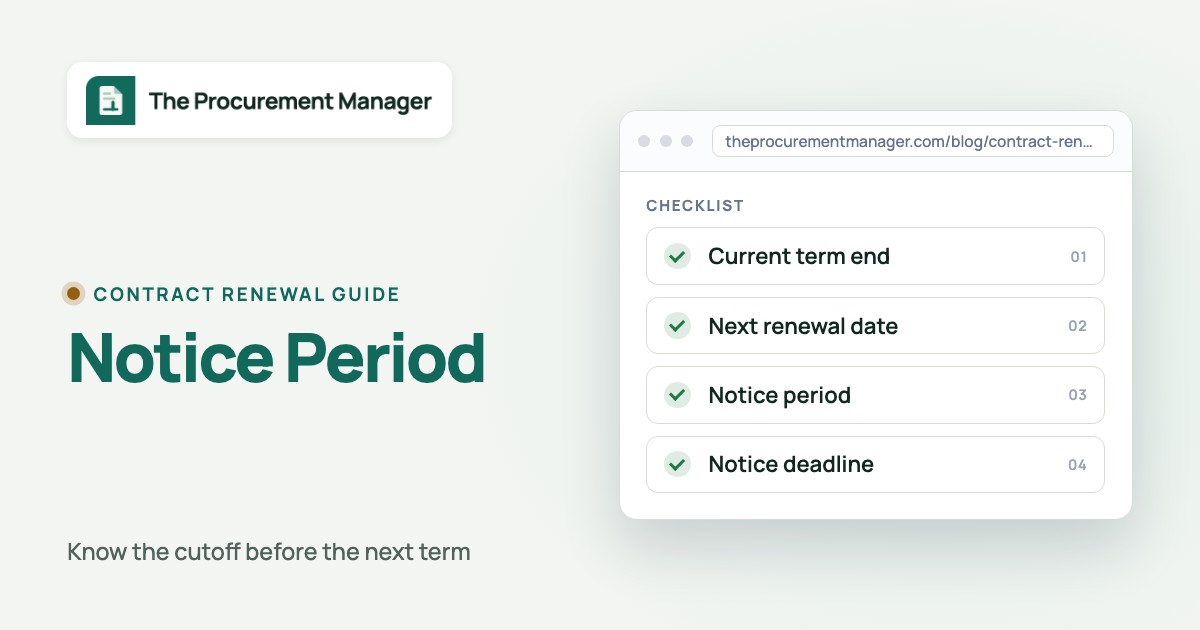
| Current term end | The date the present service term ends | May be the clause's counting anchor |
| Next renewal date | The date a new term begins if renewal occurs | May differ from the term-end date |
| Notice period | Exact words and unit, such as 90 calendar days | Defines how far to count backward |
| Notice deadline | Calculated cutoff, with a legal-review flag if ambiguous | Drives internal escalation |
| Notice mechanics | Recipient, method, address and effective-receipt rule | Determines whether the notice is valid |
How do you calculate a contract renewal notice deadline?
Calculate a contract renewal notice deadline by identifying the contractual anchor date, subtracting the stated notice interval and checking the agreement's counting and delivery rules. Anchor date minus notice interval is only a provisional calculation. Months, business days, holidays and receipt language can change the usable date.
The examples below are hypothetical and assume ordinary calendar-day subtraction with no special counting rule. They aren't interpretations of a real agreement.
| Example contract | Anchor date | Notice requirement | Provisional deadline |
|---|---|---|---|
| Software subscription A | Dec 31, 2026 | 90 calendar days before term end | Oct 2, 2026 |
| Service agreement B | Jun 30, 2027 | 60 calendar days before term end | May 1, 2027 |
| Subscription C | Mar 1, 2027 | 30 calendar days before renewal | Jan 30, 2027 |
| Agreement D | Dec 31, 2026 | 3 calendar months before term end | Sep 30, 2026, subject to month-end convention |
The difference between 90 days and three months isn't cosmetic. In the first and fourth examples, the same anchor produces different provisional dates. Never convert months into a fixed number of days without checking the contract's interpretation provisions.
Find the controlling agreement
Open the signed master agreement, current order form and every amendment. Identify which document controls the particular subscription or service line.
Extract the complete clause
Copy the term, renewal, non-renewal and notices provisions into a review record. Capture the exact notice unit and the event it counts back from.
Calculate a provisional deadline
Count backward using the specified calendar days, business days or months. Flag month-end, holiday and timezone questions for counsel rather than guessing.
Verify the delivery rule
Confirm who may send notice, who must receive it, the approved channel and whether the clock stops on sending or receipt.
Set an earlier internal decision date
Give the business owner, Finance, IT and Legal time to approve the action. Save the final deadline and supporting contract excerpt together.
Calendar days, business days and months
Calendar days include weekends unless the contract supplies a different convention. Business days require a defined business calendar and often a holiday rule. A requirement measured in months may need special handling when the target month lacks the same day number. The team shouldn't assume that a spreadsheet's default date function is a legal interpretation.
For a deadline falling on a weekend or holiday, don't silently roll it forward to Monday. Some agreements define the next business day, others don't. If the clause is silent or contradictory, flag the date for legal review and use an earlier internal send target. If you're unsure which date applies, count the earlier one. That's the safer habit.
Sent versus received notice
A notice can be timely when sent under one agreement but only when received under another. A clause might require email to a named address, delivery through a designated portal or physical delivery to a contractual notice address. An account manager's acknowledgment isn't automatically proof that the contractual recipient received valid notice.
Save the message, delivery evidence and recipient details. If you're relying on email, keep the full original with headers, not a forwarded copy. If the agreement requires an acknowledgment or uses deemed-receipt language, preserve the evidence that supports that rule. Procurement should track notice sent, notice effective and vendor acknowledgment as separate fields when they don't coincide.
Which contract clauses can change the notice period?
Contract clauses can change a renewal notice deadline through their choice of anchor, counting unit, notice channel, effective-delivery rule or amendment priority. Procurement should review the full contract set, not just the sentence containing the number of days.
Check these items first, because each one can move the usable deadline.
- Term and renewal: Check whether the subscription renews automatically and whether the next term starts on the expiration date or the following day.
- Order of precedence: Confirm whether an order form overrides the master agreement for term length or cancellation.
- Notice method: Find out whether email is permitted or the agreement specifies a portal, postal address or other method.
- Recipient and authority: Identify whether notice must go to Legal, a contractual address or a named party, and who's authorized to sign or send it.
- Timing convention: Establish whether days are calendar days, business days or months, and which timezone and holiday calendar apply.
- Changes: Verify that no amendment has moved the renewal date or replaced the notice clause.
- Separate rights: Note that price objections, seat reductions, termination for cause and non-renewal may each have a different window.
A single supplier may have several order forms with different start dates. Don't merge their deadlines because the vendor name matches. They're separate commitments, and each one's clock runs on its own. Create a record for each independently renewing commitment and roll them up only for management reporting.
How early should procurement start a renewal review?
Procurement should start the renewal review far enough before the notice deadline to collect evidence, get approvals and preserve the option to exit. A practical internal cadence is 120, 90, 60 and 30 days before the notice deadline, adjusted for contract size, replacement difficulty and decision rights. These are proposed operating checkpoints, not legally required notice periods.
| Checkpoint before notice deadline | Lead owner | Required output |
|---|---|---|
| 120 days | Procurement | Contract packet, current scope and named business owner |
| 90 days | Business owner | Usage, performance and whether the service is still needed |
| 60 days | Finance and IT | Budget position, technical dependencies and switching risk |
| 30 days | Procurement and Legal | Approved renewal posture and prepared notice, if applicable |
| Before the contractual cutoff | Authorized sender | Valid delivery and saved evidence |
A 90-day contractual notice period plus a 120-day internal review lead means the first checkpoint could be 210 days before the term-end anchor in a simple calendar-day example. That much lead time suits a critical, hard-to-replace service but may be more than a small, easily replaceable one needs. Set a shorter workflow where the risk is lower, without moving the contractual deadline.
For an agreement with a very short notice period, the team can still begin the commercial review earlier. A short contractual window isn't an instruction to postpone the decision until the window opens. If you've got a 15-day window, you'll want the decision made well before it.
What should a renewal notice tracker contain?
A renewal notice tracker should hold the controlling contract reference, notice clause, exact cutoff, delivery method, decision owner and proof of action. A tracker is useful only when someone can reconstruct why a date was chosen and who made the decision.
Use this copy-ready header in a spreadsheet or CSV file. Keep sensitive agreements in your approved repository rather than pasting confidential terms into a public tool.
contract_id,vendor,order_form_id,contract_version,term_end,renewal_date,notice_period_text,provisional_notice_deadline,notice_method,notice_recipient,business_owner,procurement_owner,finance_reviewer,it_reviewer,legal_reviewer,decision_status,internal_decision_due,notice_sent_at,delivery_evidence,contract_source_link
EXAMPLE-001,Sample Analytics,OF-2026-A,Amendment 2,2026-12-31,2027-01-01,90 calendar days before term end,2026-10-02,Email to notices address,Verify from signed contract,Operations lead,Buyer A,Controller,IT lead,Counsel,Review in progress,2026-09-15,,,Internal repository reference
The sample row is fictional. Its provisional deadline assumes simple calendar-day subtraction, and the notice recipient still requires verification. A real tracker should also keep the exact clause excerpt, who verified it, when the record was checked and a link to the signed version.
For a small vendor portfolio, a spreadsheet can be enough if it's reviewed consistently. A larger portfolio needs controlled ownership changes, reliable alerts and an audit trail, but buying software doesn't replace checking the original contract. A good test is whether someone who didn't build the sheet can find the signed clause in a minute.
Who approves a renew, renegotiate or non-renew decision?
A renewal decision should have a named business owner and separate input from Procurement, Finance, IT and Legal where relevant. Procurement coordinates the decision, but it shouldn't decide service need, budget authority, security exposure or legal notice validity alone.
| Role | Evidence supplied | Decision or sign-off |
|---|---|---|
| Business owner | Service value, usage and alternatives | Continue, change or exit recommendation |
| Procurement | Current commercial terms and negotiation record | Sourcing and supplier action plan |
| Finance | Budget, invoices and proposed next-term commitment | Financial approval |
| IT or security | Integrations, data access, migration and offboarding effort | Technical risk and transition approval |
| Legal | Clause interpretation, notice method and exceptions | Validity review when needed |
| Authorized sender | Final approved instruction and recipient | Send notice and preserve proof |
A decision packet can be short. It should contain the agreement version, the renewal and notice dates, current commercial commitment, actual usage, supplier performance, proposed action, approvers, any unresolved legal interpretation and the delivery evidence. If the business wants to keep the vendor, record that choice explicitly instead of letting silence stand in for approval. If a reviewer can't find the notice date in ten seconds, the packet isn't doing its job.
A non-renewal notice doesn't always mean the business has committed to an immediate replacement. Depending on the agreement, it may be a way to avoid an automatic extension while a commercial decision is still open. Legal should confirm the consequences before Procurement uses notice as a negotiating tactic.
What should a contract non-renewal notice say?
A contract non-renewal notice should identify the agreement and applicable order, clearly state the intent not to renew and follow the contract's recipient and delivery requirements. The exact wording and sender authority depend on the signed terms, so Legal should approve the final version when the stakes or clause are uncertain.
Illustrative notice language, not a legal form:
> Regarding [agreement title and date] and [order form ID], [legal entity] gives notice that it does not intend to renew the current term ending [date], pursuant to [relevant clause]. Please acknowledge receipt and confirm the current service-end and data-return arrangements. This notice is sent by [authorized sender] using the notice method specified in the agreement.
Don't rely on an email subject line alone. You're proving what you said, not just that you wrote. The body should be unambiguous about the agreement and the intended action. Keep a copy of the signed or approved notice, any attachments, proof of delivery and follow-up acknowledgment in the contract record.
If the vendor disputes receipt, you'll need the notice provision and delivery record. A generic screenshot of a message draft won't establish that it was actually sent or received.
What happens if the contract renewal notice deadline is missed?
Missing a contract renewal notice deadline may trigger the renewal outcome stated in the agreement, but the consequences aren't identical across contracts or jurisdictions. Procurement shouldn't assume the contract has renewed irrevocably, nor assume a late email cancels it.
First, verify the controlling contract version and the deadline calculation. Next, ask Legal to examine any relevant exceptions, statutory requirements, termination rights and the vendor's actual notice practices. At the same time, Procurement can ask the supplier whether it'll agree to a written extension, revised terms or an agreed exit. Don't represent an informal conversation as a contractual waiver.
If the vendor agrees to a different outcome, capture it in an authorized writing and update the register. If the business has to continue the service, document the next decision window immediately so the same problem doesn't repeat.
Does US law set a standard contract renewal notice period?
US law doesn't supply a single standard notice period for every business-to-business contract. The agreement and the law governing the particular transaction both matter. Consumer subscription rules, commercial service-contract rules and federal procurement clauses can have different scopes, so one shouldn't be substituted for another.
For example, New York General Obligations Law section 5-903 addresses certain automatic-renewal provisions in contracts for service, maintenance or repair to real or personal property. For covered contracts, it calls for a supplier's written reminder within a specified window before the customer's notice deadline, with an exception for automatic-renewal periods of one month or less. That doesn't make its rule a universal SaaS cancellation period.
California's automatic-renewal statute addresses offers to consumers. A procurement team shouldn't apply consumer-specific requirements to its enterprise contract without legal analysis of the transaction and the statute's scope. When a clause is ambiguous or enforceability matters, ask qualified counsel in the relevant jurisdiction rather than using a generic web calculator as a legal determination.
How can procurement prevent missed notice deadlines?
Procurement can prevent missed notice deadlines by making the contractual cutoff a controlled obligation with an owner, an early review date and delivery evidence. A calendar event is useful, but it isn't a decision or a proof-of-notice record.
The following checklist is designed for a monthly vendor portfolio review. It covers both upcoming commitments and records that might have changed since the last review.
- Confirm every active order form has a named owner and current signed source.
- Check the term end, renewal event and exact notice-period wording.
- Recalculate deadlines after amendments, seat changes or new order forms.
- Flag any calendar-day, business-day, month-end or receipt ambiguity.
- Escalate undecided contracts before their internal decision date.
- Collect business value, Finance approval, IT transition risk and Legal review as needed.
- Send notice only through the permitted channel with proper authority.
- Save delivery evidence and any supplier acknowledgment.
- Update the next renewal cycle after the decision or executed amendment.
For related operational steps, use the contract renewal checklist. The notice period is one field in that larger workflow, but it's the field that often determines whether the team still has a choice.
Contract renewal notice period FAQs
The contract renewal notice period questions that matter most concern timing, the correct anchor date, delivery and missed cutoffs. The answers below assume a US commercial contract and don't replace its actual wording or governing law.
Is a 30-day renewal notice period standard?
A 30-day renewal notice period is one possible contract term, not a universal US business rule. Read the signed agreement and any amendments to find the period that applies.
Is a 90-day notice period the same as three months?
A 90-day notice period isn't necessarily the same as three calendar months. Month lengths and contract counting conventions can produce different deadlines.
Does notice have to arrive before the deadline?
Whether notice must arrive before the deadline depends on the agreement's delivery and effective-notice provisions. Some clauses focus on receipt while others define when sending is effective.
Can a vendor enforce an automatic renewal after a missed notice deadline?
An automatic renewal may take effect after a missed contractual deadline, but enforceability depends on the agreement and applicable law. Legal should review the specific transaction before the company concedes or disputes an additional term.
When should procurement start reviewing a contract with a 60-day notice period?
Procurement should begin early enough to finish approvals and any supplier negotiation before the contractual cutoff. Set internal checkpoints relative to the notice deadline rather than waiting until 60 days before contract expiration.
Should the renewal tracker use the term-end date or the notice deadline?
A renewal tracker should retain both dates, but use the notice deadline to drive escalation and decisions. Keep the underlying contract clause and delivery requirements with the record.