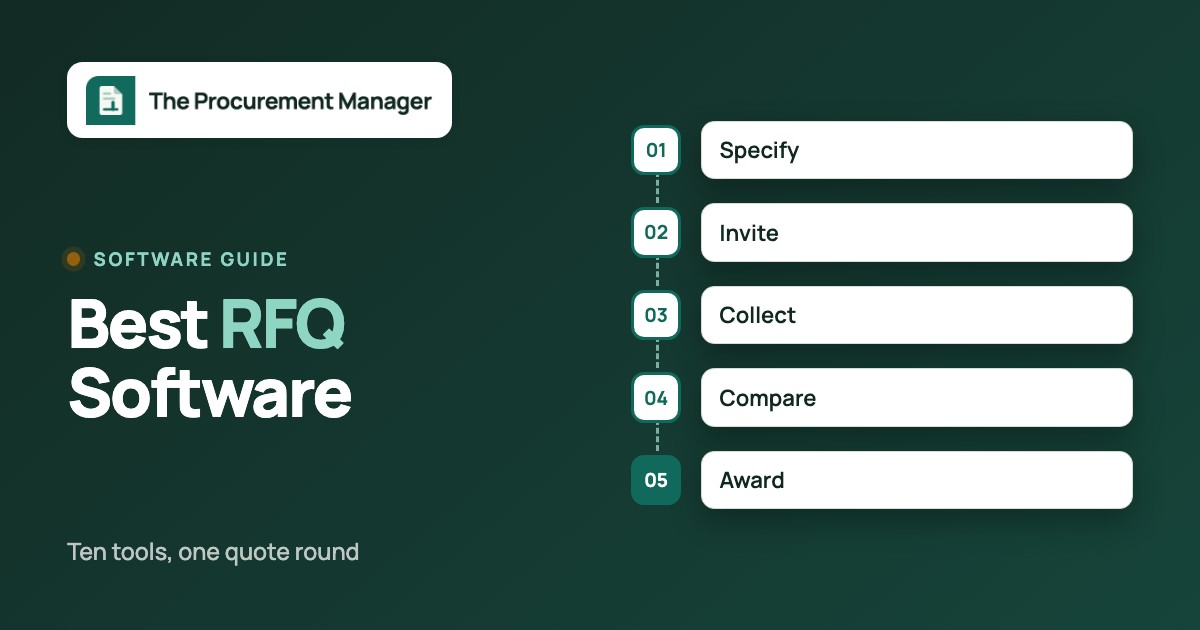
The best RFQ software depends on how many quote rounds you run and what happens after the award. Team Procure, ProcureKey and AuraVMS are built around the quote round itself. Tradogram and Precoro add quote requests to purchasing software, Market Dojo and Fairmarkit run sourcing events and tail-spend RFQs, and Coupa, SAP Ariba and JAGGAER treat an RFQ as one event type inside a source-to-pay suite.
RFQ software lets a buyer send the same request for quotation to several suppliers, collect their prices in one place and compare them line by line before placing an order. This page compares ten tools for a procurement or operations lead who buys from suppliers. For each tool it says how one RFQ round runs, where the tool stops, what it costs and who should skip it.
What is RFQ software?
RFQ software is a procurement tool that sends a request for quotation to suppliers, collects their price offers and lines them up for comparison and award. A request for quotation asks for a price on a defined item, quantity and delivery date, so the answer is a number that can be compared. That separates it from a request for proposal, which asks suppliers how they would solve a problem, and from a purchase order, which is the commitment you place after you pick a quote.
| Document | What the buyer asks or does | What comes back | Typical use |
|---|---|---|---|
| RFQ (request for quotation) | Asks for a price on a defined item, quantity and delivery date | A price per line, plus lead time and terms | The spec is fixed and price decides |
| RFP (request for proposal) | Describes a problem and asks for a solution | A written proposal with approach and price | The spec isn't fixed and quality decides |
| PO (purchase order) | Commits to buy at an agreed price | Order confirmation and delivery | After the award, to the winning supplier |
Software for RFPs is a different category, but the two overlap enough that buyers often confuse them. Our guide to RFP software covers it, and strategic sourcing software covers the wider sourcing events that RFQs sit inside. The step before both is a request for information, covered in our RFI software comparison.
Best RFQ software at a glance
Pick by the number of quote rounds you run per month and by where the winning quote has to go next. A small team that sends a dozen RFQs a month doesn't need much more than a clean round and a PO. A buyer with hundreds of low-value requests needs bundling and auto-award, whereas an enterprise sourcing team needs optimization across complex bids, and that's a very different purchase. Auctions and multi-round bidding sit outside a plain quote round, and our eSourcing software comparison covers the tools that run them.
 Best dedicated RFQ plan with a published priceTeam ProcureUnlimited suppliers, item-level comparison with freight and packaging adders, and conversion to one or several POs for $500 per month.
 Best for templates, reminders and an audit logProcureKeyBids lock at the deadline, reminders go out automatically and awards can be split by line item.
 Best for small buyers leaving email and spreadsheetsAuraVMSSuppliers quote through a private link without an account, from $4.99 per user per month.
 Best for RFQs that end in a PO inside a purchasing suiteTradogramWeighted scoring and automatic PO creation from the winning bid, with long accounting connector list.
 Best if you already buy in PrecoroPrecoroQuote requests run through its sourcing module and end in a PO, from the $999 Automation plan.
 Best for pay-as-you-go eSourcingMarket DojoLightweight Quick Quotes plus full RFx and eAuctions, priced in pounds sterling.
 Best for high-volume, low-value RFQsFairmarkitBundles similar requests and ranks suppliers by how likely they are to respond.
 Best when sourcing sits next to spend and contractsCoupaRFQs, RFPs and auctions from templates, with winning bids feeding contracts and catalogs.
 Best for large RFQs and BOM auctionsJAGGAERFrom a single-line RFQ to a 10,000-line BOM auction with line-level split awards.
RFQ software compared
Prices were checked on vendor pages on November 7, 2026, except the Tradogram and Precoro G2 figures, which date from October. Only five of the ten tools publish an amount, and the amounts aren't comparable: AuraVMS charges per user per month, Team Procure per plan, Tradogram and Precoro per plan with the RFQ capability sitting in a higher tier or add-on, and Market Dojo in pounds sterling. RFQ software costs from about $5 per user per month on AuraVMS to enterprise contracts quoted on request. The other tools sell by quote, so the table shows the price status instead of a guess.
| Tool | What the RFQ does | Price status (USD unless marked £) | Review rating |
|---|---|---|---|
| Team Procure | Item-level comparison, approvals and conversion to POs | RFQ plan $500/month for 3 users | No reviews yet |
| ProcureKey | Templates, reminders, weighted scoring, split awards | Not published | No reviews yet |
| AuraVMS | Emailed request, ranked quotes, emailed PO | From $4.99/user/month | No reviews yet |
| Tradogram | RFQ with weighted scoring, winning bid becomes a PO | Essentials from $99/month, sourcing RFx is an add-on | 4.2 (36) |
| Precoro | Quote requests via the RFP module, award per item, PO | RFP in the Automation plan, $999/month | 4.7 (222) |
| Market Dojo | Quick Quotes for simple RFQs, RFx and eAuctions | From £500/month, published in pounds | No reviews yet |
| Fairmarkit | Bundled tail-spend RFQs, Lots, reverse auctions | Quote only | No reviews yet |
| Coupa | RFx and auctions from templates, awards feed contracts | Custom quote | 6.9/10 (TrustRadius, 171) |
 SAP Ariba | Sourcing events with split awards; Simple RFx pricing goes to SAP ERP | Per user per year, quote only | 7.6/10 (TrustRadius, 770) |
| JAGGAER | RFQ to BOM auctions, line-level split awards | Custom quote | 4.1 (86) |
 The Procurement Manager Our product | Routes renewal reviews to the business owner, Finance and IT before the notice deadline | From $49 per month, flat, no per-seat fees (Starter, up to 50 contracts) | No reviews yet |
Ratings for Coupa, SAP Ariba and JAGGAER cover the whole suite, not the sourcing module alone, and Coupa and SAP Ariba are TrustRadius scores out of 10. Where a tool shows no rating, the review sites list too few reviews to call a pattern.
The RFQ round: what to check in a demo
Every tool in this list runs the same five steps, and they differ in where they stop. The columns below name the step and the failure that shows up most often when a team moves from email to software.
- Step 1Specify
- ProcureKey
- Team Procure
Breaks when the request is a free-text email, so suppliers quote different quantities and the prices can't be compared - Step 2Invite
- AuraVMS
- Tradogram
- Market Dojo
Breaks when suppliers must create an account to answer, and the slow ones simply don't quote - Step 3Collect
- ProcureKey
- Team Procure
- Fairmarkit
Breaks when quotes arrive after the deadline or in your inbox instead of the tool - Step 4Compare
- Team Procure
- Precoro
- JAGGAER
Breaks when freight, packaging and lead time are missing from the unit price, so the cheapest line isn't the cheapest order - Step 5Award
- Tradogram
- Coupa
- SAP Ariba
Breaks when the winning quote has to be retyped into the ERP or purchasing system as a PO
How to choose RFQ software
Choose by how many quote rounds you run, how many lines each round has and where the winning quote has to land. The list price matters less than whether the RFQ step is included in the plan you'd actually buy, but plenty of buyers only find that out at the quote stage.
| RFQ rounds per month | Start with | Reason |
|---|---|---|
| A few, simple items | AuraVMS, or Team Procure's RFQ plan | AuraVMS publishes a price and lets suppliers quote without an account, and Team Procure publishes a price and converts quotes to POs |
| Regular, multi-line, several approvers | Team Procure, ProcureKey, Tradogram or Precoro | Approvals and PO conversion are documented |
| Many low-value requests | Fairmarkit | Bundling and supplier matching are built for volume |
| Occasional large events with auctions | Market Dojo, or the sourcing module of your suite | Reverse auctions and weighted scoring on demand |
| Complex awards, BOMs, direct materials | JAGGAER, SAP Ariba or Coupa | Optimization across constraints and line-level splits, with implementation measured in months |
Two plan details decide more purchases than any feature. Tradogram lists sourcing RFx as an add-on to its $99 Essentials plan, and Precoro lists its RFP module under the $999 Automation plan, so the headline price isn't the RFQ price, and it's easy to budget for the wrong plan. Procurify has no native RFQ module at all: its help center says the product is not designed to create a quote request and offers a workaround with a placeholder vendor and a zero-price order request. Our guide to procurement software covers suites like Procurify, and purchase requisition software covers the step before the RFQ.
- Run one of your real RFQs with at least ten lines and three suppliers, not the vendor's sample
- Ask what the supplier sees and whether they need an account to quote
- Ask how freight, packaging, lead time and payment terms are compared, not only unit price
- Ask what happens at the deadline: do bids lock, can you extend, who gets a reminder
- Award one line to one supplier and the rest to another, and see whether two POs result
- Ask where the winning quote goes next and who retypes it into your ERP or accounting system
- Ask which plan includes the RFQ module and what each extra user costs
- Ask for the contract term and the implementation time in writing
RFQ software reviews
Each entry follows one RFQ round: how the request is built, how suppliers answer, how quotes are compared and what the award hands off. We read vendor pages, help documentation and review-site listings and didn't run these products. Prices appear once per entry and in the table.
Team Procure
Team Procure sells RFQ, purchasing, a supplier portal and eAuction as separate modules, with published monthly prices and conversion of selected quote items into purchase orders.
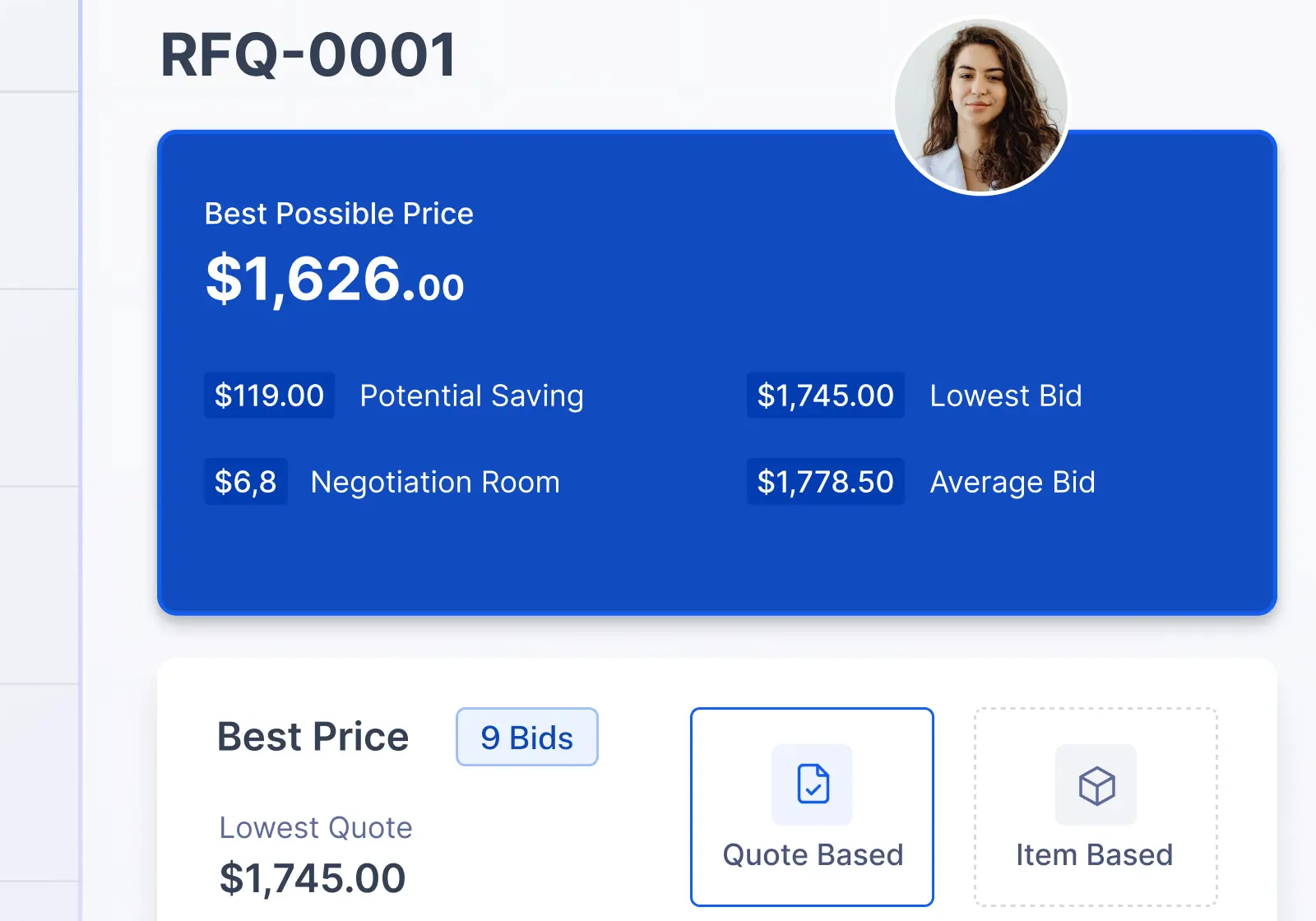
Team Procure sells RFQ as its own $500-a-month plan, with item-level comparison and a pricing matrix that turns the best line from each supplier into one or several purchase orders.
Build and invite. A buyer sets a scheduled start and end time, invites suppliers and can require an NDA before a supplier sees the request. The vendor says the number of suppliers per RFQ is unlimited. An RFQ stays editable while it is in draft, and custom fields carry attachments, delivery dates and warranty terms.
Compare. Custom price adders for freight, packaging and service level the offers, and the item-level view shows the best, average and highest price per line with the best supplier. A negotiation room estimates the room to negotiate and the potential saving.
Award. Selected offers go to an approval step, suppliers are notified when the approval is done, and the chosen items convert into one or several POs. Exports go to PDF and Excel.
Integrations. Only QuickBooks is named on the integrations page, and custom API integrations carry an extra setup fee.
What users report. The review-site listings show only a handful of reviews, so there is no pattern to quote.
Price. The RFQ plan is $500 per month for 3 users, the Procurement Suite is $250 per month for 3 users, and there is a 14-day trial with no long-term contract. The page shows a dollar sign without naming the currency.
- you send RFQs often and want item-level comparison across suppliers with freight and packaging adders
- you want a published price and a 14-day trial instead of a sales call
- you need a native ERP connector: only QuickBooks is named and custom API integrations carry a setup fee
- you want RFQ and purchasing in one subscription: Team Procure sells them as separate modules at $500 and $250 a month for 3 users
- Starting price
- RFQ plan $500 per month for 3 users; Procurement Suite $250 per month for 3 users (no currency code on the page)
- Suppliers per RFQ
- Unlimited
- Bidding window
- Scheduled start and end, deadline extensions
- Comparison
- Item-level pricing matrix with custom price adders
- Next step
- Convert selected items into one or several POs
- Trial
- 14 days
- Plan
- RFQ, $500 per month, 3 users
ProcureKey
ProcureKey runs RFQs and larger eSourcing events from templates, with a vendor portal, automatic deadline reminders, weighted scoring and a timestamped audit log.
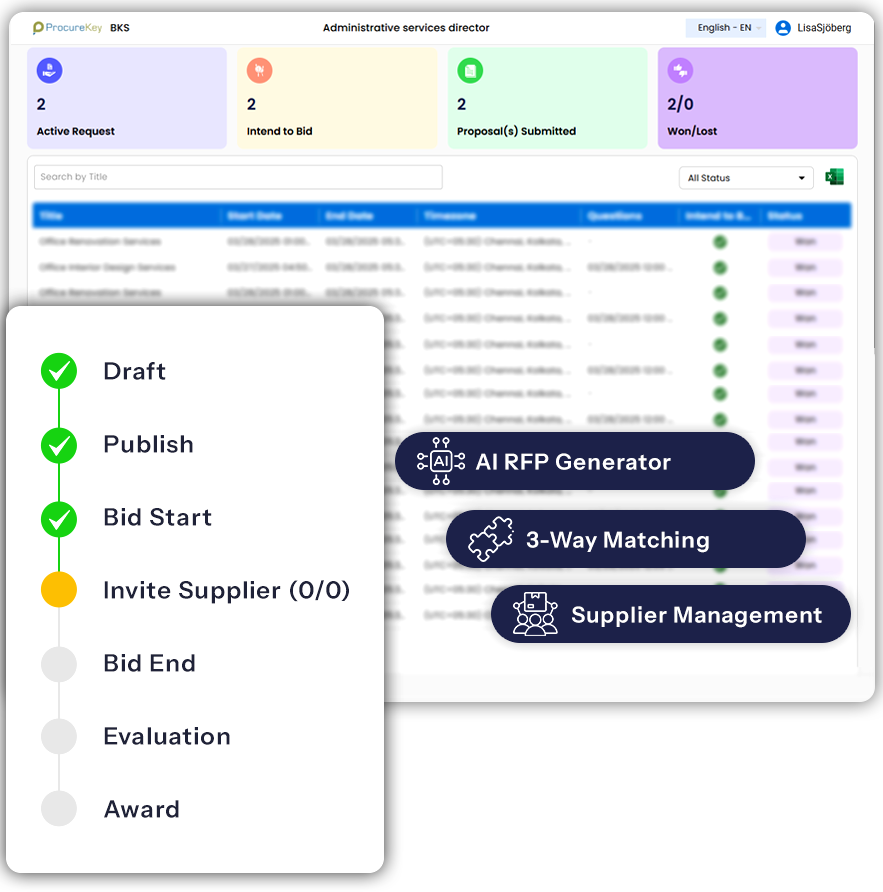
ProcureKey runs RFQs from templates with a vendor portal, locked bids at the deadline and line-item comparison, and it logs and timestamps every bid.
Build and invite. Templates and role-based teams set up the RFQ, and a purchase requisition can convert into an RFQ. Suppliers answer in a vendor portal, and automatic reminders go out before the deadline.
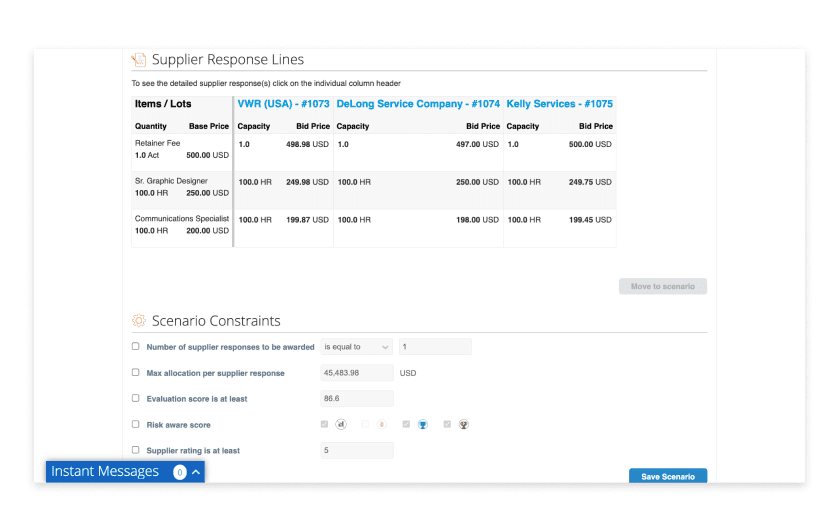
Collect and compare. Bids lock when the deadline passes, so nobody edits a price after seeing a rival. Quotes line up at line-item level with weighted scoring for criteria beyond price.
Award. Awards can be split across suppliers by line. The product pages show PO conversion only in a mockup, so confirm the handoff in a demo.
Integrations. The integrations page names SharePoint, Outlook, Teams and Excel. Connectors to SAP, Oracle and others appear only in homepage claims.
What users report. G2 and Capterra list too few reviews to call a pattern.
Price. Not published. There is a 7-day trial with no credit card, and a demo.
- you want templates, reminders and an audit log around each RFQ
- you split awards across suppliers by line item
- you need a cost before a demo: ProcureKey offers a 7-day trial without a credit card, but no price
- you need documented ERP connectors: the integrations page names only SharePoint, Outlook, Teams and Excel
- Starting price
- Not published; 7-day trial and demo
- Deadline
- Bids lock at the deadline, automatic reminders
- Comparison
- Line-item comparison with weighted scoring
- Award
- Split awards across suppliers
- Audit
- Timestamped audit log
- Trial
- 7 days, no credit card
AuraVMS
AuraVMS replaces RFQs by email and spreadsheet: the buyer sends a request, suppliers quote through a private link with no account, and the buyer compares ranked quotes and emails the PO.
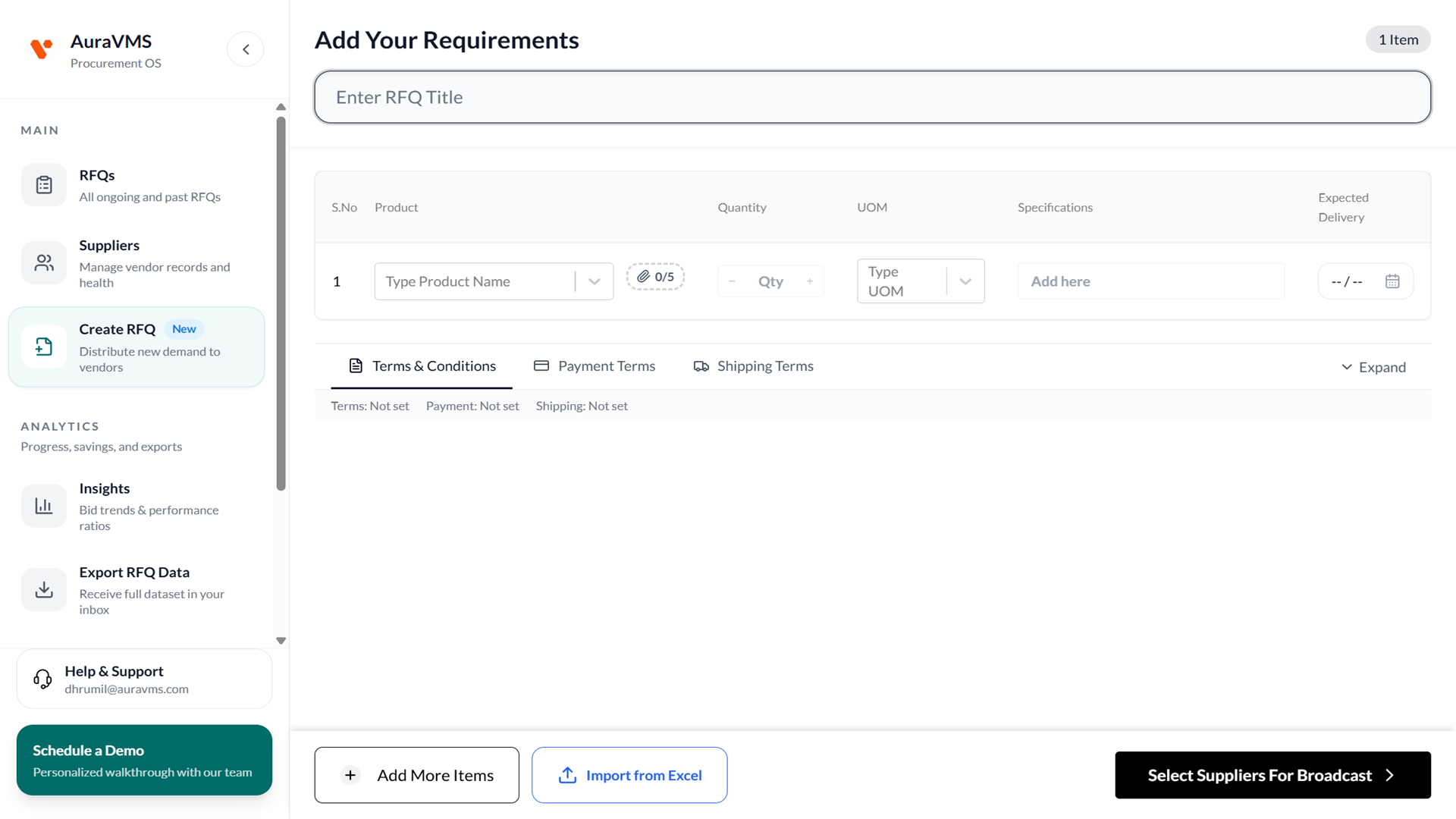
AuraVMS replaces RFQs sent by email and spreadsheet: the buyer sends the request, suppliers quote through a private link without an account, and the buyer ranks the quotes and emails the PO.
Build and invite. The buyer creates an RFQ, optionally by uploading an Excel file, and sends it by email, with WhatsApp on some plans. Suppliers open a private link, so there is no portal account to create, and bids are anonymous to the other suppliers.
Compare. Quotes show side by side with L1, L2 and L3 price ranking. The buyer can edit a price, split the order between suppliers and place it, and each supplier receives an emailed PO.
Limits. RFQs and suppliers per RFQ are unlimited. Reminders, bulk supplier import and attachments come with the Medium Team plan. Approval workflows and custom PO formats are Enterprise customizations only, and there is no native mobile app.
Integrations. A REST API with an OpenAPI spec and an MCP server are available. No ERP connector is documented.
What users report. The review sites list too few reviews to rate it.
Price. Small Team is $4.99 per user per month billed annually for one user, Medium Team is $7.99 per user per month billed annually, and Enterprise is custom. There is a free trial with no credit card.
- you run repeat quote rounds by email or Excel and want them in one place for a few dollars per user
- your suppliers won't create accounts
- you need approval workflows or ERP-synced POs: approvals are an Enterprise customization
- Starting price
- From $4.99 per user per month billed annually (Small Team, 1 user); Medium Team $7.99 per user per month
- Suppliers and RFQs
- Unlimited
- Supplier access
- Private link, no account, anonymous bids
- Ranking
- L1, L2 and L3 price ranking
- Order
- Split the order, supplier receives an emailed PO
- Plans
- Small Team $4.99, Medium $7.99 per user per month; Enterprise custom
- Small Team
- $4.99 per user per month, annual
- Medium Team
- $7.99 per user per month, annual
Tradogram
Procurement and purchase order software with the lowest published entry price in this list, but requisitions and custom approvals are add-ons on that plan.
Tradogram carries RFQs and RFPs inside a purchasing suite, with deadlines, templates, a supplier portal, weighted scoring and automatic conversion of the winning bid into a purchase order.
Build and invite. RFQs and RFPs start from templates and run on a deadline. Suppliers answer through a supplier portal.
Compare and award. Weighted scoring ranks the responses, and the winning bid converts into a PO automatically. Reverse auctions and item-level bidding aren't described on the vendor pages.
Integrations. Connectors include QuickBooks, Xero, NetSuite, Sage, Dynamics 365 Business Central, SAP and Oracle, plus PunchOut catalogs. That is the longest accounting list among the lower-priced tools here.
What users report. G2 showed 4.2 from 36 reviews in October. Reviewers praise easy setup and responsive support, and name fields that can't be adapted and modules sold as a package as weaknesses.
Price. Essentials starts at $99 per month, but sourcing RFx, requisitions and the integrations are priced as add-ons on that plan. Premium and Scale are quote-only.
- you want RFQs, POs and approvals in one low-cost suite with a long accounting connector list
- you need the winning bid to become a PO automatically
- you need auctions: they aren't described on the vendor pages
- you expect RFQs in the $99 plan: sourcing RFx is an add-on there
- Users like
- Easy setup and personal, engaged customer service, and POs that go to suppliers automatically once approval completes.
- Users dislike
- Fields that can't be adapted, modules sold as a package, and one report of approvers being bypassed despite thresholds.
- Source: G2, 36 reviews
- Starting price
- From $99 per month (Essentials); requisitions are an add-on there
- Approval levels
- Up to 10, each with up to 5 alternates
- Extra users on Essentials
- $32 per user
Precoro
Procurement and AP automation for small and mid-sized companies, with published plan prices and per-approver amount thresholds.
Precoro runs quote requests through its sourcing module, which it calls RFP: invite suppliers, compare a matrix that highlights the lowest price per item, award by item and convert to a PO.
Build and invite. A buyer creates the request from scratch or from a purchase requisition and invites several suppliers by email link. Suppliers submit their proposals in Precoro.
Compare and award. A comparison matrix highlights the lowest price for each item, and the buyer awards item by item and converts the award to a PO.
Not documented. The help article doesn't describe deadline behavior, sealed bids or auctions, and the word RFQ doesn't appear in it.
Integrations. The help center shows NetSuite, Xero, QuickBooks, Slack and an API.
What users report. G2 shows 4.7 from 222 reviews as of late October. Reviewer tags praise ease of use, the approval process and support, and name a learning curve and missing features as top negatives.
Price. Core is $499 per month, Automation is $999 per month and Enterprise is custom, all billed annually. The RFP module is listed under Automation, not Core.
- you already buy in Precoro and want quote requests converted to POs without leaving it
- you need to award item by item across suppliers
- you need RFQ on a lower tier: the module is in Automation at $999 a month
- you need sealed bids or auctions: neither is documented
- Users like
- G2 reviewer tags list ease of use, the approval process, simplicity and support as top positives.
- Users dislike
- G2 reviewer tags list 'not intuitive', missing features, invoice problems and a learning curve as top negatives.
- Source: G2, 222 reviews
- Starting price
- From $499 per month, billed annually (Core)
- Next tier
- Automation, from $999 per month billed annually
- Accounting sync
- QuickBooks Online, Xero, NetSuite, Sage Intacct, Business Central
- Real-time budget tracking
- Automation plan ($999/mo) and above, not Core
- Savings dashboard
- Savings and overspend by month and supplier against a baseline price per PO line
- Overbudget step
- Fires only when a transaction exceeds budget and needs the Budget module
- RFP module
- Automation plan and above
Market Dojo
Market Dojo is an eSourcing platform that runs RFx events and eAuctions on monthly, annual or single-event licences, with weighted events and API integration in a higher tier.
Market Dojo splits sourcing in two: Quick Quotes for simple RFQs, and full RFx and eAuction events with weighted scoring, lots and partial bidding.
Build and invite. Quick Quotes covers the plain request for a price. The full sourcing product adds RFx, eAuctions, multi-stage events, lots and partial bidding, with templates and Excel integration.
Compare and award. Weighted events and multi-scoring are in the higher tiers. Scenario optimization isn't described, and award-to-PO conversion isn't described either.
Integrations. Only API and single sign-on are stated. What suppliers see in a Quick Quotes round, how quotes are compared and what happens at the deadline aren't described in Market Dojo's public documentation.
What users report. Market Dojo has only a handful of G2 reviews, so no rating is quoted.
Price. Prices are in pounds sterling. Annual plans start at £500 per month, with £583 and £667 tiers above it, and Quick Quotes is £100 per user per month. Monthly licences cost more per user. The site has a currency switch, but the plan tiers are published in pounds.
- you want to start with simple quotes and add auctions later
- you want a licence you can buy by the month
- you need a price in US dollars: the plans are published in pounds
- you need a documented ERP connector list: only API and single sign-on are stated
- Starting price
- From £500 per month billed annually for simple RFx and eAuctions; £1,000 per month or £1,000 per event on-demand (pounds sterling, no USD price)
- Sourcing events
- Simple RFx and eAuctions with templates and libraries, Excel integration and live messaging
- Award analysis
- Weighted events and collaborative multi-scoring in the £583 per month annual tier; scenario modeling is not described
- Supplier discovery
- The homepage lists supplier discovery and says AI helps discover and qualify suppliers
- Handoff after award
- The homepage lists a Contract Management module; the handoff steps are not described
- Currency
- Pounds sterling
Fairmarkit
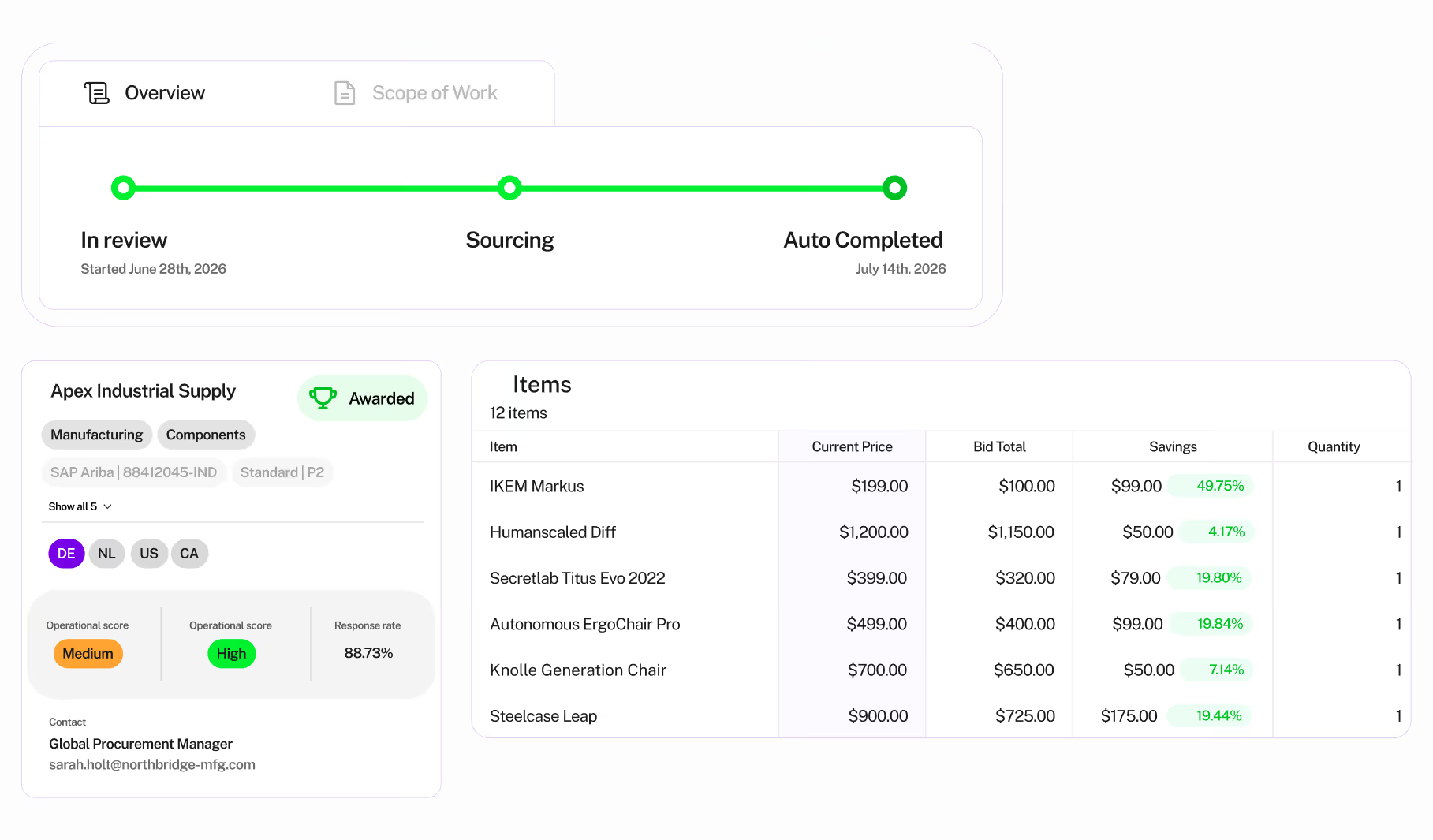
Fairmarkit runs tactical RFQs, strategic RFx and reverse auctions, with AI that bundles similar RFQs, matches suppliers and can auto-award by weighted rules. It is built around high-volume, low-value requests.
Fairmarkit is built for volume: it bundles similar RFQs and sends them to the suppliers it expects to answer.
Build and invite. Tactical RFQs, strategic RFx from templates and multi-row Lots run in one tool. AI ranks vendors by their likelihood to respond and bundles similar requests.
Compare. Multi-row bids show a blended price and total-cost-of-ownership math. Award scenarios weigh cost, supplier mix, ESG and risk, with Excel import and export. Reverse auctions come in Dutch, English and Japanese formats.
Award and handoff. The integrations page says it updates purchase requests in your ERP, which stays the system of record, and no PO conversion is described.
Integrations. SAP S/4HANA, SAP ECC, Ariba, Oracle, Coupa, ServiceNow and Zip. Implementation takes about 40 days.
What users report. Review sites list a small number of reviews, so no pattern is quoted.
Price. Not published, demo request only.
- you run many low-value requests and want bundling and supplier matching
- you need reverse auctions and multi-line Lots in one tool
- you want a figure without a sales meeting: Fairmarkit sells only after a demo request
- you need RFQ-to-PO conversion inside the tool: the ERP stays the system of record
- Starting price
- Not published, demo request only
- Sourcing events
- Tactical and tail-spend RFQs, strategic RFx from templates, multi-line Lots and Dutch, English and Japanese reverse auctions
- Award analysis
- Blended price and TCO calculations, shared reviews and approvals with an audit trail; auto-award to the response closest to weighted rules, enabled with a Customer Success Manager
- Supplier discovery
- AI ranks vendors by likelihood to respond, bundles similar RFQs and sends them to matched suppliers on a schedule
- Handoff after award
- Not described on the published vendor pages
Coupa
Enterprise source-to-pay suite whose requisitions run through guided buying, punchout and prioritized approval chains with budget meters.
Coupa's sourcing module runs RFIs, RFQs and RFPs from templates plus reverse auctions, and a winning bid feeds contracts and catalog items inside the same suite.
Build and invite. Events start from pre-built templates, and past events can be duplicated with questions, pricing structures and supplier lists. For routine events, Autonomous Sourcing selects a pre-approved template, invites qualified suppliers, gathers pricing and presents an evaluated award for buyer review.
Compare and award. Auctions come in English, Dutch and Japanese formats, and an RFx event can combine with an auction in the pre-bidding phase. Sourcing optimization analyzes award scenarios across volumes, service levels and supplier capacity. A complete audit trail covers supplier communications, bids, evaluations and approvals.
Handoff. Winning bids generate contracts and catalog items, and invoices are validated against contracted terms. A direct RFQ-to-PO step isn't stated on the page.
Integrations. Reviewers name NetSuite, Oracle Fusion and SAP Business One, and one reviewer describes heavy integration work with SAP.
What users report. G2 shows 4.2 from 570 reviews and TrustRadius 6.9 out of 10 from 171 ratings, both for the whole suite, not sourcing alone. TrustRadius reviewers praise ease of use and configurability, and one calls it less suitable for complex direct-material sourcing.
Price. No public price for sourcing. G2 reviewers put implementation at about 6 months.
- your purchasing already runs in Coupa and awards should feed contracts and catalogs
- you need auctions and award optimization in the same suite
- you want a published price or a standalone RFQ tool for a small team
- you source direct materials or run SAP and can't absorb heavy integration work
- Users like
- Approval routing and spend compliance for indirect buying, with clear purchase limits per person.
- Users dislike
- Heavy integration work with ERPs such as SAP, and a supplier portal that confuses vendors asked to create profiles.
- Source: TrustRadius, 171 ratings
- Starting price
- Custom buyer quote; no public US rate card verified
- Standard supplier portal
- Free for suppliers; Coupa Advanced is a paid supplier tier (SSO, API, QuickBooks and NetSuite sync)
- Buyer-side platform
- No verified public universal USD rate
- Requisition API
- Create and submit for approval
- Process Automator
- Document events and API call outs
- Supplier join
- Buyer invitation (link expires after 30 days), self-registration or a PO email
- Budget meters
- Show remaining budget per budget item before commitment
- Hard stop
- A budget-line setting blocks requisition submission over budget
- Dashboards
- Out-of-the-box dashboards, KPI benchmarking and savings insights
- Sourcing events
- RFP, RFI, RFQ and reverse auctions are listed in the FAQ (answer text not visible); routine events run from preapproved templates
- Award analysis
- Coupa Sourcing Optimization sets per-supplier caps, geography, tariffs and freight as constraints and compares scenarios side by side, with manual overrides
- Supplier discovery
- Pre-rated, pre-enabled suppliers filterable by diversity, rating or geography; AI suggests suppliers from category performance
- Spend analysis
- Cross-platform spend visibility, automatic classification and suggested opportunities such as expiring contracts
- Handoff after award
- Winning terms and rate cards pass into draft contracts in Coupa CLM and into catalogs on approval
- Spend classification
- AI engine maps transactions to a proprietary Coupa taxonomy of roughly 60 primary categories and 1,800 sub-categories, built for category management. It classifies by supplier first, using invoice and PO descriptions. Source post dates from 2022.
- Category strategy
- Coupa Category Strategy starts from a category taxonomy built on Coupa data, uses AI-guided stakeholder interviews and the Navi assistant for recommendations, and rolls every strategy into one portfolio view using a single methodology.
- Savings tracking
- Coupa describes tracking value through stages identified, negotiated, contracted and realized, to link negotiated savings to P&L impact. Initiative value can include non-cost benefits such as supplier relationships and resilience.
- Category supplier view
- Category Strategy page says it pairs with Coupa Supplier Information & Risk Management to segment suppliers, track performance and manage risk. Sourcing suggests suppliers from category performance. Segmentation criteria are not detailed publicly.
- Supplier risk module (checked 2026-11-06)
- Coupa Supplier Risk & Performance: monitoring of outside data sources, alerts, next-step recommendations and a supplier hold that can block transactions from purchasing to invoicing
- Risk datasheet (2021)
- Standard (onboarding, monitoring, scorecards) and Advanced (multi-domain assessments, inherent and residual scoring, multi-tier, mitigation plans); fees may apply for the Coupa risk data service
- Risk Assess
- Questionnaires across domains such as InfoSec, ABAC and GDPR, with alerts when risk increases
- Supplier risk price
- Not published, demo request only
SAP Ariba
SAP's source-to-pay suite covering sourcing events with scoring and award simulation, buying and invoicing, contracts and supplier collaboration through SAP Business Network.
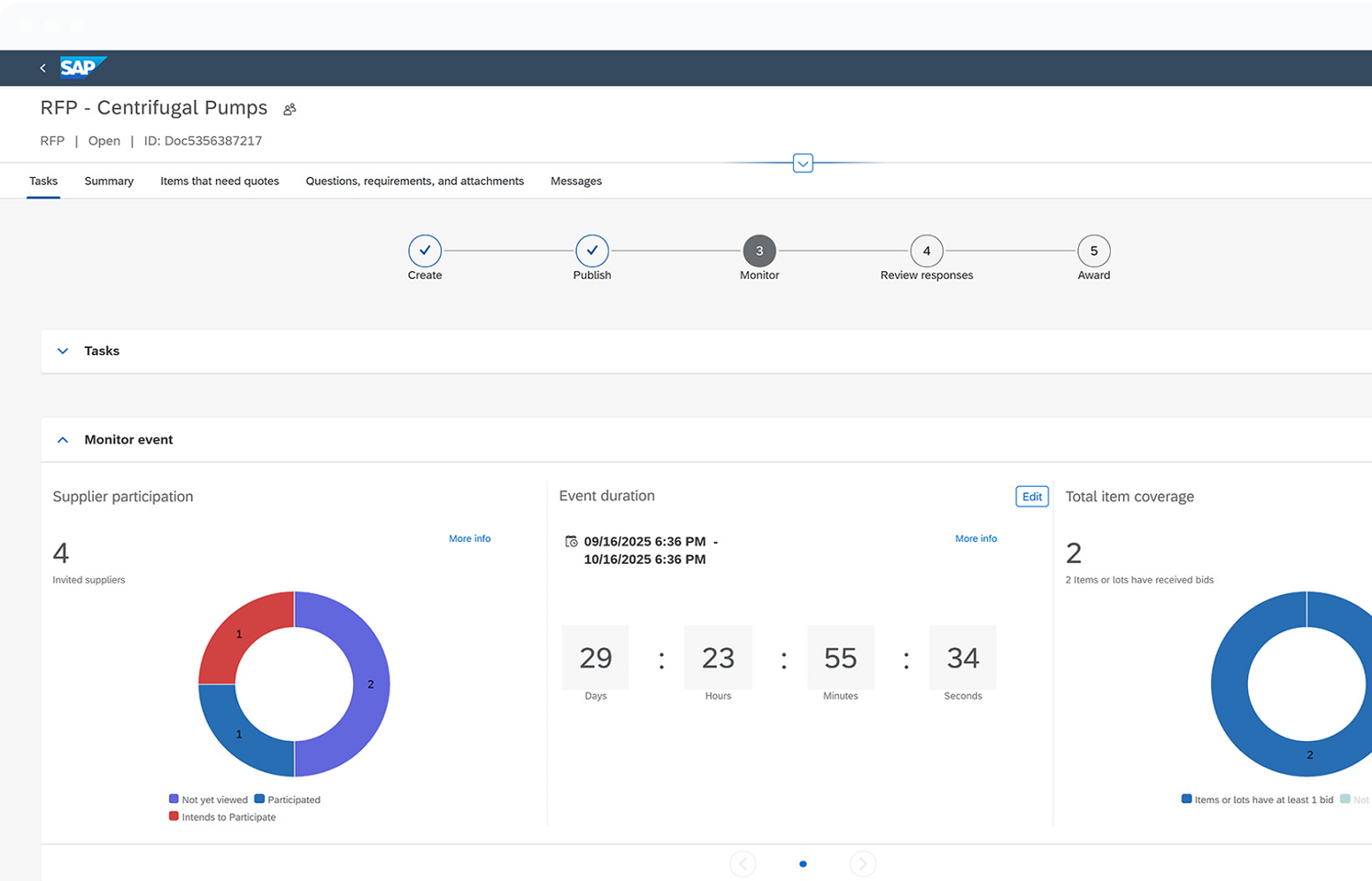
SAP Ariba Sourcing starts from a sourcing request form, builds the event with AI help and can send accepted pricing from a Simple RFx to the SAP ERP, which suits companies that already run SAP master data.
Build and invite. Requests from integrated systems turn into sourcing projects and flow into the RFx document. SAP Business Network Discovery adds suppliers without leaving the event screen, and automated bid reminders and approvals keep the round moving.
Compare and award. Buyers filter and compare bids, trigger single or split awards and set up award scenarios in natural language. The Simple RFx option for materials ends in price acceptance sent to the SAP ERP, not a full award, and doesn't support scheduling, multi-currency or scoring.
Integrations. G2 lists SAP ECC and S/4HANA among others. TrustRadius reviewers call the SAP and third-party integration complex and the interface outdated.
What users report. G2 shows 4.1 from 810 reviews and TrustRadius 7.6 out of 10 from 770 ratings, both for the whole suite, not sourcing alone.
Price. Sourcing is sold per user per year on one to five year terms, price on request. Direct-materials and public-sector e-tendering add-ons cost extra. G2 reviewers put implementation at about 6 months.
- your ERP is SAP and accepted pricing should flow back to it
- you need single or split awards with scenario setup
- you run a non-SAP ERP and want easy integration
- you need a quick rollout: G2 reviewers put implementation at about 6 months
- Users like
- Punch-out catalogs and guided buying with approval workflows that standardize how people buy.
- Users dislike
- An outdated interface, weak reporting and hard integration with non-SAP ERPs.
- Source: TrustRadius, 770 ratings
- Starting price
- Price upon request, no public buyer rate
- Buying and Invoicing pricing
- Price upon request, priced on processed spend
- Standard supplier account
- Free on SAP Business Network, unlimited documents
- Enterprise supplier account
- Fixed subscription level fee plus transacted volume
- Supplier order flow
- PO confirmation, ship notices, PO flip invoices, invoice and payment status
- Sourcing events
- RFI, RFP, multi-round bidding and English, Dutch, Japanese, total-cost, traffic-light, basket and lot auctions (SAP slides dated May 2022)
- Award analysis
- Scoring and grading, bid comparison report, award scenario comparison and one-click awarding; AI bid summaries and award simulation on the product page
- Supplier discovery
- Search by industry, item or service in SAP Business Network Discovery; profiles show certifications and ESG data
- Handoff after award
- Follow-on documents such as POs, purchase info records and scheduling agreements in an external system; links to SAP Ariba Contracts
- Spend classification
- The newer Spend Analysis and Insights offer maps spend to UNSPSC (incl. v25) or a custom taxonomy, with a stated 95% accuracy, and ingests SAP Cloud ERP, Ariba, Fieldglass, Concur plus non-SAP data.
- Category strategy
- Guided strategy process with category profiles, hierarchy management, Kraljic, PESTLE, SWOT and Porter's Five Forces frameworks, AI-curated market intelligence (third-party content from Beroe), generative AI drafts, and approval workflow.
- Savings tracking
- Managers pick value levers, goals and KPIs per category, document initiatives with owners, timelines and estimated outcomes, and follow them in a monitoring workbench, dashboard and calendar view. Savings accounting rules are not detailed publicly.
- Category supplier view
- Category segmentation and cost structure analysis are listed features, and the Kraljic matrix segments categories or suppliers by supply risk and profit impact. Supplier performance scorecards belong to separate Ariba supplier management modules.
JAGGAER
JAGGAER is a source-to-pay suite whose supplier management module gives suppliers a portal with guided self-service onboarding, compliance checks and configurable workflows, plus automated verification of uploaded documents.
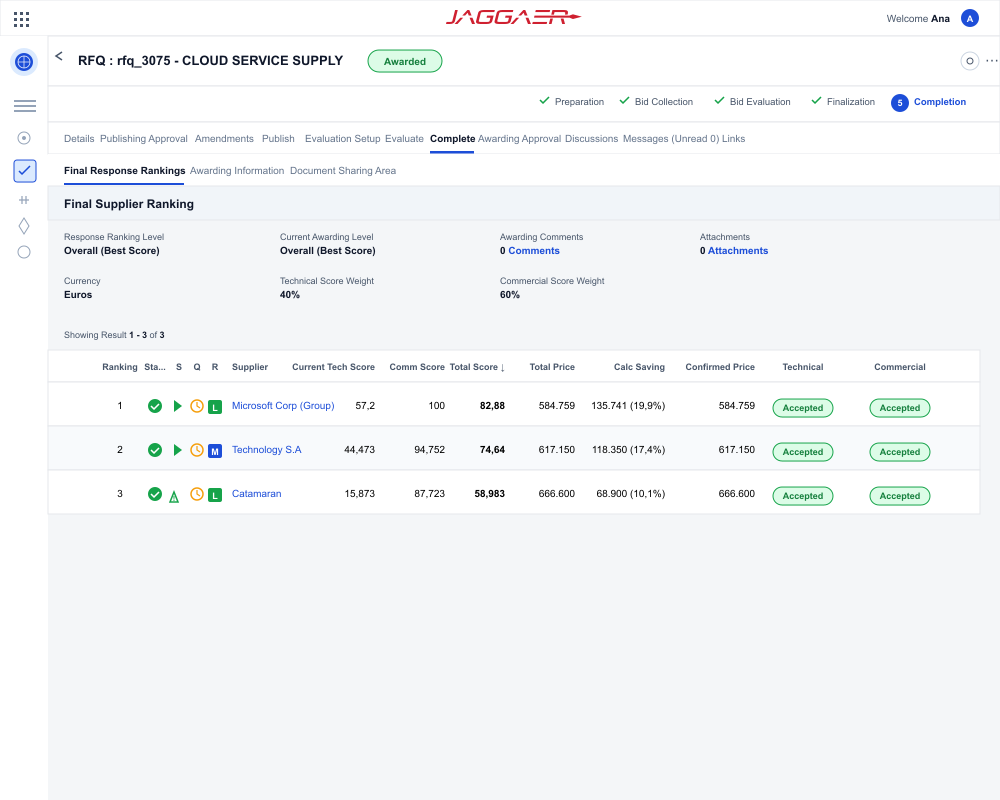
JAGGAER covers the widest RFQ range in this list, from a single-line quote request to a 10,000-line bill-of-materials auction with multi-round optimization.
Build and invite. RFI, RFP and RFQ events start from reusable templates with stage-gated approvals. Smart Quote turns a natural-language description into a structured RFQ with suggested questions and supplier recommendations.
Compare and award. Bids can carry separate commercial and technical envelopes, and weighted scorecards rate price, quality, lead time, ESG and risk. Auction formats include reverse, forward, Dutch, Japanese and ranked. Award optimization supports line-level split allocation, and a three-bid-and-buy view serves decentralized buyers.
Integrations. The vendor lists more than 40 pre-built integrations, including SAP, Oracle, Workday, NetSuite and Infor. How awards become POs isn't described on the sourcing page.
What users report. G2 shows 4.1 from 86 reviews for the suite. Reviewers praise flexibility and support and name an inconsistent interface, setup complexity and supplier-side feature limits as weaknesses. Many top reviews were invited by the vendor.
Price. Custom quote, no pricing page. G2 reviewers put implementation at about 9 months.
- you source manufactured goods with long bills of materials or run large auctions
- you need line-level split awards with optimization
- you want a published price or a tool live in weeks: G2 reviewers put implementation at about 9 months
- your suppliers are many small vendors who need a frictionless experience
- Users like
- Flexibility and configurability, strong support and consulting teams.
- Users dislike
- An inconsistent interface across modules, setup complexity and supplier-side feature limits.
- Source: G2, 86 reviews
- Starting price
- Not published, custom quote
- Supplier portal
- Guided self-service with built-in compliance checks
- Documents
- Automated document validation (JAI)
- Integration
- Integrates with existing business systems, no ERPs named on the page
- Sourcing events
- RFI, RFP and RFQ from templates; reverse, forward, Dutch, Japanese and ranked auctions
- Award analysis
- Weighted scorecards, BAFO rounds and constraint-based optimization with unlimited what-if scenarios and line-level split awards
- Supplier discovery
- AI supplier recommendations, risk flags and Smart Quote suggested suppliers
- Handoff after award
- Sourcing feeds Contracts and Procure-to-Pay on one data layer; the steps are not detailed
- Integrations
- 40+ pre-built, including SAP, Oracle, Workday, NetSuite, Infor and JD Edwards
- Spend classification
- Automatic Spend Classification uses NLP on invoice text or product numbers to predict eCl@ss codes, and the same method can predict UNSPSC. It runs on demand or in batch. No accuracy figures published. Press release dates from 2019.
- Category strategy
- Category management page lists built-in Kraljic, SWOT and Porter frameworks, a stage-gated process with standard approvals and templates, and market intelligence such as commodity, FX and price indices plus 800+ category reports.
- Savings tracking
- A savings pipeline covers idea capture, validation and tracking from identified through realized. Mapping of savings to category targets or baselines is not detailed on the page.
- Category supplier view
- Page mentions a unified view of spend, supplier performance and market data, with category risk scored across supplier, financial, ESG and geopolitical factors. Supplier segmentation per category is not explicitly described.
RFQ software for responding to quotes
Some pages that rank for this term cover the other side: software a seller uses to answer incoming RFQs. Responsive and Loopio are in that group, and they're built to import a questionnaire, draft answers from a content library and route reviews. They don't send requests to suppliers or compare quotes, which is why they aren't ranked here, although they do answer the RFQs that other buyers send. If you answer bids rather than send them, start with our guide to RFP software, which covers both sides.
After the award: contract dates
An award ends the RFQ, but the supplier relationship it starts has dates of its own, and they're easy to miss. A quote that wins at a lower price often comes with a term, an auto-renewal and a notice period, and those sit in the contract, not in the RFQ tool. Our guides to contract renewal notice periods and contract negotiation software cover the dates to capture, and purchase order software covers the order that follows the award.
None of the RFQ tools above tracks the renewal decision for the contract the award creates, and that's the gap The Procurement Manager is built for.
Frequently asked questions
What is RFQ software?
RFQ software sends a request for quotation to several suppliers, collects their prices in one place and lines them up for comparison and award. The better tools also approve the choice and turn the winning quote into a purchase order.
What is the difference between an RFQ, an RFP and a PO?
An RFQ asks suppliers for a price on a defined item, quantity and date. An RFP describes a problem and asks for a proposal, so quality matters as well as price. A PO is the order you place after choosing a quote. Our guide to RFP software covers the proposal side.
How much does RFQ software cost?
RFQ software costs from $4.99 per user per month on AuraVMS to $500 per month for Team Procure's RFQ plan and $999 per month for Precoro's Automation plan, which includes its RFP module. Market Dojo starts at £500 per month in pounds sterling. ProcureKey, Fairmarkit, Coupa, SAP Ariba and JAGGAER sell by quote.
Is there free RFQ software?
None of the ten tools offers a free plan for live RFQs, and Market Dojo's free sandpit uses test suppliers only. Several offer trials: AuraVMS a free trial without a credit card, Team Procure 14 days and ProcureKey 7 days. A shared spreadsheet or email thread is the free option, and it breaks down once several suppliers quote several lines.
What is the best software for quoting?
The best software for quoting depends on which side you sit on. Buyers who request quotes from suppliers use the RFQ tools in this list. Sellers who prepare quotes for customers use quoting or CPQ software, and sellers who answer RFQs use RFP response software, which is a different category.
Can my purchasing software run RFQs?
Purchasing software can run RFQs, but check the plan. Tradogram and Precoro run quote requests inside their purchasing suites, in an add-on and a higher tier. Procurify has no native RFQ module, and its help center describes a workaround rather than supplier invitations and bid comparison.