The best supplier relationship management software depends on which part of the relationship you're trying to run. If you want formal quarterly reviews inside an SAP stack, SAP Ariba Supplier Lifecycle and Performance documents the most complete review loop. If you want segmentation, scorecards, corrective actions and a supplier portal in one source-to-pay platform, Ivalua documents the most of them. If you want an SRM tool that isn't a suite, Kodiak Hub is built for scorecards and risk on top of your ERP, and Vizibl is built for joint projects and business reviews with a few strategic suppliers.
Supplier relationship management (SRM) software is the tool a buying team uses after a supplier is approved: it sorts suppliers into tiers, scores their performance, runs reviews, tracks improvement actions and gives both sides a shared place to work. We compared eight tools on those jobs using each vendor's own pages, and we mark every capability a vendor doesn't describe.
- tools compared
- 8
- SRM jobs checked per tool
- 5
- publish a price
- 0
- Pick by the job. SAP Ariba, Ivalua and GEP SMART document the most complete review loops inside a suite. Kodiak Hub and Gatekeeper are the lighter, SRM-first options. Vizibl is a collaboration workspace, not a scorecard tool.
- Not one of the eight publishes a price. All are a quote, a demo request or a contact form, so the first question for every vendor is what your supplier count costs.
- The weak spot across the pages we read is segmentation and what happens after a bad score. Only a few vendors describe tiering rules or the follow-up action in any detail, so test both in every demo.
Our picks by SRM job
Supplier relationship management software covers several different jobs, and the tools are not equally strong at each. These picks follow the job, not a score.
 Best for formal periodic reviewsSAP AribaA master scorecard copied into quarterly or yearly scorecards, stakeholder surveys and supplier corrective action tasks.
 Best for tiering plus corrective actionsIvaluaSegmentation, scorecards, improvement plans with owners and re-evaluation dates, and sub-tier risk in one platform.
 Best for threshold-triggered follow-upGEP SMARTCorrective actions that trigger automatically when a threshold is breached, tracked to closure with an audit trail.
 Best SRM-first tool next to an ERPKodiak HubCustom KPI scorecards, dynamic segmentation and risk ratings without buying a whole suite.
 Best for survey scorecards with contractsGatekeeperStakeholder survey scorecards, a vendor portal and risk feeds in the same record as the contract.
 Best for joint plans with strategic suppliersViziblDigital QBRs, shared goals and 360 degree relationship surveys in a workspace both sides use.
 For the contract after the reviewThe Procurement ManagerRoutes each renewal decision to the business owner, Finance and IT before the notice deadline.
What supplier relationship management software does
Supplier relationship management software gives you one place to segment suppliers, measure how they perform, review the results with them and act on what you find. It's a different job from collecting supplier documents and bank details at onboarding, which our supplier management software comparison covers. SRM starts once the supplier record exists and asks whether the relationship is worth what you pay for it.
The work breaks into five jobs. We use them as the yardstick for every tool below.
- Job 1Segment
- Ivalua
- SAP Ariba
What breaks every supplier gets the same review effort - Job 2Score
- Kodiak Hub
- Gatekeeper
What breaks scores come from opinions nobody can trace - Job 3Improve
- GEP SMART
- SAP Ariba
What breaks a low score has no owner or date - Job 4Collaborate
- Vizibl
- Ivalua
What breaks suppliers never see their own results - Job 5Watch risk
 Coupa
- Kodiak Hub
What breaks risk lives in a different system than performance
Supplier relationship management vs supplier management
The terms overlap, and vendors use them loosely, so it helps to pin them down. In this article, supplier management means the record: who the supplier is, whether it's approved and whether its data is correct. Supplier relationship management means the ongoing work: tiering, performance, reviews and joint plans. A tool can be strong at one and thin at the other, which is why the same vendors show up in both comparisons with different strengths.
Supplier relationship management software compared
All eight tools are quote-based. The table shows what each one is and the handoff it owns. The matrix below it shows which of the five jobs each vendor describes on the pages we read.
| Tool | Type | What it owns | Starting price | G2 rating |
|---|---|---|---|---|
| SAP Ariba | Enterprise source-to-pay and sourcing | Supplier review projects with master scorecards | Price upon request, no public buyer rate | 7.6/10 (TrustRadius, 757) |
| Coupa | Enterprise spend management and procurement | Supplier health rating and risk holds | Custom buyer quote; no public US rate card verified | 7.2/10 (TrustRadius, 168) |
 JAGGAER | Source-to-pay suite with supplier management | Scorecards and automatic corrective plans | Not published, custom quote | No reviews yet |
| Ivalua | Source-to-pay suite with supplier information management | Tiering, scorecards, plans and sub-tier risk | Not published, quote only (a third party reports a buyer-reported floor near $150,000 per year, unverified) | No reviews yet |
| GEP SMART | Source-to-pay suite with sourcing module | Scorecards and threshold-triggered actions | Not published | No reviews yet |
| Kodiak Hub | Supplier relationship management (SRM) | KPI scorecards, segmentation and risk ratings | Not published, quote only (modular SaaS licence) | 4.8 (Capterra, 14) |
| Vizibl | Supplier collaboration workspace | Joint plans and digital business reviews | Not published (the pricing page returned a 404) | No reviews yet |
| Gatekeeper | Vendor and contract management | Survey scorecards beside contracts and risk | Not published, quote only, plans sized by number of third parties (Pro up to 250, Enterprise up to 750, Enterprise Plus 750+) | 4.5 (91) |
| The Procurement Manager Our product | Contract renewal decisions | Routes renewal reviews to the business owner, Finance and IT before the notice deadline | From $49 per month, flat, no per-seat fees (Starter, up to 50 contracts) | No reviews yet |
Prices checked on vendor pages on October 29, 2026. Ratings are shown only where we read the review page.
Which SRM jobs each tool describes
"Yes" means the vendor's page describes the capability in concrete terms. "Partly" means it is mentioned without the detail you'd need to judge it. "Not described" means we found nothing on the pages we read, which isn't proof the tool can't do it.
| Tool | Segment | Score | Improve | Collaborate | Watch risk |
|---|---|---|---|---|---|
| SAP Ariba | Partly | Yes | Yes | Partly | Partly |
| Coupa | Partly | Partly | Partly | Partly | Yes |
| JAGGAER | Not described | Partly | Partly | Partly | Partly |
| Ivalua | Yes | Partly | Partly | Yes | Yes |
| GEP SMART | Partly | Partly | Yes | Partly | Yes |
| Kodiak Hub | Partly | Yes | Partly | Partly | Yes |
| Vizibl | Not described | Partly | Yes | Yes | Partly |
| Gatekeeper | Partly | Yes | Partly | Partly | Yes |
How we compared the tools
For each tool we read the vendor's pricing statement, a product page on supplier performance or SRM, a documentation, datasheet or demo page that shows how a review is built, and a review source where it loaded. G2, Capterra and TrustRadius blocked many direct requests, so some tools have no rating here instead of a guessed one. Entries follow the same four steps: how the tool segments suppliers, how it scores them, what happens after a poor score and how suppliers take part. Capabilities a vendor doesn't describe are named as such. Order within each group follows the five jobs, not any sponsorship.
Suites with an SRM module
These five tools put SRM inside a broader source-to-pay or procurement platform. That's the right shape if the same vendor already runs your sourcing, buying or contracts and you want supplier scores to travel with the supplier record. It's the wrong shape if SRM is the only thing you need, because you'd adopt a suite just to get one module.
SAP Ariba
SAP's source-to-pay suite covering sourcing events with scoring and award simulation, buying and invoicing, contracts and supplier collaboration through SAP Business Network.
SAP Ariba Supplier Lifecycle and Performance runs supplier reviews as formal projects with a master scorecard, weighted KPIs, stakeholder surveys and supplier tasks, and it's the entry with the clearest description of a periodic review cycle.
Segment. Suppliers are grouped in a region by commodity matrix and carry a preferred, authorized or restricted status into sourcing and buying. The page doesn't say what triggers a status change, so we mark segmentation as partly described.
Score. One master scorecard per supplier is copied into periodic scorecards, quarterly or yearly. Core KPIs such as Account Management, Pricing and Quality apply to every supplier, and others such as On Time Delivery apply by category. Scoring is weighted, and survey answers feed the KPIs.
Improve. Internal stakeholders answer surveys, and the system alerts users when scorecard data leaves set thresholds. When KPIs are missed, tasks prompt the supplier to create a corrective action plan. Reports can be shared with the supplier. The threshold values aren't shown.
Collaborate. Suppliers maintain their own data through self-service and take part in reviews through tasks. A "voice of the supplier" criterion lets suppliers rate the buyer. SAP lists joint collaboration as a benefit but gives no detail on joint projects.
Fit with the stack. Bi-directional sync with the ERP keeps vendor data current, and the module feeds the rest of SAP Ariba so employees are guided to preferred suppliers. It's aimed at enterprises, especially SAP shops.
- you run SAP ERP or other Ariba modules, so preferred-supplier status and ERP sync flow into buying
- you want formal periodic review projects with weighted KPIs, surveys and supplier corrective action tasks
- you need a published price or a quick start: SAP lists none, and a Gartner reviewer cites technical, costly initial configuration
- you want documented joint supplier development or external risk feeds: the pages mention both only in general terms
- Users like
- Punch-out catalogs and guided buying with approval workflows that standardize how people buy.
- Users dislike
- An outdated interface, weak reporting and hard integration with non-SAP ERPs.
- Source: TrustRadius, 757 ratings
Price and what reviewers say
SAP Ariba doesn't publish a price for this module. On TrustRadius reviewers rate SAP Ariba 7.6 out of 10 from 757 ratings for the whole product, and they like guided buying but dislike an outdated interface, weak reporting and hard integration with non-SAP ERPs (read October 22, 2026). The module's own Gartner Peer Insights page shows 4.0 from two ratings, one citing technical and costly initial configuration, which is too small a sample to lean on.
- Starting price
- Price upon request, no public buyer rate
- Buying and Invoicing pricing
- Price upon request, priced on processed spend
- Standard supplier account
- Free on SAP Business Network, unlimited documents
- Enterprise supplier account
- Fixed subscription level fee plus transacted volume
- Supplier order flow
- PO confirmation, ship notices, PO flip invoices, invoice and payment status
- Sourcing events
- RFI, RFP, multi-round bidding and English, Dutch, Japanese, total-cost, traffic-light, basket and lot auctions (SAP slides dated May 2022)
- Award analysis
- Scoring and grading, bid comparison report, award scenario comparison and one-click awarding; AI bid summaries and award simulation on the product page
- Supplier discovery
- Search by industry, item or service in SAP Business Network Discovery; profiles show certifications and ESG data
- Handoff after award
- Follow-on documents such as POs, purchase info records and scheduling agreements in an external system; links to SAP Ariba Contracts
- Review cadence
- Quarterly or yearly scorecards
- After a missed KPI
- Supplier corrective action task
- ERP link
- Bi-directional sync
Coupa
Enterprise source-to-pay suite whose requisitions run through guided buying, punchout and prioritized approval chains with budget meters.
Coupa Supplier Management combines onboarding, continuous risk monitoring and performance scorecards inside the same platform as purchasing and invoicing, and its strongest documented feature is what a risk finding can do to a transaction.
Segment. The datasheet covers ongoing management of suppliers and other partners, diversity tracking and preferred-supplier flags in purchasing. No tiering or segmentation model is described.
Score. Scorecards combine risk and performance into an overall supplier health rating. Performance data comes from business users in the context of transactions, and KPIs are captured automatically and compared with benchmarks. The KPI list isn't shown.
Improve. The datasheet shows scorecards, recommended risk responses and risk mitigation plans in the Advanced tier. We found no improvement-plan fields, cadence or supplier-facing corrective action workflow in the first-party sources.
Collaborate. Suppliers update their own data, and the platform asks for overdue information at invoice submission. No joint development or business review feature is described.
Watch risk. Continuous monitoring uses Coupa-provided feeds on financial and judicial risk plus a customer's own feeds. The Advanced tier covers third and fourth parties, and risk teams can put a supplier on hold across purchasing and invoicing.
The first-party material we could read is a datasheet dated 2021, so confirm the current tiers in a demo.
- you already run Coupa for purchasing, so a risk finding or health score can stop a transaction
- risk is your main concern: continuous feeds and multi-tier residual risk scoring are described for the Advanced tier
- you need a documented improvement-plan workflow: the sources we read show scorecards and risk plans but no corrective action process
- you need open pricing: none is published and the datasheet mentions extra fees for risk data
- Users like
- Approval routing and spend compliance for indirect buying, with clear purchase limits per person.
- Users dislike
- Heavy integration work with ERPs such as SAP, and a supplier portal that confuses vendors asked to create profiles.
- Source: TrustRadius, 168 ratings
Price and what reviewers say
Coupa doesn't publish a price for Supplier Management. On Gartner Peer Insights the Coupa listing in the supplier risk management market shows 4.2 out of 5 from 27 ratings, with praise for risk monitoring and compliance visibility and complaints about custom reporting flexibility (review titles only, read October 29, 2026). On TrustRadius the whole Coupa platform is rated 7.2 out of 10 from 168 ratings, with heavy ERP integration work and a confusing supplier portal as complaints (read October 20, 2026).
- Starting price
- Custom buyer quote; no public US rate card verified
- Standard supplier portal
- Free for suppliers; Coupa Advanced is a paid supplier tier (SSO, API, QuickBooks and NetSuite sync)
- Buyer-side platform
- No verified public universal USD rate
- Requisition API
- Create and submit for approval
- Process Automator
- Document events and API call outs
- Supplier join
- Buyer invitation (link expires after 30 days), self-registration or a PO email
- Budget meters
- Show remaining budget per budget item before commitment
- Hard stop
- A budget-line setting blocks requisition submission over budget
- Dashboards
- Out-of-the-box dashboards, KPI benchmarking and savings insights
- Sourcing events
- RFP, RFI, RFQ and reverse auctions are listed in the FAQ (answer text not visible); routine events run from preapproved templates
- Award analysis
- Coupa Sourcing Optimization sets per-supplier caps, geography, tariffs and freight as constraints and compares scenarios side by side, with manual overrides
- Supplier discovery
- Pre-rated, pre-enabled suppliers filterable by diversity, rating or geography; AI suggests suppliers from category performance
- Spend analysis
- Cross-platform spend visibility, automatic classification and suggested opportunities such as expiring contracts
- Handoff after award
- Winning terms and rate cards pass into draft contracts in Coupa CLM and into catalogs on approval
- Overall score
- Supplier health rating (risk plus performance)
- Tiers
- Standard and Advanced
- Action on risk
- Supplier hold across purchasing to invoicing
JAGGAER
JAGGAER is a source-to-pay suite whose supplier management module gives suppliers a portal with guided self-service onboarding, compliance checks and configurable workflows, plus automated verification of uploaded documents.
JAGGAER ONE offers supplier scorecards, automatic development and corrective action plans and a supplier portal inside its source-to-pay suite, with the best-documented ERP connector list of the suites here.
Segment. The supplier management and performance pages describe no segmentation or tiering feature.
Score. Customizable data-driven scorecards and dashboards track metrics such as delivery times and product quality, and a 360 Supplier Snapshot shows performance, risk and compliance together. Who fills the scorecards and how often isn't stated.
Improve. Development and corrective action plans are activated automatically when supplier performance drops, and AI-powered development plans are listed as a capability. No fields, owners or review cadence are described.
Collaborate. A supplier portal offers guided self-service, built-in compliance checks and configurable workflows, though the page frames it mainly around onboarding and lifecycle management.
Fit with the stack. Pre-built connectors are listed for SAP, Oracle, Workday, Infor, NetSuite, Banner and PeopleSoft, plus REST API, EDI, cXML and punchout. Customer examples are large enterprises.
- you already run or plan JAGGAER ONE for sourcing, because scorecards, plans and the portal sit in the same suite
- you need ERP connectors that are named: SAP, Oracle, Workday and NetSuite are on the page
- you need documented supplier segmentation: the product pages don't describe it
- you need setup detail before a demo: scorecard fields and plan owners aren't public
Price and what reviewers say
JAGGAER doesn't publish a price. G2, Gartner and TrustRadius pages returned errors when we tried to read them, so we don't show a rating for JAGGAER rather than repeat a search snippet.
- Starting price
- Not published, custom quote
- Supplier portal
- Guided self-service with built-in compliance checks
- Documents
- Automated document validation (JAI)
- Integration
- Integrates with existing business systems, no ERPs named on the page
- Sourcing events
- RFI, RFP and RFQ from templates; reverse, forward, Dutch, Japanese and ranked auctions
- Award analysis
- Weighted scorecards, BAFO rounds and constraint-based optimization with unlimited what-if scenarios and line-level split awards
- Supplier discovery
- AI supplier recommendations, risk flags and Smart Quote suggested suppliers
- Handoff after award
- Sourcing feeds Contracts and Procure-to-Pay on one data layer; the steps are not detailed
- Integrations
- 40+ pre-built, including SAP, Oracle, Workday, NetSuite, Infor and JD Edwards
- After a score drop
- Automatic development and corrective action plans
- ERP connectors
- SAP, Oracle, Workday, Infor, NetSuite
- Segmentation
- Not described
Ivalua
Ivalua is a source-to-pay suite whose supplier management module runs a branded supplier portal for onboarding and compliance and adds a supplier information management offering that cleanses supplier records and updates ERP records in bulk.
Ivalua describes the most complete set of SRM jobs in one platform: segmentation with tiers, scorecards, improvement plans with owners and dates, a branded supplier portal and risk monitoring down to sub-tier level.
Segment. Suppliers can be segmented, reviewed and approved with AI-backed insights, and supplier hierarchies are supported. An Ivalua blog post describes tiering by spend, impact and risk into strategic, critical and transactional suppliers.
Score. AI-enabled scorecards and KPIs are listed. The same blog gives example KPIs such as on-time delivery, defect rate, invoice accuracy, contract compliance and total cost of ownership, weighted and normalized to a 1 to 5 or 0 to 100 scale. Who enters the data isn't stated.
Improve. Corrective actions and AI-powered improvement plans are linked to outcomes with owners, milestones and re-evaluation dates. Below-threshold KPIs can trigger plans or contract reviews, and the blog suggests monthly or quarterly reviews for strategic suppliers.
Collaborate. A branded supplier portal handles onboarding, compliance and document sharing, and buyers and suppliers can co-create action plans and track progress.
Watch risk. Risk is monitored at supplier, sub-tier and contract level with alerts, business rules and external risk intelligence. Multi-ERP integration is offered, with no specific ERPs named.
- you want tiering, scorecards, improvement plans and sub-tier risk described in one platform
- you run several ERPs and want one supplier data view
- you need a price or a self-serve trial: pricing is contact-sales only
- you need field-level scorecard setup before buying: public pages don't show roles or fields
Price and what reviewers say
Ivalua doesn't publish a price, and a third party reports a buyer-reported floor near $150,000 per year, which we couldn't verify. G2, Gartner and TrustRadius pages returned errors when we tried to read them, so we show no rating.
- Starting price
- Not published, quote only (a third party reports a buyer-reported floor near $150,000 per year, unverified)
- Supplier portal
- Branded portal for onboarding, compliance and document sharing
- Record cleanup
- On-demand cleansing with a review workbench, bulk updates to ERP supplier records
- Approvals
- Smart approval workflows for governance
- Sourcing events
- RFI, RFP and RFQ from templates with multi-round RFx; multi-lot Dutch, English and Japanese auctions
- Award analysis
- Sourcing Decision Center uses AI and mathematical optimization, a scenario library and natural-language rule-based scenarios
- Supplier discovery
- Search the supplier repository or the web using the event's criteria
- Handoff after award
- Native link to Ivalua Contract Management; PO creation from an award is not described
- Tiers described
- Strategic, critical, transactional (blog)
- Improvement plans
- Owners, milestones, re-evaluation dates
- Risk depth
- Supplier, sub-tier and contract level
GEP SMART
GEP's source-to-pay platform, presented under the GEP Quantum Intelligence brand, runs RFx events and e-auctions in one place and moves awarded suppliers into contracting.
GEP SMART keeps one record per supplier and adds scorecards, continuous performance monitoring and corrective actions that trigger on their own when a threshold is breached.
Segment. Segmentation and risk assessment are listed under the supplier repository, but no tiering method or criteria are described. Performance can be analyzed by category, region and business unit.
Score. Custom or pre-configured scorecards, surveys and reports come from one repository, and a Performance Monitor Agent tracks supplier KPIs and trends. KPI definitions and who fills the scorecards aren't stated.
Improve. Action plans are managed together with suppliers and tracked to closure with an audit trail. Corrective actions can trigger automatically when thresholds are breached. Review cadence is described as continuous, with no schedule.
Collaborate. Records are buyer- and supplier-managed, so suppliers can manage parts of their own data. A dedicated portal for ongoing collaboration isn't named on the page we read.
Watch risk. A Risk and Compliance Agent monitors supplier data. The page gives an example: an ISO 14001 certificate expiring in 14 days triggers a renewal request and an escalation after 5 days without a response.
- you already run or plan GEP for sourcing and contracts and want supplier scorecards and actions in the same suite as ERP-linked master data
- you want threshold-triggered corrective actions and certificate-expiry follow-up handled with an audit trail
- you need documented segmentation or tiering logic: the pages we read describe none
- you want a light SRM-only tool or a published price: the module sits inside a wider suite and pricing is not published
Price and what reviewers say
GEP doesn't publish a price. G2, Capterra and TrustRadius blocked direct reads. SoftwareReviews shows a 7.3 out of 10 composite from 37 reviews of GEP SMART as a whole, with support and source-to-pay breadth praised and usability scored lower (read October 29, 2026).
- Starting price
- Not published
- Sourcing events
- RFx events including RFPs, plus e-auctions and live auctions
- Award analysis
- AI agents score bids against value drivers and model price, risk and performance tradeoffs; field-level setup is not shown
- Supplier discovery
- Supplier intelligence across categories and regions; a Supplier Discovery Agent uses performance and public data
- Handoff after award
- Awarded suppliers move into contracting; PO handoff is not described
- Integrations
- ERPs and S2P suites such as SAP Ariba, Coupa, Ivalua, SAP, Oracle and Microsoft Dynamics
- After a breach
- Automatic corrective action, tracked to closure
- Risk example
- Certificate expiry request, escalation after 5 days
- ERP link
- SAP, Oracle and Microsoft Dynamics named
SRM specialists
The three SRM specialists are built around the relationship itself instead of a procurement suite. They need an ERP or purchasing system next to them for orders and invoices, and they differ from each other more than the suites do.
Kodiak Hub
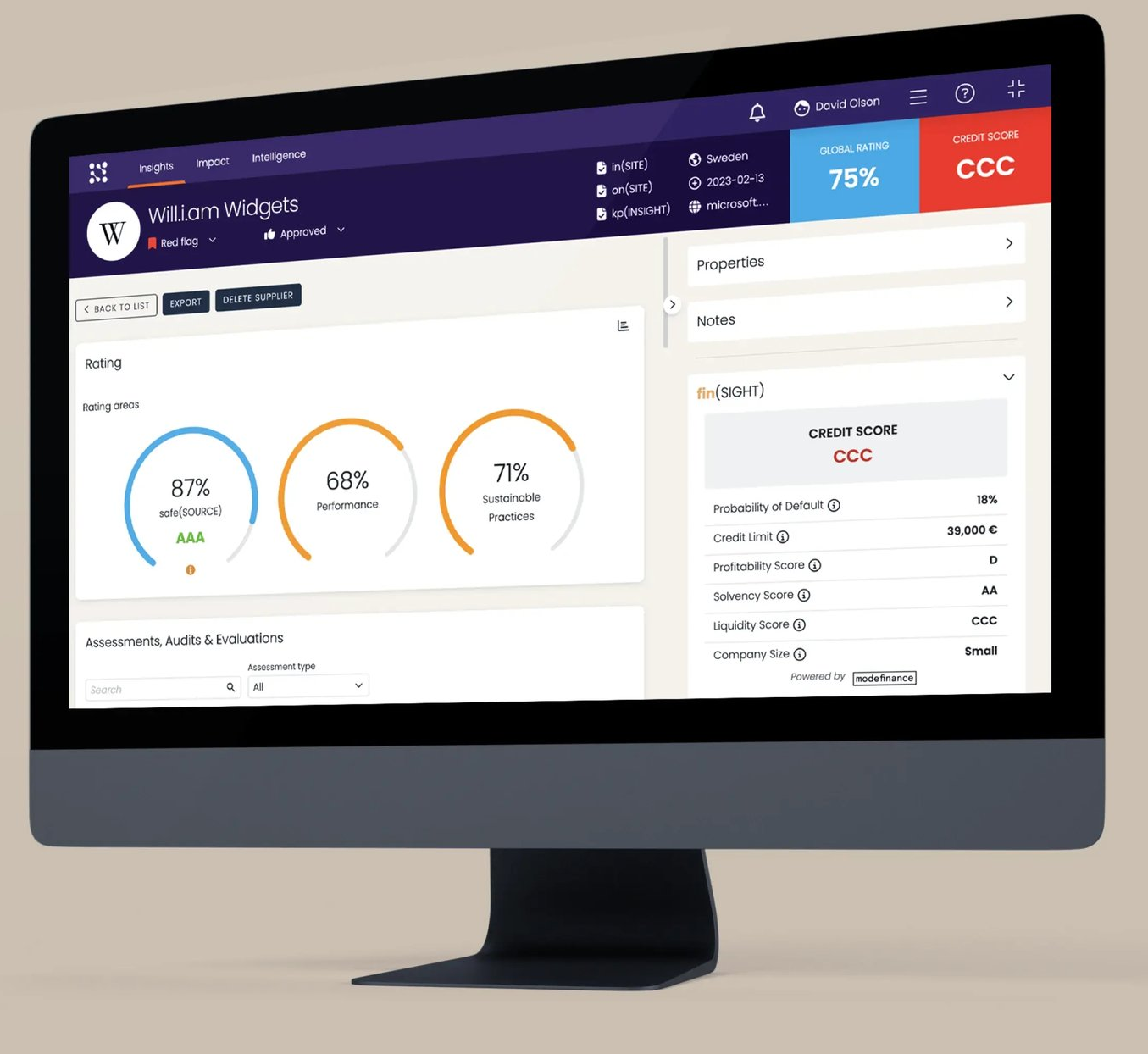
Modular SRM platform that collects supplier data through self-registration and assessment campaigns and turns it into risk and performance scorecards.
Kodiak Hub is a dedicated SRM platform with custom KPI scorecards, dynamic segmentation, ESG self-assessments and risk monitoring, and it's the specialist that describes the most scorecard detail.
Segment. Suppliers are clustered automatically using standard or custom models with user-defined rules, and changes trigger notifications and actions. Specific criteria and tier names aren't listed.
Score. Predefined or custom KPIs cover quality, delivery, commercial, collaboration, innovation and sustainability, with adjustable thresholds and goals. Data comes from stakeholder evaluations, the ERP, suppliers and market intelligence. Who fills them and how often isn't stated.
Improve. Improvement actions carry status indicators and automated notifications, and automated preventive and corrective schemes exist for ESG and compliance. The step-by-step workflow after a bad score is described only at a high level.
Collaborate. A collaboration page covers onboarding, continuous information sharing and a single source of truth with suppliers. Whether suppliers log into their own portal isn't stated.
Watch risk. Macro risk, sanctions, financial risk, adverse media and politically exposed persons feed a global risk rating, with automatic updates when a supplier's level changes. Supplier data is pulled from the ERP and insights can be sent back.
- you want an SRM-first tool with custom KPI scorecards across quality, delivery, commercial, collaboration, innovation and sustainability
- you need segmentation, ESG self-assessments and third-party risk ratings in one tool
- you need named ERP connectors or a published price: neither is on the pages we read
- you need a documented improvement workflow before buying: the pages describe it only at a high level
- Users like
- Ease of use, all supplier data and documents in one place, and an easier ERP integration than older SRM platforms.
- Users dislike
- Reporting that isn't fully developed yet, module names some users find confusing, and, for one reviewer, a platform that's hard to customize.
- Source: Capterra, 14 reviews
Price and what reviewers say
Kodiak Hub doesn't publish a price. On Capterra it shows 4.8 out of 5 from 14 reviews, with ease of use and all supplier data in one place praised and reporting that isn't fully developed as the complaint (read October 21, 2026). SoftwareFinder lists only three reviews, too few to draw a pattern.
- Starting price
- Not published, quote only (modular SaaS licence)
- Also on G2
- 4.4 out of 5 from 31 reviews
- Risk data
- Financial, sanctions and PEP, adverse media, country risk modules
- Supplier join
- Self-registration through a configurable sign(UP) form
- Supplier SSO
- Single sign-on offered, ISO/IEC 27001 certified
- Evidence source
- Supplier self-assessments plus external risk signals
- Assessments
- Template builder and library covering 15 business and sustainability areas
- Corrective actions
- Findings feed workflows and improvement projects
- KPI areas
- Quality, delivery, commercial, collaboration, innovation, sustainability
- Segmentation
- Dynamic, rule-based clustering
- Risk inputs
- Sanctions, financial, adverse media, PEP, country
Vizibl
A shared workspace where buyers and strategic suppliers run joint projects, goals, digital business reviews and relationship surveys.
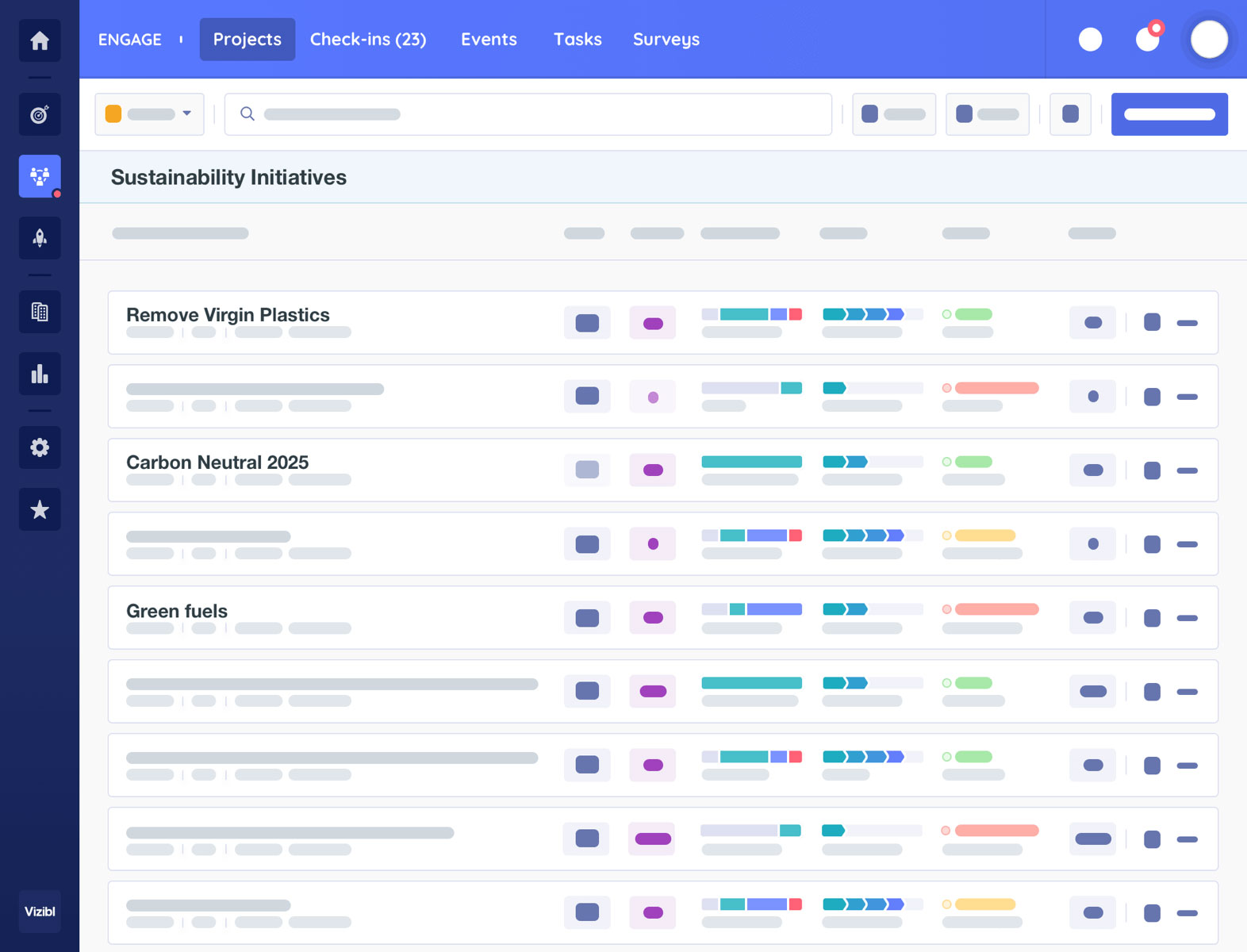
Vizibl is a shared workspace where buyers and strategic suppliers run joint projects, goals, digital quarterly business reviews and 360 degree relationship surveys, so it covers the collaboration side more than the scoring side.
Segment. Not described on the pages we read.
Score. Dashboards and reporting track progress at user level and give executives visibility. No supplier KPI scorecard structure is described.
Improve. 360 degree surveys measure relationship health from both sides. Quarterly business reviews run digitally in the workspace, tied to a shared vision and a joint business plan, and either side can raise issues outside the review.
Collaborate. Internal teams and suppliers share projects, discussions, documents, tasks and value trackers tied to shared goals.
Watch risk. The homepage says deep collaboration with business-critical suppliers helps pre-empt and mitigate risk. No risk scoring or external data feed is described.
Fit with the stack. ERP integration isn't described beyond a mention of disparate systems. Vizibl Ltd is a UK company, and we found no confirmed acquisition.
- the main goal is joint projects and digital business reviews with a few strategic suppliers on a shared plan
- supplier innovation or sustainability programs need a shared workspace rather than a KPI scorecard tool
- you need a weighted KPI scorecard: none is described on the pages we read
- you need a published price or a named ERP integration: neither is published
Price and what reviewers say
Vizibl doesn't publish a price, and its pricing page returned a 404 when we checked. G2 and Capterra blocked direct reads, so we show no rating.
- Starting price
- Not published (the pricing page returned a 404)
- Review loop
- Digital QBRs against a joint business plan
- Relationship health
- 360 degree surveys, both sides
- Workspace
- Joint projects, tasks, documents and value trackers
- Scorecards
- Not described
Gatekeeper
A platform that keeps vendor records, contracts, spend and renewals on one record, with date-based triggers that start a renewal review workflow with approvers and escalation.
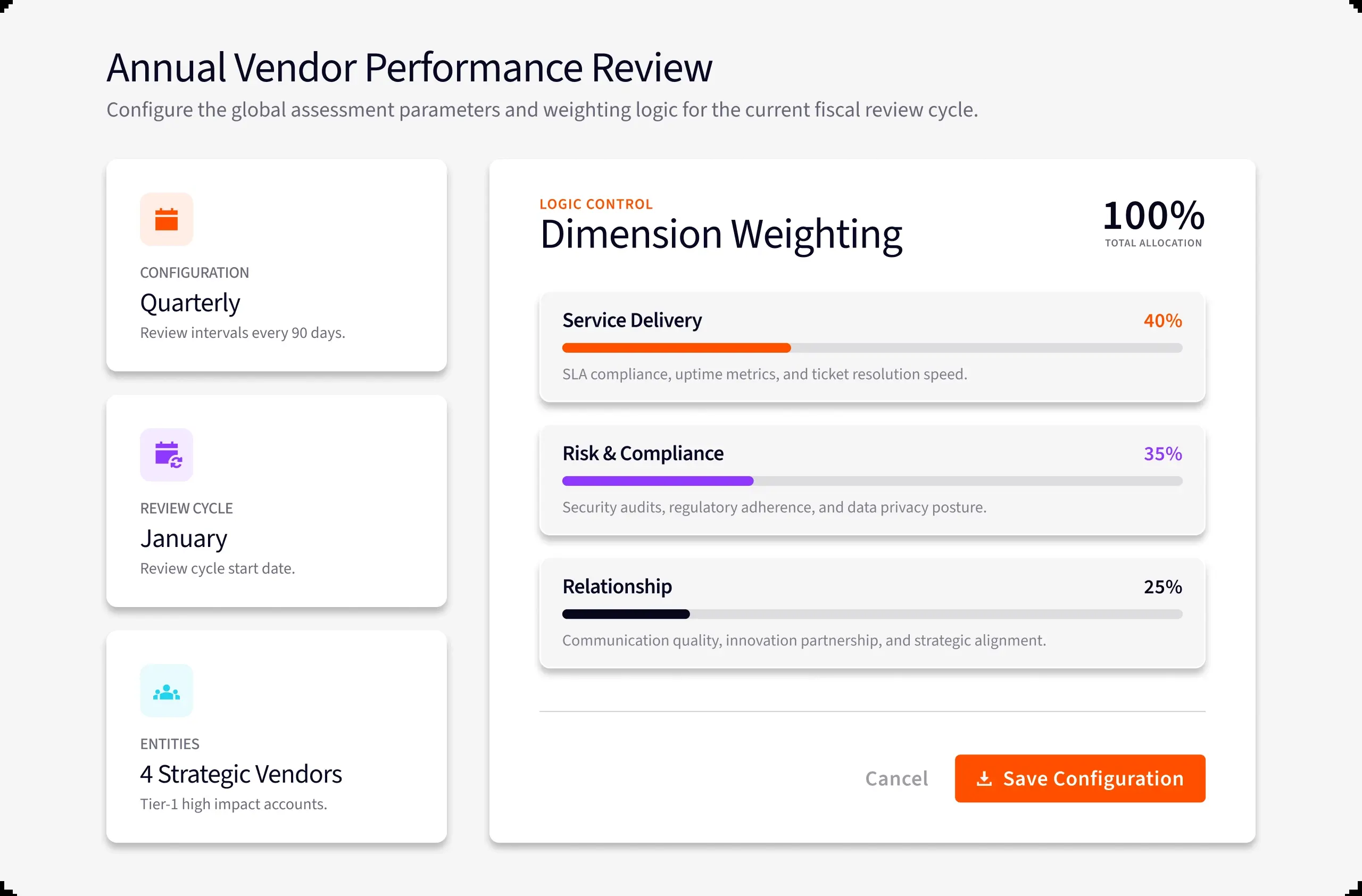
Gatekeeper puts survey-based balanced scorecards, a vendor portal and risk feeds in the same record as the contract, which suits teams where finance and legal share ownership of vendors.
Segment. No tiering feature is described. A performance quadrant plots vendors by contract spend against survey score, which supports manual prioritization.
Score. Scorecards use main dimensions such as Finance, Communication and Compliance, with sub-dimensions as survey questions. The total is a weighted score, reported as the median across reviewers. Scorecards are an Enterprise-tier feature, and they rest on stakeholder surveys rather than delivery data.
Improve. Scheduled automated surveys go to internal stakeholders, and results appear in the vendor dashboard, the quadrant and a CSV export. Follow-up actions or improvement plans after a poor score aren't described.
Collaborate. A vendor portal is included on all plans, plus an employee portal.
Watch risk. A risk monitoring add-on tracks financial health, cyber ratings and sanctions with red-amber-green alerts, and a risk register is on all plans. A two-way NetSuite sync covers vendor records, contracts and spend; other ERPs aren't named.
- you want stakeholder survey scorecards, contracts and renewals in one vendor record
- you want financial, cyber and sanctions risk feeds beside performance scores
- you need OTIF, quality or delivery KPIs fed from operational data: documented scoring is survey based
- you need a documented corrective action workflow or supplier tiering: neither is described
- Users like
- a user-friendly interface and efficient contract processing, per G2's summary of reviews
- Users dislike
- limited customization and slowdowns with larger data sets, per the same summary
- Source: G2, 91 reviews
Price and what reviewers say
Gatekeeper doesn't publish a price; plans are sized by the number of third parties. On G2 it shows 4.5 out of 5 from 91 reviews, with an easy interface and efficient contract handling praised and limited customization and slowdowns on large data sets as complaints, per G2's summary (read October 19, 2026).
- Starting price
- Not published, quote only, plans sized by number of third parties (Pro up to 250, Enterprise up to 750, Enterprise Plus 750+)
- Pricing
- Quote only, by third-party count
- Plan tiers
- Pro (250), Enterprise (750), Enterprise Plus (750+)
- Default renewal triggers
- 90 days before notice date and end date
- Vendor portal
- Invitation or self-registration link, scored questionnaires, document upload, two-factor authentication for every portal user
- Evidence source
- SIG Lite questionnaire plus SecurityScorecard and Creditsafe data
- Questionnaire
- SIG Lite, 169 questions, pre-scored, annual refresh
- Risk Module
- Risk register scored from probability and impact
- Score source
- Stakeholder surveys, weighted median
- Plan sizes
- Up to 250, 750 or more third parties
- ERP link
- Two-way NetSuite sync
How to choose supplier relationship management software
Start with three questions, because they remove most of the shortlist.
- How many suppliers will you actually review? Gatekeeper sizes plans at 250, 750 and more than 750 third parties, and most suites are built for hundreds of suppliers. Reviewing 30 strategic suppliers properly isn't the same task as scoring 3,000.
- Which system holds orders and invoices? If it's SAP, Coupa or JAGGAER, the matching module reads that data directly. If it's something else, ask which connectors are named and which are custom work.
- What matters more: cost, risk or the relationship itself? Cost and delivery KPIs point to the suites and Kodiak Hub. ESG and compliance risk point to Ivalua, GEP SMART, Coupa and Kodiak Hub. Joint plans and innovation point to Vizibl.
Who fills in supplier scorecards?
Scorecard data comes from stakeholder surveys, from the ERP or from the supplier, and the vendors differ. SAP Ariba and Gatekeeper rely on internal stakeholders answering surveys, Kodiak Hub combines stakeholder evaluations with ERP data, supplier input and market intelligence, and Coupa captures KPIs automatically while business users rate suppliers in the context of transactions. For JAGGAER, Ivalua and GEP SMART, the pages we read don't say who enters the data, so ask in the demo.
Does supplier relationship management software integrate with SAP or NetSuite?
Supplier relationship management software integrates with SAP or NetSuite where the vendor names the connector, and five of the eight name one. SAP Ariba syncs with the ERP in both directions, JAGGAER lists connectors for SAP, Oracle, Workday, Infor and NetSuite, GEP SMART names SAP, Oracle and Microsoft Dynamics, and Gatekeeper offers a two-way NetSuite sync. Coupa integrates with its own purchasing platform, and Kodiak Hub, Ivalua and Vizibl don't name specific ERPs on the pages we read.
How much does supplier relationship management software cost?
Supplier relationship management software costs a quote with every vendor here, so the number depends on your supplier count and modules. Gatekeeper sizes plans by third parties, at up to 250, up to 750 and more than 750. A third party reports a buyer-reported floor near $150,000 per year for Ivalua, which we couldn't verify. Ask each vendor for the price at your supplier count with the scorecard, portal and risk modules included, because some of them, such as Gatekeeper's Enterprise-tier scorecards and Coupa's Advanced tier, sit in higher tiers.
How long does implementation take?
None of the eight vendors publishes an implementation time on the pages we read. A Gartner reviewer of SAP Ariba Supplier Lifecycle and Performance says initial configuration demands technical expertise and cost, and Coupa reviewers on TrustRadius describe heavy integration work with ERPs. Ask for a timeline that covers your ERP connection and the first scorecard cycle, not just the software install.
Segment suppliers before you configure anything
No tool can tell you who your strategic suppliers are, and the pages we read are thin on tiering rules. You'll want to decide the tiers first. A simple scheme uses spend and how hard the supplier is to replace.
| Tier | Typical test | Review effort |
|---|---|---|
| Strategic | High spend and hard to replace | Quarterly business review, joint plan |
| Important | High spend or hard to replace | Scorecard each half year |
| Routine | Low spend and easy to replace | Exception-based, only on incidents |
The scheme above is our working scheme, not a vendor standard. Ivalua's blog describes a similar split of strategic, critical and transactional suppliers.
Questions for every demo
- Show how a supplier moves from one tier to another and what triggers it.
- Show a scorecard where one KPI is below its threshold. Who is notified, and what task is created?
- Show what the supplier sees. Can they respond to a low score or only read it?
- Show where a score comes from: a survey, the ERP or a manual entry.
- Show the export. Can you get the scorecard out as a table, not only a screenshot?
- Ask for the price at your supplier count and the modules you need.
What a review loop looks like
A scorecard is only useful if something happens after it. The loop we'd expect any tool to support has four steps, and the demo checklist above tests each one: a score falls below a threshold, an owner is notified, the supplier gets a task or a plan with a date, and someone re-checks the score at that date. SAP Ariba, Ivalua and GEP SMART describe versions of this loop most clearly. Gatekeeper and Vizibl describe the scoring or the review but not the follow-up task, and for Coupa and JAGGAER the follow-up is only partly described.
From supplier review to renewal decision
A review often ends in a decision about the contract: keep the supplier, renegotiate or leave. That decision has a deadline, the notice date in the contract, and none of the SRM pages we read describe who makes it before that date. The Procurement Manager is a small tool for that one job. It routes each contract renewal to the business owner, Finance and IT and produces one decision packet with the exact dates and source evidence before the notice deadline. It doesn't score suppliers, read contracts or cancel anything on its own. Use it next to an SRM tool if good reviews and bad renewals are your problem. Our contract renewal notice period guide and contract lifecycle management software comparison cover the contract side.
Frequently asked questions
What is supplier relationship management software?
Supplier relationship management software is a tool that segments suppliers, scores their performance, runs reviews and tracks improvement actions after the supplier is onboarded. It also gives buyers and suppliers a shared place to work. It differs from supplier management software, which focuses on the supplier record and onboarding.
How much does supplier relationship management software cost?
Supplier relationship management software costs a quote for every tool here, because none of the eight publishes a price. SAP Ariba, Coupa, JAGGAER, Ivalua, GEP SMART, Kodiak Hub, Vizibl and Gatekeeper sell by quote or demo. Gatekeeper sizes its plans by the number of third parties, at 250, 750 and more than 750, so supplier count is the number to bring to every quote.
Does SAP have supplier relationship management software?
Yes, SAP has supplier relationship management software. SAP Ariba Supplier Lifecycle and Performance covers supplier qualification and performance evaluation, with a master scorecard, weighted KPIs, stakeholder surveys and corrective action tasks. It syncs with the ERP and feeds the rest of SAP Ariba.
What is the difference between SRM and a supplier portal?
A supplier portal is the place where suppliers maintain their data and answer requests. SRM is the whole practice of tiering, scoring and reviewing suppliers, and the portal is one part of it. Ivalua, JAGGAER and Gatekeeper describe portals, and Vizibl is built around a shared workspace instead.
Do I need a full source-to-pay suite for SRM?
No, you don't need a full suite for supplier relationship management. Kodiak Hub, Gatekeeper and Vizibl are SRM-first tools that sit next to your ERP. A suite makes sense when the same vendor already runs your sourcing, buying or contracts and you want supplier scores to travel with the supplier record.
How often should I review suppliers?
Strategic suppliers are usually reviewed quarterly and others less often, and SAP Ariba supports quarterly or yearly scorecards. An Ivalua blog post suggests monthly or quarterly reviews for strategic suppliers. Set the cadence by tier, not one schedule for everyone.