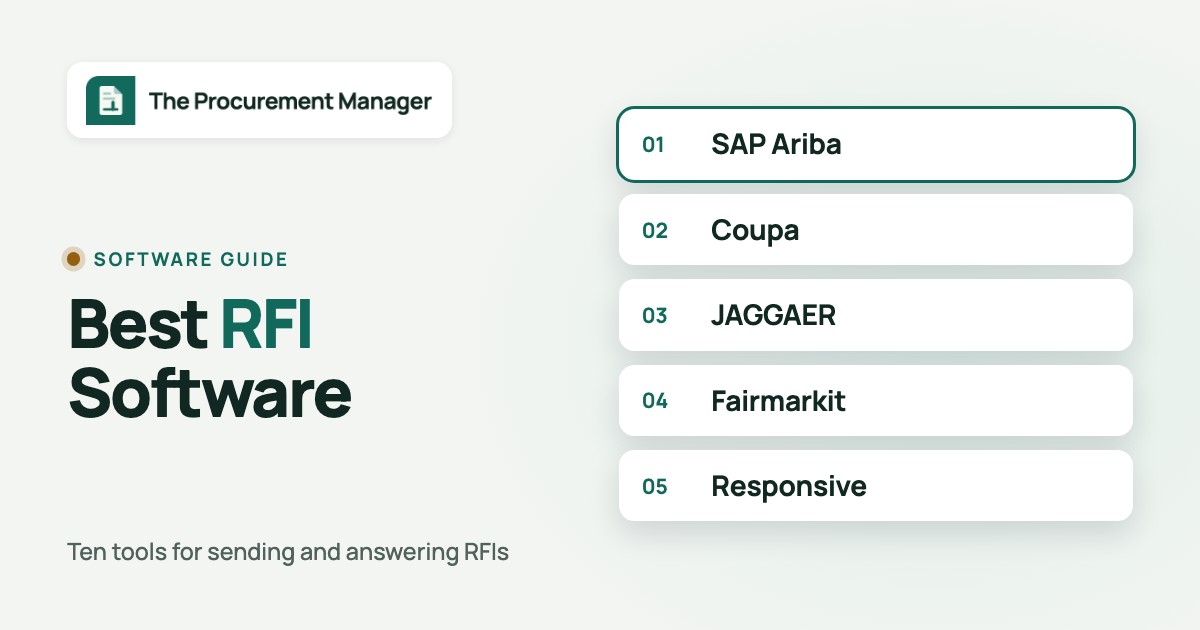
The best RFI software depends on whether you send requests for information to suppliers or answer them for customers. If you send them, Fairmarkit, SAP Ariba, Coupa, JAGGAER, GEP SMART, Workday Strategic Sourcing and Market Dojo document an RFI step. If you answer them, Responsive, Loopio and Iris are built for it. A third group, construction RFI tools such as Procore, handles a different document that shares the acronym and isn't covered here.
RFI software is a tool that manages a request for information: the buyer sends a questionnaire to a list of suppliers, collects the answers in one place and uses them to decide who gets a follow-on RFP or RFQ. Response-side software does the reverse job for the supplier. We compared ten tools from their own documentation and mark every step a vendor doesn't document. Review sites block automated readers, so any ratings shown come from our tool database and can lag the live listings.
- tools compared
- 10
- buyer-side and response-side
- 7 + 3
- publish a price
- 2
- Pick by your side of the RFI. SAP Ariba, Coupa, JAGGAER, GEP SMART, Workday Strategic Sourcing, Fairmarkit and Market Dojo issue RFIs to suppliers. Responsive, Loopio and Iris answer RFIs from customers.
- An RFI collects information and usually carries no price. SAP's own training material calls it a non-competitive, mostly question-and-answer event that comes before an RFP or auction.
- Only two of the ten publish a price: Responsive from $10,000 and Market Dojo from £500 per month, in pounds. The other eight are a quote or demo request.
What is RFI software?
RFI software is a tool that sends a request for information to suppliers, collects their answers to a questionnaire and lets the buyer compare them before any price is requested. A request for information asks what a supplier can do, so the answers are mostly text and documents. That separates it from a request for quotation, which asks for a price on a defined item, and from a request for proposal, which asks for a worked solution and a price.
| Document | What the buyer asks | What comes back | Typical use |
|---|---|---|---|
| RFI (request for information) | What can you supply, how, and under which terms | Answers to a questionnaire and supporting documents | The need is clear but the market and the specification aren't |
| RFP (request for proposal) | How would you solve this problem, and at what price | A written proposal with approach and price | Quality and fit decide the award |
| RFQ (request for quotation) | What is your price for this exact item and quantity | A price per line plus lead time and terms | The specification is fixed and price decides |
An RFI is also a way to shortlist. SAP's training material describes it as an event that often comes before an RFP or auction, and lets a buyer reuse the answers in a follow-on event or pick participants to invite to it. Our guides to RFP software and RFQ software cover the next two steps, and strategic sourcing software covers the wider sourcing events around them.
RFI software for buyers or for responders
The same acronym covers two different jobs, and the tools don't overlap. Buyer-side software builds the questionnaire, invites suppliers and compares the answers. Response-side software imports the questionnaire a customer sent, drafts answers from approved content and routes them to experts. Responsive describes its own RFI product as software for the team answering, and describes procurement teams as the ones who use RFIs to qualify or eliminate vendors.
Construction is a third meaning. In a building project an RFI is a question from a contractor to the design team, and tools such as Procore and Archdesk track those questions and their answers on site. That is a project-management job with no supplier shortlist behind it, so it sits outside this comparison.
Best RFI software at a glance
 Best documented RFI event typeSAP AribaSAP's own training pages describe RFI as a non-competitive question-and-answer event with a standard template, no line-item pricing and reusable answers.
 Best for public-sector style RFIsJAGGAERGovernment buyers publish step-by-step eRFI guides: pick the RFI event type, start from a template, monitor each supplier's status and completion percentage.
 Best for a short, documented RFI flowFairmarkitAdd questions, pick suppliers, publish, then compare every response on one screen and record the outcome.
 Best when RFI feeds an RFQ or RFP in the same suiteCoupaRFI answers are collected through questionnaires or attachments, and Coupa's own guidance treats an RFI as the step before an RFQ or RFP.
 Best inside a Workday landscapeWorkday Strategic SourcingRFI, RFP and RFQ events from templates, with side-by-side comparison and contract creation in Workday once a supplier is selected.
 Best for enterprise teams with many eventsGEP SMARTOne platform runs RFI, RFQ, RFP and auctions, with a dashboard across all events.
 Best for a published buyer priceMarket DojoEvent or monthly licences from £500 per month on an annual plan, with free RFI templates published on its site.
 Best for answering RFIs at scaleResponsiveImports RFIs in Word, Excel and PDF and drafts first answers from approved content.
 Best for cited AI draftsIris AIAnswers carry citations and a confidence score, and locked approved answers are inserted word for word.
 Best for a maintained answer libraryLoopioFills questions from a library and routes the rest to experts with reminders.
RFI software compared
Prices were last checked on vendor pages between October 22 and November 7, 2026. Only Responsive and Market Dojo publish an amount, and the two aren't comparable: Responsive lists an annual edition in dollars, and Market Dojo lists subscriptions in pounds sterling. Every other tool sells by quote. The ratings come from review sites where a rating could be read, and where none could, the table says so.
| Tool | What the tool does with an RFI | Price status (USD unless marked £) | Review rating |
|---|---|---|---|
| Fairmarkit | Questionnaire to chosen suppliers, one comparison screen, outcome note | Quote only | No reviews yet |
| SAP Ariba | Non-competitive RFI event, reusable answers, invite list for follow-on events | Quote only | 7.6/10 (TrustRadius, 770) |
| Coupa | RFI questionnaires or attachments, next step is an RFQ or RFP | Custom quote | 6.9/10 (TrustRadius, 171) |
| JAGGAER | eRFI from a template, supplier status and completion tracking | Custom quote | 4.1 (86) |
| GEP SMART | RFI among RFx events, dashboard across all events | Quote only | No reviews yet |
| Workday Strategic Sourcing | RFI from templates, side-by-side comparison, then contract creation | Quote only | 4.5 (35) |
| Market Dojo | RFx events with free RFI templates on its site | From £500/month billed annually, in pounds | No reviews yet |
| Responsive | Imports an RFI, drafts answers, exports in the buyer's format | Emerging edition from $10,000 | No reviews yet |
| Iris AI | Drafts cited answers to RFIs, DDQs and questionnaires | Quote only | 4.9 (85) |
| Loopio | Answers RFIs from a library with expert routing | Custom quote | No reviews yet |
 The Procurement Manager Our product | Routes renewal reviews to the business owner, Finance and IT before the notice deadline | From $49 per month, flat, no per-seat fees (Starter, up to 50 contracts) | No reviews yet |
Ratings for SAP Ariba, Coupa and JAGGAER cover the whole suite, not the sourcing module alone, and SAP Ariba and Coupa are TrustRadius scores out of 10. Where a tool shows no rating, none is shown.
The RFI round: what to check in a demo
Every buyer-side tool runs the same five steps, and they differ in where they stop. The columns name each step and the failure that shows up most when a team moves from email and spreadsheets.
- Step 1Write the questions
- JAGGAER
- SAP Ariba
Breaks when the questionnaire is a long free-text list, so answers come back in different shapes and can't be compared - Step 2Choose suppliers
- Fairmarkit
- GEP SMART
Breaks when the invite list is the supplier list you already know, so the market isn't tested - Step 3Collect answers
- JAGGAER
- Workday Strategic Sourcing
Breaks when suppliers answer by attachment instead of the questionnaire, and nothing is comparable - Step 4Compare
- Fairmarkit
- Coupa
Breaks when there is no shared scoring rule, so the loudest supplier wins the shortlist - Step 5Hand off
- SAP Ariba
- Workday Strategic Sourcing
Breaks when the shortlist and the answers have to be retyped into the RFP or RFQ
RFI software for buyers
SAP Ariba, Coupa, JAGGAER, GEP SMART and Workday Strategic Sourcing sell RFI events as one event type inside a wider sourcing suite. Fairmarkit is a narrower sourcing tool with a short documented RFI flow, and Market Dojo is an eSourcing platform with licences you can buy per event or per month.
SAP Ariba
SAP's source-to-pay suite covering sourcing events with scoring and award simulation, buying and invoicing, contracts and supplier collaboration through SAP Business Network.
SAP Ariba Sourcing treats an RFI as a non-competitive question-and-answer event that sits before an RFP or auction and carries no line-item pricing.
Build and send. SAP's own training pages place RFI in the event-type list next to RFP, reverse auction and forward auction, with one standard RFI template and a guided-sourcing version of it. RFIs have questions with various response types and don't carry pricing through line items and lots.
Compare. Participant responses are not shown to other participants, according to SAP's course material. One quiz item in the same training catalog says otherwise, so confirm the setting in a demo.
Hand off. The information from an RFI can be reused in a follow-on event, and a buyer can use it to choose which participants to invite to an RFP or auction.
- your sourcing runs on SAP and you want the RFI, the follow-on RFP and the award in one event chain
- you want a documented, standard RFI template instead of building the questionnaire from scratch
- you want a lightweight tool: complexity is the most frequent criticism in reviews of SAP Ariba
- you need a figure upfront: SAP gives buyer prices only on request, and Buying and Invoicing is priced on processed spend
- Users like
- Punch-out catalogs and guided buying with approval workflows that standardize how people buy.
- Users dislike
- An outdated interface, weak reporting and hard integration with non-SAP ERPs.
- Source: TrustRadius, 770 ratings
Price and what reviewers say
SAP Ariba doesn't publish a buyer price for sourcing. On TrustRadius reviewers rate it 7.6 out of 10 from 770 ratings for the whole product, praising punch-out catalogs and guided buying and criticizing an outdated interface, weak reporting and hard integration with non-SAP ERPs (read November 7, 2026).
- Starting price
- Price upon request, no public buyer rate
- Buying and Invoicing pricing
- Price upon request, priced on processed spend
- Standard supplier account
- Free on SAP Business Network, unlimited documents
- Enterprise supplier account
- Fixed subscription level fee plus transacted volume
- Supplier order flow
- PO confirmation, ship notices, PO flip invoices, invoice and payment status
- Sourcing events
- RFI, RFP, multi-round bidding and English, Dutch, Japanese, total-cost, traffic-light, basket and lot auctions (SAP slides dated May 2022)
- Award analysis
- Scoring and grading, bid comparison report, award scenario comparison and one-click awarding; AI bid summaries and award simulation on the product page
- Supplier discovery
- Search by industry, item or service in SAP Business Network Discovery; profiles show certifications and ESG data
- Handoff after award
- Follow-on documents such as POs, purchase info records and scheduling agreements in an external system; links to SAP Ariba Contracts
- Spend classification
- The newer Spend Analysis and Insights offer maps spend to UNSPSC (incl. v25) or a custom taxonomy, with a stated 95% accuracy, and ingests SAP Cloud ERP, Ariba, Fieldglass, Concur plus non-SAP data.
- Category strategy
- Guided strategy process with category profiles, hierarchy management, Kraljic, PESTLE, SWOT and Porter's Five Forces frameworks, AI-curated market intelligence (third-party content from Beroe), generative AI drafts, and approval workflow.
- Savings tracking
- Managers pick value levers, goals and KPIs per category, document initiatives with owners, timelines and estimated outcomes, and follow them in a monitoring workbench, dashboard and calendar view. Savings accounting rules are not detailed publicly.
- Category supplier view
- Category segmentation and cost structure analysis are listed features, and the Kraljic matrix segments categories or suppliers by supply risk and profit impact. Supplier performance scorecards belong to separate Ariba supplier management modules.
Coupa
Enterprise source-to-pay suite whose requisitions run through guided buying, punchout and prioritized approval chains with budget meters.
Coupa lists RFI next to RFQ, RFP and reverse auctions, and collects RFI answers through questionnaires or attachments rather than item and lot lines.
Build and send. Coupa's supplier documentation says RFI information is collected in the Questionnaires or Attachments folder and isn't tied to the items or lots you intend to source. In the Sourcing API an event created without a type defaults to an RFI. Routine events run from preapproved templates.
Compare. Coupa's blog describes an RFI as a general information-gathering step that is typically followed by an RFQ or RFP. Some companies skip it and go straight to an RFQ.
Hand off. Winning terms from an awarded event pass into draft contracts in Coupa CLM and into catalogs on approval. That describes awards, not RFI answers, and the published pages don't say whether RFI answers carry into the next event.
- you already buy in Coupa and want the RFI, the RFQ and the contract in the same suite
- you want pre-rated suppliers you can filter by diversity, rating or geography to build the invite list
- you need a public price: Coupa has no verified public USD rate card
- you want to compare RFI answers side by side without a wider suite: the published pages describe that for awards, not for RFIs
- Users like
- Approval routing and spend compliance for indirect buying, with clear purchase limits per person.
- Users dislike
- Heavy integration work with ERPs such as SAP, and a supplier portal that confuses vendors asked to create profiles.
- Source: TrustRadius, 171 ratings
Price and what reviewers say
Coupa sells by custom quote. On TrustRadius reviewers rate it 6.9 out of 10 from 171 ratings, praising approval routing and spend compliance for indirect buying and criticizing heavy ERP integration work and a supplier portal that confuses vendors (whole product, read November 7, 2026).
- Starting price
- Custom buyer quote; no public US rate card verified
- Standard supplier portal
- Free for suppliers; Coupa Advanced is a paid supplier tier (SSO, API, QuickBooks and NetSuite sync)
- Buyer-side platform
- No verified public universal USD rate
- Requisition API
- Create and submit for approval
- Process Automator
- Document events and API call outs
- Supplier join
- Buyer invitation (link expires after 30 days), self-registration or a PO email
- Budget meters
- Show remaining budget per budget item before commitment
- Hard stop
- A budget-line setting blocks requisition submission over budget
- Dashboards
- Out-of-the-box dashboards, KPI benchmarking and savings insights
- Sourcing events
- RFP, RFI, RFQ and reverse auctions are listed in the FAQ (answer text not visible); routine events run from preapproved templates
- Award analysis
- Coupa Sourcing Optimization sets per-supplier caps, geography, tariffs and freight as constraints and compares scenarios side by side, with manual overrides
- Supplier discovery
- Pre-rated, pre-enabled suppliers filterable by diversity, rating or geography; AI suggests suppliers from category performance
- Spend analysis
- Cross-platform spend visibility, automatic classification and suggested opportunities such as expiring contracts
- Handoff after award
- Winning terms and rate cards pass into draft contracts in Coupa CLM and into catalogs on approval
- Spend classification
- AI engine maps transactions to a proprietary Coupa taxonomy of roughly 60 primary categories and 1,800 sub-categories, built for category management. It classifies by supplier first, using invoice and PO descriptions. Source post dates from 2022.
- Category strategy
- Coupa Category Strategy starts from a category taxonomy built on Coupa data, uses AI-guided stakeholder interviews and the Navi assistant for recommendations, and rolls every strategy into one portfolio view using a single methodology.
- Savings tracking
- Coupa describes tracking value through stages identified, negotiated, contracted and realized, to link negotiated savings to P&L impact. Initiative value can include non-cost benefits such as supplier relationships and resilience.
- Category supplier view
- Category Strategy page says it pairs with Coupa Supplier Information & Risk Management to segment suppliers, track performance and manage risk. Sourcing suggests suppliers from category performance. Segmentation criteria are not detailed publicly.
- Supplier risk module (checked 2026-11-06)
- Coupa Supplier Risk & Performance: monitoring of outside data sources, alerts, next-step recommendations and a supplier hold that can block transactions from purchasing to invoicing
- Risk datasheet (2021)
- Standard (onboarding, monitoring, scorecards) and Advanced (multi-domain assessments, inherent and residual scoring, multi-tier, mitigation plans); fees may apply for the Coupa risk data service
- Risk Assess
- Questionnaires across domains such as InfoSec, ABAC and GDPR, with alerts when risk increases
- Supplier risk price
- Not published, demo request only
JAGGAER
JAGGAER is a source-to-pay suite whose supplier management module gives suppliers a portal with guided self-service onboarding, compliance checks and configurable workflows, plus automated verification of uploaded documents.
JAGGAER One runs an RFI as an event type from a template, and public buyers publish the steps for monitoring supplier status and completion.
Build and send. A University System of Georgia guide walks a buyer through selecting the Request for Information event type and recommends starting from the eRFI template. JAGGAER's own page says teams can gather information through questionnaires or by pulling data from supplier profiles.
Collect. In a UK government guide, suppliers answer the questionnaire online or download it as Excel, fill it in offline and import it back. The buyer's monitor page shows each supplier as Not Replied or Replied with a completion percentage, and the same guide notes a supplier can instead upload an attachment.
Compare. The Georgia guide notes an RFI can be set to Unsealed so a buyer can view responses before the event closes, but not for a competitive call-off event. JAGGAER's own pages don't document authoring the questionnaire.
- you want an RFI with status tracking per supplier and an Excel route for suppliers who prefer offline answers
- your awards later need weighted scorecards and constraint-based scenarios, which JAGGAER documents for RFPs and RFQs
- you want a cost before a sales call: JAGGAER quotes each deal individually
- you want to rely on vendor documentation for RFI setup: the step-by-step guides come from public buyers, not from JAGGAER
- Users like
- Flexibility and configurability, strong support and consulting teams.
- Users dislike
- An inconsistent interface across modules, setup complexity and supplier-side feature limits.
- Source: G2, 86 reviews
Price and what reviewers say
JAGGAER sells by custom quote. G2 shows 4.1 out of 5 from 86 reviews for the whole suite, with flexibility and strong support praised and an inconsistent interface, setup complexity and supplier-side limits criticized (read November 7, 2026).
- Starting price
- Not published, custom quote
- Supplier portal
- Guided self-service with built-in compliance checks
- Documents
- Automated document validation (JAI)
- Integration
- Integrates with existing business systems, no ERPs named on the page
- Sourcing events
- RFI, RFP and RFQ from templates; reverse, forward, Dutch, Japanese and ranked auctions
- Award analysis
- Weighted scorecards, BAFO rounds and constraint-based optimization with unlimited what-if scenarios and line-level split awards
- Supplier discovery
- AI supplier recommendations, risk flags and Smart Quote suggested suppliers
- Handoff after award
- Sourcing feeds Contracts and Procure-to-Pay on one data layer; the steps are not detailed
- Integrations
- 40+ pre-built, including SAP, Oracle, Workday, NetSuite, Infor and JD Edwards
- Spend classification
- Automatic Spend Classification uses NLP on invoice text or product numbers to predict eCl@ss codes, and the same method can predict UNSPSC. It runs on demand or in batch. No accuracy figures published. Press release dates from 2019.
- Category strategy
- Category management page lists built-in Kraljic, SWOT and Porter frameworks, a stage-gated process with standard approvals and templates, and market intelligence such as commodity, FX and price indices plus 800+ category reports.
- Savings tracking
- A savings pipeline covers idea capture, validation and tracking from identified through realized. Mapping of savings to category targets or baselines is not detailed on the page.
- Category supplier view
- Page mentions a unified view of spend, supplier performance and market data, with category risk scored across supplier, financial, ESG and geopolitical factors. Supplier segmentation per category is not explicitly described.
GEP SMART
GEP's source-to-pay platform, presented under the GEP Quantum Intelligence brand, runs RFx events and e-auctions in one place and moves awarded suppliers into contracting.
GEP SMART runs RFI, RFQ, RFP and auctions on one platform and gives a dashboard across all events.
Build and send. GEP's materials say the software handles an RFI, RFQ, RFP or auction, and that events start from best-practice templates. Suppliers respond through a portal, and a buyer can search the supplier database before adding suppliers to an event.
Compare. The sourcing dashboard covers RFIs, RFPs, RFQs and auctions across the enterprise. AI agents scoring bids against value drivers are described for awards, and the field-level setup isn't shown.
Hand off. A sourcing event can carry into contracting and award, and awarded suppliers move into contracting. PO handoff isn't described.
- you run many events across categories and want one dashboard for RFIs, RFPs, RFQs and auctions
- you want to search a supplier database before deciding who to invite
- you want a published price: GEP sells by quote
- you want RFI-specific detail: GEP's pages describe RFx events in general, not an RFI questionnaire workflow
Price and what reviewers say
GEP SMART sells by quote. No G2 or TrustRadius rating is shown for it.
- Starting price
- Not published
- Sourcing events
- RFx events including RFPs, plus e-auctions and live auctions
- Award analysis
- AI agents score bids against value drivers and model price, risk and performance tradeoffs; field-level setup is not shown
- Supplier discovery
- Supplier intelligence across categories and regions; a Supplier Discovery Agent uses performance and public data
- Handoff after award
- Awarded suppliers move into contracting; PO handoff is not described
- Integrations
- ERPs and S2P suites such as SAP Ariba, Coupa, Ivalua, SAP, Oracle and Microsoft Dynamics
- Spend classification
- Supports UNSPSC, SIC and custom enterprise taxonomies. An AI engine cleanses, normalizes and classifies each spend line, adds supplier parent-child links and duplicate detection. No accuracy figures published.
- Category strategy
- A Cat Strategy Agent drafts category strategies and updates them as markets move, recommending generic, specific or hybrid sourcing approaches. The page gives little detail on the step by step plan workflow.
- Savings tracking
- Opportunities become savings projects with milestones and live metrics. The pipeline moves projected savings to realized and checks results against targets. A sample view shows a 284,000 USD IT hardware opportunity.
- Category supplier view
- Supplier Intelligence monitors performance, risk and financial health continuously. A Performance Monitor Agent tracks supplier KPIs. No scorecard design or category based segmentation method is described.
Workday Strategic Sourcing
Workday's sourcing application covers intake, RFP, RFI and RFQ events, reverse auctions, side-by-side bid comparison and scenario modeling, with contract creation starting once a supplier is selected.
Workday Strategic Sourcing runs RFI, RFP and RFQ events from templates with questionnaires, and starts a contract in Workday once a supplier is selected.
Build and send. Workday's own user guide names RFP, RFI and RFQ as sourcing events. Questionnaires sit inside the event, not as a separate event type, and questions can be pasted in bulk, though one Excel file can't be uploaded to create an event.
Compare. The datasheet lists AI-assisted response summaries, side-by-side comparison and scenario modeling. Feedback asking suppliers to revise questionnaire answers can happen inside a single event.
Hand off. Contract creation starts in Workday CLM when a supplier is selected, and the datasheet claims visibility through to the purchase order.
- you already run Workday and want sourcing events, comparison and contract start in one place
- you want to ask suppliers to revise their questionnaire answers without opening a second event
- you want a published price: Workday sells through a representative or demo
- you want to load a finished questionnaire from Excel: the documentation says one file can't create an event
Price and what reviewers say
Workday Strategic Sourcing sells by quote. G2 shows 4.5 out of 5 from 35 reviews (read October 28, 2026), a small sample.
- Starting price
- Not published, via a Workday representative or demo
- Sourcing events
- RFP, RFI and RFQ from templates with questionnaires and pricing controls; reverse auctions
- Award analysis
- AI-assisted response summaries, side-by-side comparison and scenario modeling against savings targets; price visibility can be hidden during technical evaluation
- Supplier discovery
- Onboarding portal and risk scoring are described; finding new suppliers is not
- Handoff after award
- Contract creation starts in Workday CLM when a supplier is selected; the datasheet claims visibility through to the purchase order
Fairmarkit
Fairmarkit runs tactical RFQs, strategic RFx and reverse auctions, with AI that bundles similar RFQs, matches suppliers and can auto-award by weighted rules. It is built around high-volume, low-value requests.
Fairmarkit documents a short RFI flow: add questions, choose suppliers, publish, compare every response on one screen and record what happened next.
Build and send. The buyer adds questions about the items or services, selects the suppliers to invite and publishes the event.
Collect. Invited suppliers respond within a set time frame. Responses can include answers, prices and terms, and suppliers can message the buyer with questions.
Compare and hand off. All supplier responses show on one consolidated screen. The buyer then marks the event reviewed and adds a note, such as creating an RFP or noting that the project is out of budget. The documentation says the RFP module requires contacting a Fairmarkit Customer Success Representative, and the published pages don't describe a PO handoff.
- you want a simple, documented RFI with one comparison screen and a recorded outcome
- you already use Fairmarkit for tail-spend RFQs and want the information step in the same tool
- you need a published price: Fairmarkit shows a demo request only
- you need structured scoring on RFI answers: the documentation describes comparison on one screen, not weighted scoring
Price and what reviewers say
Fairmarkit sells by demo request. No review rating is shown for it.
- Starting price
- Not published, demo request only
- Sourcing events
- Tactical and tail-spend RFQs, strategic RFx from templates, multi-line Lots and Dutch, English and Japanese reverse auctions
- Award analysis
- Blended price and TCO calculations, shared reviews and approvals with an audit trail; auto-award to the response closest to weighted rules, enabled with a Customer Success Manager
- Supplier discovery
- AI ranks vendors by likelihood to respond, bundles similar RFQs and sends them to matched suppliers on a schedule
- Handoff after award
- Not described on the published vendor pages
Market Dojo
Market Dojo is an eSourcing platform that runs RFx events and eAuctions on monthly, annual or single-event licences, with weighted events and API integration in a higher tier.
Market Dojo is an eSourcing platform with licences by month or by event, and it publishes free RFI templates in its template library.
Build and send. Market Dojo's site describes RFx events and eAuctions with templates and libraries, Excel integration and live messaging. It published a free supplier RFI template during the COVID-19 period and offers a Brexit RFI among its global templates, with a video showing how the template works.
Compare. Weighted events and collaborative multi-scoring are listed in the £583 per month annual tier. Market Dojo's pages don't describe how RFI answers are compared inside the tool.
Hand off. The homepage lists a Contract Management module, and the handoff steps aren't described.
- you run RFIs now and then and want a licence you can buy for a month or a single event
- you want a published price and a starter RFI template before a demo
- you need USD pricing: Market Dojo publishes pounds sterling only
- you want RFI-specific scoring: Market Dojo's pages describe weighted events in general
Price and what reviewers say
Market Dojo lists simple RFx and eAuctions from £500 per month billed annually, or £1,000 per month or per event on demand, in pounds sterling. No review rating is shown for it.
- Starting price
- From £500 per month billed annually for simple RFx and eAuctions; £1,000 per month or £1,000 per event on-demand (pounds sterling, no USD price)
- Sourcing events
- Simple RFx and eAuctions with templates and libraries, Excel integration and live messaging
- Award analysis
- Weighted events and collaborative multi-scoring in the £583 per month annual tier; scenario modeling is not described
- Supplier discovery
- The homepage lists supplier discovery and says AI helps discover and qualify suppliers
- Handoff after award
- The homepage lists a Contract Management module; the handoff steps are not described
RFI software for responders
Responsive, Loopio and Iris are for the team that receives the RFI. They differ in how they produce an answer: from AI drafts and a content library, from a maintained library with expert routing, or from cited AI drafts and locked approved answers. None of them issues or scores an RFI.
Responsive
Responsive is a response-side platform for supplier teams that answer RFPs, RFIs and security questionnaires, with import mapping, AI first drafts and templated export. Pricing is an annual platform fee plus user licenses and add-ons.
Responsive imports an RFI in Word, Excel or PDF, drafts first answers from approved content and exports the result in the buyer's format.
Import. Its RFI page says AI agents import RFIs in Word, Excel, PDF or other formats and flag requirements. Standard Excel files such as SIG or CAIQ configure automatically, and others need manual mapping.
Answer. Agents draft from approved content, you control which sources the AI draws from, and responses can be managed in several languages. The page presents a TRACE Score as a way to trust AI answers but doesn't explain how it works.
Review and export. Authors and reviewers are assigned per section, and review order can be Any, All or Sequential. Export runs from the Projects menu to Excel or a template. Vendor figures such as responding 80 percent faster are the vendor's own claims.
- a sales, product, legal or security team answers RFIs and needs experts assigned per section
- you answer standard questionnaires such as SIG or CAIQ and want them to configure automatically
- you need a quote for under $10,000 a year: the Emerging edition starts there and the other editions are quotes
- you want to issue or score RFIs: the product is built for answering them
Price and what reviewers say
Responsive lists an Emerging edition from $10,000, with Growth and Enterprise editions by quote and no per-RFP fees. No review rating is shown.
- Starting price
- Emerging edition from $10,000; Growth and Enterprise by quote
- Response project
- Create a project from scratch or a template, then add sections manually, from section templates or by uploading xlsx, xls, docx or pdf. Standard Excel files such as SIG or CAIQ configure automatically; others need manual mapping.
- Library and AI
- Reuse approved answers or generate first drafts with built-in prompts; you control which sources the AI draws from and can translate responses. Library structure itself was not described on the page read.
- Collaboration and review
- Authors and reviewers are assigned per section; review order can be Any, All or Sequential. Email notifications can be queued into one combined email.
- Import and export
- Export from the Projects menu: choose file name, type (source file, default Excel or a template) and sections; the file can take a few minutes. Import accepts Word, Excel and PDF.
- Size and fit
- Pricing page lists Emerging, Growth and Enterprise editions, with no per-RFP fees (unlimited projects and responses). No headcount range stated.
- Integrations
- Not described on the published vendor pages
Loopio
Loopio is a response-side platform for supplier teams that answer RFPs, RFIs and security questionnaires from a maintained content library with AI drafting. It is sold in three tiers (Foundations, Enhanced, Enterprise) on custom quotes.
Loopio fills an incoming RFI from a maintained content library, then uses AI agents to draft what the library doesn't cover.
Import. Questions are imported from a document or web portal, organized and filled from the library. A Help Center summary describes import from Word, Excel and PDF.
Answer. The library is fed by connectors for SharePoint, Google Drive and websites. AI agents draft first answers from approved knowledge, and a TRACE Score rates AI answers with source citations.
Review and export. Questions can be assigned to subject matter experts with automated reminders, and multi-step reviews are listed from the Enhanced tier up. Export goes to Excel, Word or HTML.
- your team wants a maintained answer library with expert routing and reminders
- you need Salesforce or Highspot connections, which are listed as priced add-ons
- you need a public price: every tier is a custom quote
- you want to run the buying side of an RFI: Loopio answers incoming ones
Price and what reviewers say
Loopio sells three tiers, Foundations (10 seats), Enhanced and Enterprise, all on custom quotes. No review rating is shown.
- Starting price
- Custom quote, not published
- Response project
- Questions are imported from a document or web portal, organized and auto-filled from the library. Questions can be assigned to SMEs with automated reminders; project milestones show progress.
- Library and AI
- Library is fed by connectors (SharePoint, Google Drive, websites). AI agents draft first answers from approved knowledge; a TRACE Score rates AI answers and source citations are shown.
- Collaboration and review
- @mentions and comments, scheduled content review triggers. Per-project access levels: No Access, Participant, Creator, Full Access. Multi-step reviews are listed from the Enhanced tier up.
- Import and export
- Help Center (summary description only): import from Word, Excel and PDF, with answer fields confirmed on import; export to Excel, Word or HTML.
- Integrations
- Lists Microsoft tools (SharePoint, Teams, OneDrive, Word, PowerPoint), Google Drive, Confluence, Box, Slack, Salesforce, HubSpot, Dynamics 365, Seismic, Highspot, Okta and Azure SSO. Salesforce and Highspot are priced add-ons.
- Size and fit
- Foundations (10 seats) is aimed at smaller sales-led proposal teams; Enhanced and Enterprise at larger teams, business units and sandboxes. No headcount range stated.
Iris AI
Iris is a response-side platform that drafts answers to RFPs, RFIs, DDQs and security questionnaires from your approved content and deal context. It suits sales engineering and bid teams that answer buyer documents, not buyers who issue them.
Iris drafts answers to RFPs, RFIs, DDQs and security questionnaires from approved content and deal context, with a citation and a confidence score on every answer.
Answer. Drafts use deal data, prospect research and a knowledge map. Locked approved answers insert legal or security text verbatim, and missing context is flagged as insufficient instead of invented.
Review. Assignments route to experts with an SLA timer, comments and mentions sit on single answers, and an audit trail records each change with person, time and prior version.
Integrations. Salesforce, HubSpot, Gong, Slack, Teams, SharePoint, Google Drive, Confluence and others are named, along with MCP access for ChatGPT, Claude and Gemini. Iris's pages don't describe import and export formats.
- you want every drafted answer to show its source and a confidence score
- your legal or security wording must go in unchanged, which locked answers do
- you want to see import and export formats before buying: Iris's pages don't describe them
- you want to run the buying side of an RFI: Iris answers them
- Users like
- Ease of use (43 mentions) and time savings (36) in G2's pros summary; reviewers describe a thorough first draft.
- Users dislike
- Lack of features (5 mentions); reviewers say human review is still needed, the interface is hard to navigate and implementation was clumsy for one team.
- Source: G2, 85 reviews
Price and what reviewers say
Iris publishes one full-platform bundle with unlimited RFPs, DDQs and questionnaires and no price. G2 shows 4.9 out of 5 from 85 reviews, with ease of use and time savings praised and a few reviewers noting human review is still needed and the interface is hard to navigate (read October 30, 2026).
- Starting price
- Not published, per active user, quote only
- Response project
- Analyzer extracts questions, requirements and compliance clauses from long RFPs and scores go/no-go fit. Answers can be approved, edited, reassigned or regenerated, each logged. A G2 reviewer describes automatic field mapping when starting a response.
- Library and AI
- Drafts use deal data, prospect research and a knowledge map. Each answer has citations and a confidence score. Locked golden answers insert approved legal or security text verbatim. Missing context is flagged as insufficient rather than invented.
- Collaboration and review
- Assignments route to experts with an SLA timer. Comments and @-mentions sit on single answers. An audit trail records each change, person, time and prior version.
- Integrations
- Named: Salesforce, HubSpot, Gong, Slack, Teams, SharePoint, Google Drive, Confluence, Notion, Highspot, Seismic, Vanta, Drata, plus MCP access for ChatGPT, Claude and Gemini. SSO via Okta, Microsoft, Google.
- Size and fit
- Pricing page lists one full-platform bundle with unlimited RFPs, DDQs and questionnaires, SSO/SAML/SCIM and a customer success manager. G2 profile shows reviewers from small to over 1,000 employee companies.
- Import and export
- Not described on the published vendor pages
How to choose RFI software
Choose by which side you're on, how often you run RFIs and what has to happen to the answers afterward. The price matters less than whether the RFI step is documented in the plan you'd actually buy.
| Your situation | Start with | Reason |
|---|---|---|
| A few RFIs a year, small team | Market Dojo, or Fairmarkit | Event or month licences, and a short documented flow |
| RFIs always lead into an RFP or RFQ | SAP Ariba, Coupa or Workday Strategic Sourcing | The RFI is one event type in the chain, so the supplier list carries over |
| Public-sector RFIs with published guides | JAGGAER | Public buyers publish eRFI steps and supplier status tracking |
| Many events across categories | GEP SMART | One dashboard across event types |
| You answer RFIs from customers | Responsive, Iris or Loopio | Import, draft, review and export |
- Ask the vendor to build an RFI from a template, not from a finished demo event
- Check whether suppliers can answer in the questionnaire and by attachment, and how both show up
- Ask whether responses are hidden from other suppliers and whether the buyer can open them before the deadline
- See how two suppliers' answers to the same question are compared side by side
- Ask whether the invite list and the answers carry into the follow-on RFP or RFQ
- Confirm whether the RFI step is in the plan you are quoted or a separate module
- Ask for a reference who runs RFIs, not only RFPs
- For response tools, load a real customer RFI and check what imports without manual mapping
After the RFI: the contract and its renewal date
An RFI ends in a shortlist, then an RFP or RFQ, then an award. The award becomes a contract with a term, a notice period and a renewal date. SAP Ariba, Coupa, Workday and GEP describe the handoff into a contract in some form, and the published pages don't describe who decides the renewal before the notice date. The Procurement Manager is a small tool for that one job: it routes each contract renewal to the business owner, Finance and IT and produces one decision packet with the exact dates and source evidence before the notice deadline. It doesn't issue RFIs, score suppliers, read contracts or cancel anything on its own. Our contract renewal notice period guide covers the dates.
Frequently asked questions
What is RFI software?
RFI software is a tool that manages a request for information. Buyer-side tools send a questionnaire to suppliers, collect the answers and compare them before an RFP or RFQ. Response-side tools help a supplier import a customer's RFI, draft answers from approved content and route them to experts.
What is the difference between an RFI and an RFP?
The difference between an RFI and an RFP is that an RFI asks what a supplier can do and carries no price, so it helps a buyer shortlist. An RFP asks for a worked solution with a price. SAP's training material describes RFIs as non-competitive events that usually come before an RFP or auction.
How much does RFI software cost?
RFI software costs a quote for eight of the ten tools. Responsive lists its Emerging edition from $10,000, and Market Dojo lists £500 per month billed annually, in pounds sterling. There is no sourced figure for what a single RFI costs, so we don't quote one.
Do I need RFI software, or is a spreadsheet enough?
A spreadsheet is enough for a handful of suppliers and one questionnaire. Software helps when many suppliers answer the same questions, answers have to be compared side by side or the shortlist has to feed an RFP. Check that the RFI step is in the plan you are quoted.
Is RFI software the same as construction RFI software?
No. In construction an RFI is a question from a contractor to the design team, and tools such as Procore track those questions on a project. This comparison covers procurement RFIs, where a buyer asks suppliers for information before an RFP or RFQ.
Can the same tool send and answer RFIs?
No, not in any vendor material we compared. Buyer-side tools build and compare RFIs, and response-side tools answer them. Responsive's RFI page is written for the answering team.