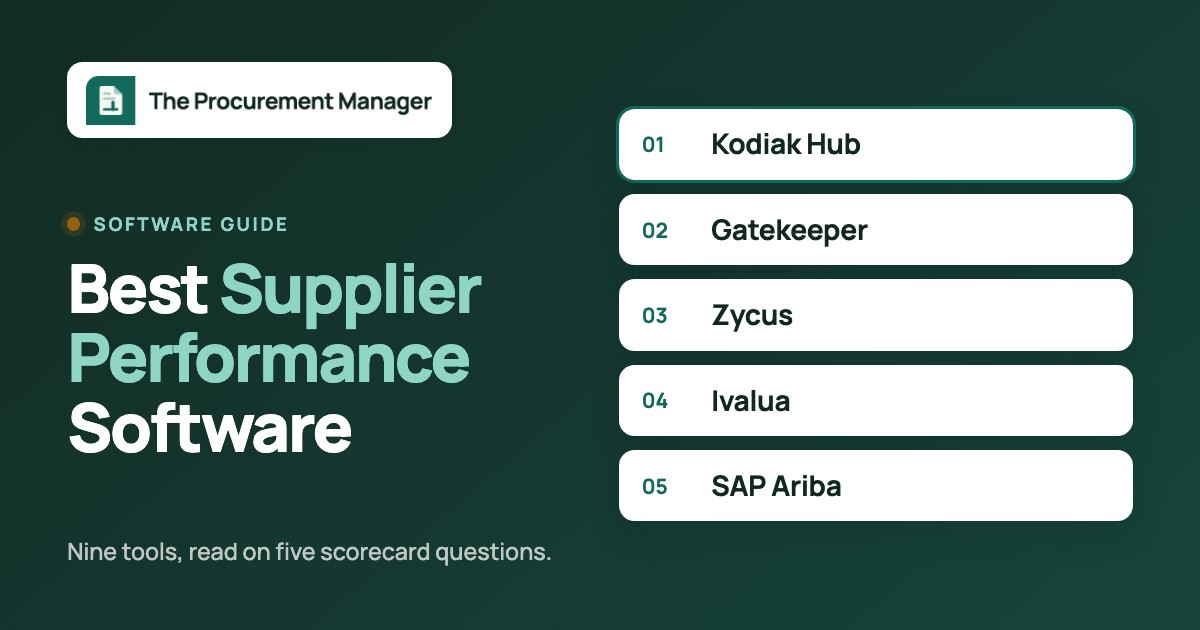
The best supplier performance management software depends on where your performance data lives. If it lives in stakeholder surveys and contract service levels, look at Gatekeeper and Kodiak Hub. If it lives in an ERP and you already buy through a source-to-pay suite, the scorecard modules in Ivalua, SAP Ariba, JAGGAER, GEP SMART, Coupa and Zycus score suppliers from data the suite already holds. If you manage a small group of strategic suppliers through joint plans and reviews, Vizibl is built for that.
Supplier performance management software measures how well suppliers deliver against the terms you agreed, scores them on a scorecard, and tracks the actions that follow when a score drops. We compared nine tools on the same five scorecard questions: what feeds the score, how it's weighted, who is asked, what happens to a weak score, and where the result goes. Where a vendor's public pages say nothing about one of them, the table says "not documented" instead of guessing.
What is supplier performance management software?
Supplier performance management (SPM) software is a system that collects delivery, quality, cost and service data about each supplier, turns it into scorecards against agreed targets, and tracks the corrective actions that follow. SPM is the practice of measuring a supplier's actual performance against the expectations set in the contract, finding the gaps and agreeing actions to close them (Wikipedia). Vendor performance management software is the same category: it usually describes service and IT vendors measured on service levels rather than goods suppliers measured on delivery and defects, and the tools in this list cover both.
Supplier performance management is narrower than supplier relationship management. SPM checks that a supplier delivers what the contract promises, while relationship management is the wider, two-way work with strategic suppliers, and performance is one input to it (Wikipedia). Our guides to supplier relationship management software and vendor relationship management software cover that wider job. It's also not risk screening. A scorecard answers "how well does this supplier deliver?", while risk tools answer "how likely is this supplier to fail or expose us?", which is the subject of our list of supplier risk management software. Several tools below show both on one record, and the five-question table says which.
Performance monitoring is also a compliance matter in some industries. ISO 9001:2015 clause 8.4.1 requires an organization to set criteria for the evaluation, selection, monitoring of performance and re-evaluation of external providers. A scorecard with a history of dated scores is the usual way to show an auditor that this happens. For the wider category, see supplier management software.
- Decide first where the score comes from. Surveys and contract service levels point to Gatekeeper or Kodiak Hub. ERP and receiving data point to the suite modules in Ivalua, SAP Ariba, JAGGAER, GEP SMART, Coupa or Zycus.
- Only five of the nine tools document weighted KPIs, and only three document SLA tracking. Ask every vendor for the default KPI list and how weights are set before the demo.
- None of the nine publishes a price on its own site. Gatekeeper at least says plans are sized by the number of third parties. Plan for a quote process and ask for the number at your supplier count.
- A scorecard doesn't fix anything by itself. Check what happens to a weak score: an action with an owner and a due date, a link to the renewal, or nothing.
Our picks by job
 Best for configurable scorecards by supplier typeKodiak HubPredefined and custom KPIs with configurable weights and targets, and scorecards that link to audits and corrective actions.
 Best for scoring against contract service levelsGatekeeperScheduled stakeholder surveys, a Performance Quadrant and a renewal workflow on the same record as the contract.
 Best for joint plans with strategic suppliersViziblShared goals, QBRs and 360 surveys in a workspace both sides can see.
 Best for AI agents tracking SLAs and riskZycusBuyer-defined KPIs, SLA tracking by agents and supplier corrective action requests.
 Best for multi-ERP buyers tying scores to contractsIvaluaScorecard templates, issue management and shared action plans in the supplier portal.
 Best for SAP buyers scoring through surveysSAP AribaScorecards built from template masters, with KPI values mostly taken from stakeholder surveys.
 Best for automatic improvement plansJAGGAERDevelopment and corrective action plans start when a supplier's performance declines.
 Best for improvement plans with milestonesGEP SMARTScorecards by category or supplier, SLA monitoring and action plans with an audit trail.
 Best if you already run CoupaCoupaPerformance feedback captured in transactions, with health ratings and risk feeds in one view.
 Our product · for the decision at renewalThe Procurement ManagerRoutes each contract renewal to the business owner, Finance and IT before the notice deadline.
Supplier performance management software compared
- tools compared
- 9
- publish a price on their own site
- 0
- document weighted KPIs
- 5
- document SLA tracking
- 3
| Tool | Type | Scorecard approach | Starting price | G2 rating |
|---|---|---|---|---|
| Kodiak Hub | Supplier relationship management (SRM) | Configurable KPI scorecards, audits and corrective action workflows | Not published, quote only (modular SaaS licence) | 4.8 (Capterra, 14) |
| Gatekeeper | Vendor and contract management | Survey-fed scorecards against contract service levels, flowing into the renewal workflow | Not published, quote only, plans sized by number of third parties (Pro up to 250, Enterprise up to 750, Enterprise Plus 750+) | 4.5 (96) |
| Vizibl | Supplier collaboration workspace | Shared goals, QBRs and 360 surveys with strategic suppliers | Not published | No reviews yet |
| Zycus | Source-to-pay suite with supplier management and AI risk | Buyer-defined KPIs and SLAs scored by AI agents, plus supplier corrective action requests | Not published | No reviews yet |
| Ivalua | Source-to-pay suite with supplier information management | Scorecard templates, issue management and shared action plans in the portal | Not published, quote only (a third party reports a buyer-reported floor near $150,000 per year) | No reviews yet |
| SAP Ariba | Enterprise source-to-pay and sourcing | Scorecards whose KPI values mostly come from stakeholder surveys | Price upon request, no public buyer rate | 7.6/10 (TrustRadius, 770) |
| JAGGAER | Source-to-pay suite with supplier management | Dashboards and scorecards, with improvement plans started automatically | Not published, custom quote | 4.1 (86) |
| GEP SMART | Source-to-pay suite with sourcing module | Quantitative and qualitative scorecards with SLA monitoring and action plans | Not published | No reviews yet |
| Coupa | Enterprise spend management and procurement | Transaction-time feedback, health ratings and risk feeds in one view | Custom buyer quote; no public US rate card verified | 6.9/10 (TrustRadius, 171) |
| The Procurement Manager Our product | Contract renewal decisions | Routes renewal reviews to the business owner, Finance and IT before the notice deadline | From $49 per month, flat, no per-seat fees (Starter, up to 50 contracts) | No reviews yet |
Prices as published by each vendor, checked between October 24 and November 10, 2026. Quote only means no public price. Ratings are shown with their source and scale; where a rating covers a whole suite it's labelled that way.
What each tool uses to build a score
We read vendor material and did not run these products. "Not documented" means the vendor's public product, help and pricing pages say nothing about that point, not that the tool lacks it. Ask for it in the demo.
| Tool | What feeds the score | How KPIs are weighted | Who is asked | What a weak score triggers |
|---|---|---|---|---|
| Kodiak Hub | ERP measures, stakeholder evaluations, supplier-submitted data, external risk data | Configurable weights, thresholds and targets; method not documented | Stakeholder evaluations; survey design not documented | Actions with deadlines in the supplier record; audits can start corrective action workflows |
| Gatekeeper | Scheduled stakeholder surveys, contract, invoice and spend data | Weighted total per reviewer; overall score is the median of reviewer totals | Internal stakeholders in scheduled surveys | Renewal workflow can flag a vendor for renegotiation, remediation or replacement |
| Vizibl | Supplier data pulled in or requested from the supplier, shared goals | Not documented | Both sides in 360 surveys and QBRs | Roadmaps of targets; a corrective action workflow isn't documented |
| Zycus | Internal delivery, quality and AP history, plus Dun & Bradstreet, RapidRatings and EcoVadis data | KPIs and weights set by the buyer; method not documented | Not documented | Supplier corrective action requests; AI-recommended mitigation |
| Ivalua | Operational KPIs, compliance data, external risk indicators | Thresholds and weighting per the vendor's blog; defaults not documented | Structured assessments; surveys not documented | Corrective actions, improvement plans and issues with owners, shared in the supplier portal |
| SAP Ariba | Survey answers (most common), Ariba reports or manual entry | KPI weights and target grades from template masters | Stakeholders through surveys | Scorecards can hold an issue resolution plan; formal improvement workflow not documented |
| JAGGAER | Existing business systems through connectors | Not documented | Not documented | Development and corrective action plans start automatically when performance declines |
| GEP SMART | ERP, accounts payable, sourcing and contracting data; supplier self-evaluation in a customer example | Not documented | Not documented; surveys not mentioned | Action plans with milestones, assignments and an audit trail |
| Coupa | User feedback captured in transactions, outside and community data, risk feeds | Not documented | Users at the time of the transaction | Prescriptive recommendations and supplier holds; formal improvement plans not documented |
What does a supplier scorecard track?
A supplier scorecard usually tracks delivery, quality, cost and responsiveness, each as a number that can be compared with a target. The measures should be chosen by business need and written into the contract or statement of work, otherwise the supplier has nothing to be held to. The table lists the measures most scorecards start from and how each is calculated.
| Measure | What it shows | How it's calculated |
|---|---|---|
| On-time delivery | Share of supplier orders delivered by the original requested date | On-time deliveries divided by total deliveries, times 100 |
| On-time in-full (OTIF) | Share of orders that arrive both on time and complete | On-time and complete deliveries divided by total deliveries, times 100 |
| Defect rate (PPM) | Quality of what arrives | Defective parts divided by parts received, times 1,000,000 |
| Lead-time adherence | Whether the agreed lead time is kept | Actual lead time against the agreed lead time, per order |
| Price variance | Whether invoices match contracted prices | Actual price minus contracted price, per line |
| SLA attainment | Service vendors: uptime, response and resolution times | Measured result against each service level in the agreement |
Delivery measures compound, which is why OTIF looks worse than on-time delivery alone. A perfect order needs every dimension right at once: on schedule, complete, undamaged, billed correctly and documented. Five dimensions that each score 95% give a perfect-order rate of about 77%. KPMG, citing APQC data, puts the median perfect-order rate near 90% and top-quartile performers at 95% or higher (KPMG).
Weights decide what the score rewards. A manufacturer might weight quality 40%, delivery 30%, cost 20% and service 10%, while a services buyer would put most of the weight on SLA attainment. These numbers are an illustration, not a standard, and you'll want your own. If you change weights for one supplier, scores stop being comparable across suppliers, which defeats the point of a scorecard. SAP says the same about its own scorecards.
Formal rating scales exist outside procurement software. The US Federal Acquisition Regulation evaluates contractor performance at least annually and when work completes. It uses factors such as technical quality, cost control and schedule, rates them on five levels from exceptional to unsatisfactory, and lets the contractor comment (FAR 42.15). It's a useful reference when you design your own scale.
How does a supplier score turn into action?
A score turns into action when someone owns the follow-up. The flow below shows the four steps and which tools in this list cover each one most clearly. Collecting data and scoring are where most tools overlap, while fixing the problem and deciding at renewal are where they differ.
- Step 1Collect the data
- Kodiak Hub
- JAGGAER
- Coupa
Where it breaks scores rest on surveys nobody answers or on ERP fields that are empty - Step 2Score against targets
- Gatekeeper
- SAP Ariba
- Zycus
Where it breaks weights change per supplier and scores stop being comparable - Step 3Fix the gap
- Ivalua
- GEP SMART
Where it breaks an action has no owner or due date - Step 4Decide at renewal
- Gatekeeper
- The Procurement Manager
Where it breaks the score exists but nobody reads it before the notice deadline
For a serious miss, quality teams often use a supplier corrective action request (SCAR). A typical SCAR runs in four phases. The buyer sends a request that describes the nonconformity, the response expected and due dates. The supplier contains the problem, finds the root cause, proposes corrective and preventive action and verifies it. The buyer reviews the response and sends it back if it falls short. Last, the case is approved and documented. A formal SCAR suits major interruptions or systemic issues, while a one-off miss is usually raised directly first. Tools with a SCAR or corrective action workflow in their public pages are Zycus, Kodiak Hub, JAGGAER and Ivalua.
Dedicated scorecard and supplier relationship tools
The three tools below are built around the supplier record and the relationship, not around purchasing transactions. They sit next to your ERP and read from it or from the people who work with the supplier.
Kodiak Hub
Kodiak Hub
Modular SRM platform that collects supplier data through self-registration and assessment campaigns and turns it into risk and performance scorecards.
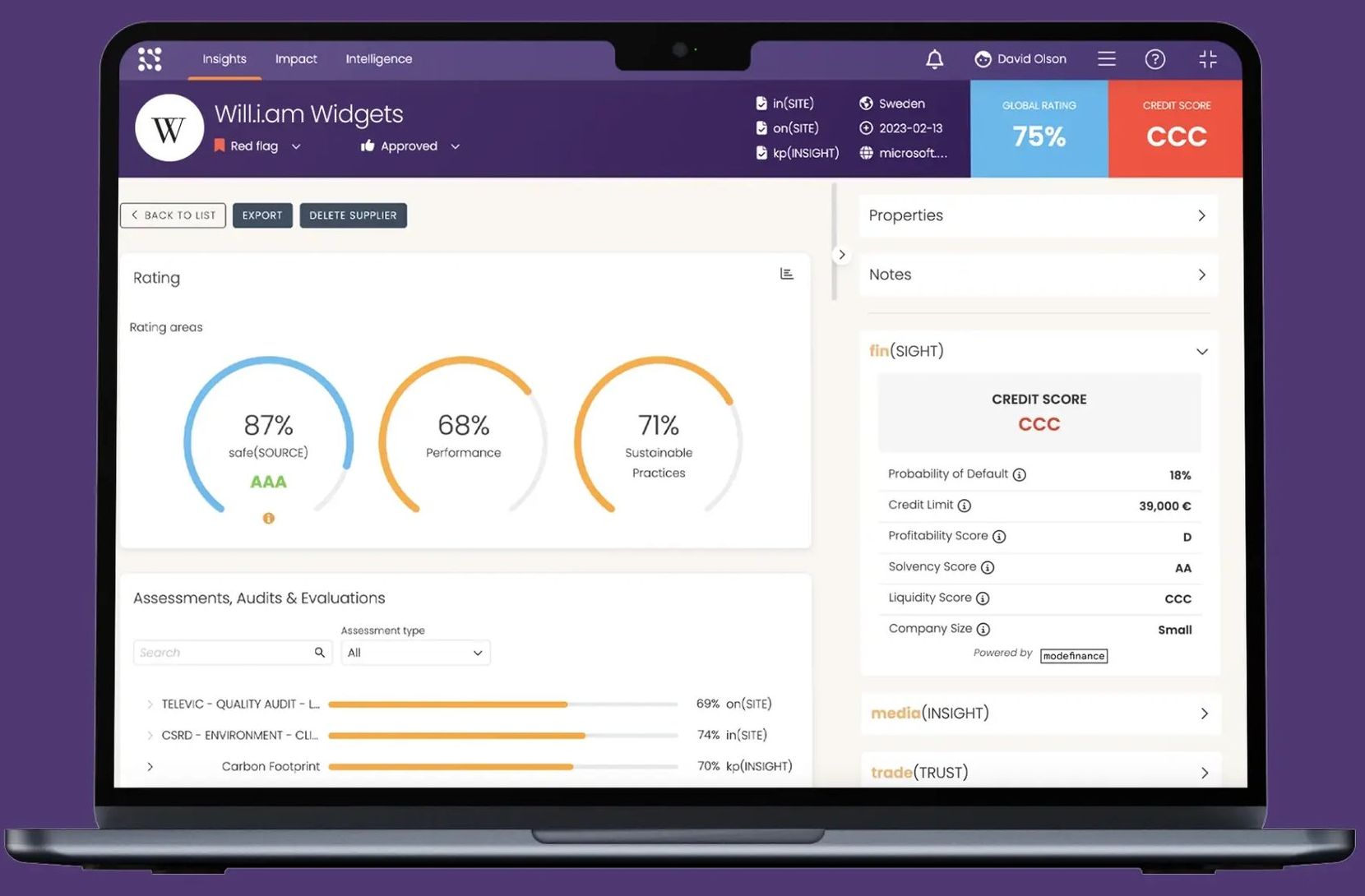
Kodiak Hub is a modular supplier relationship platform that builds configurable scorecards from ERP measures, stakeholder evaluations, supplier-submitted data and external risk data.
The vendor's performance page lists predefined and customizable KPIs for quality (defects, complaints, non-conformities, audit findings), delivery reliability, corrective action progress and stakeholder feedback, plus cost, risk, compliance, ESG, responsiveness and innovation. Weights, thresholds, targets and rating models can be configured by supplier criticality, category and relationship type, and different scorecards can be used for strategic, direct-material, service and contract-manufacturer suppliers. When a score falls below target, the buyer assigns actions with deadlines to suppliers and internal stakeholders and tracks them in the supplier record, and audits can start corrective action workflows. Each rating links back to its supporting data, with trends over time.
- you want suppliers to register and answer assessments themselves, with sustainability and compliance questions built in
- your ERP or source-to-pay suite stays the system of record and you need an SRM layer for scorecards and risk on top
- you need to budget before the first sales call: Kodiak Hub sells its SRM modules as a quoted licence
- reporting is your main requirement: several reviewers call it the weakest part
- Users like
- Ease of use, all supplier data and documents in one place, and an easier ERP integration than older SRM platforms.
- Users dislike
- Reporting that isn't fully developed yet, module names some users find confusing, and, for one reviewer, a platform that's hard to customize.
- Source: Capterra, 14 reviews
How it works in practice
On Capterra, Kodiak Hub holds 4.8 out of 5 from 14 reviews. Reviewers praise ease of use, having supplier data and documents in one place and an easier ERP integration than older platforms, but they name reporting that isn't fully developed and module names some users find confusing (Capterra reviews). On G2 it shows 4.4, and reviewers mention responsive support and an English-only interface. The vendor doesn't publish a price and sells by demo request.
- Starting price
- Not published, quote only (modular SaaS licence)
- Also on G2
- 4.4 out of 5 from 31 reviews
- Risk data
- Financial, sanctions and PEP, adverse media, country risk modules
- Supplier join
- Self-registration through a configurable sign(UP) form
- Supplier SSO
- Single sign-on offered, ISO/IEC 27001 certified
- Evidence source
- Supplier self-assessments plus external risk signals
- Assessments
- Template builder and library covering 15 business and sustainability areas
- Corrective actions
- Findings feed workflows and improvement projects
- Score inputs
- ERP, stakeholder evaluations, supplier assessments, external risk data
- Weak score
- Actions with deadlines in the supplier record
- Not documented
- Scorecard cadence, SLA tracking, survey design
Gatekeeper
Gatekeeper
A platform that keeps vendor records, contracts, spend and renewals on one record, with date-based triggers that start a renewal review workflow with approvers and escalation.
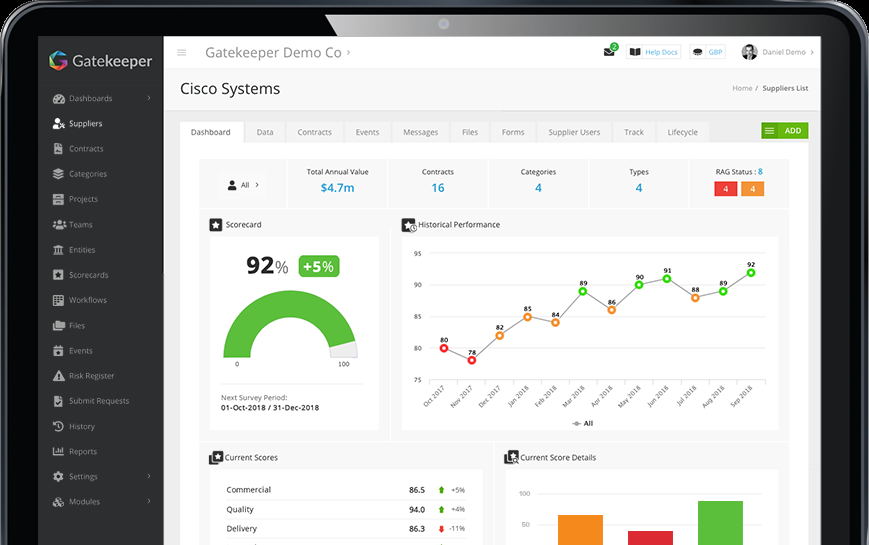
Gatekeeper keeps vendors, contracts, spend and risk on one record and scores vendors against the service levels written into their contracts.
Scorecards are fed by scheduled, automated stakeholder surveys, with contract, invoice and spend data on the same record. Per the help centre, a weighted total is calculated for each reviewer across the scorecard dimensions and the overall score is the median of those totals, which limits the effect of one outlier. The score uses the most recent survey period, and history is kept per period. A Performance Quadrant plots vendors by contract spend against survey performance, and red, amber and green alerts drive escalation. Scores and risk insights feed the renewal workflow, where a vendor can be flagged for renegotiation, remediation or replacement. Balanced scorecards are included from the Enterprise plan upward.
- you want vendor risk, onboarding, spend and contract renewals in one system with approval workflows and escalation to a team manager
- you run NetSuite or need many system connections and want unlimited contracts, users and e-signature licenses
- you want self-serve pricing: every plan is quote only and sized by third-party count
- you only need a simple repository with date reminders: the workflow setup is more configuration than a basic tracker needs, and notice dates cannot be set automatically
- Users like
- efficient contract processing, per G2's summary of reviews
- Users dislike
- limited customization and slowdowns with larger data sets, per the same summary
- Source: G2, 96 reviews
How it works in practice
On G2, Gatekeeper holds 4.5 out of 5 from 96 reviews. Reviewers praise ease of use, easy integration and strong support, but they name limited customization and slowdowns with larger data sets (G2 reviews). Gatekeeper doesn't publish a price. Plans are sized by the number of third parties: Pro up to 250, Enterprise up to 750 and Enterprise Plus above that, with unlimited users on all plans. It lists native two-way sync with NetSuite and connectors for Sage, Xero, QuickBooks, Microsoft Dynamics 365 and Workday, and says it doesn't replace an ERP.
- Starting price
- Not published, quote only, plans sized by number of third parties (Pro up to 250, Enterprise up to 750, Enterprise Plus 750+)
- Pricing
- Quote only, by third-party count
- Plan tiers
- Pro (250), Enterprise (750), Enterprise Plus (750+)
- Default renewal triggers
- 90 days before notice date and end date
- Vendor portal
- Invitation or self-registration link, scored questionnaires, document upload, two-factor authentication for every portal user
- Evidence source
- SIG Lite questionnaire plus SecurityScorecard and Creditsafe data
- Questionnaire
- SIG Lite, 169 questions, pre-scored, annual refresh
- Risk Module
- Risk register scored from probability and impact
- Risk checks (checked 2026-11-06)
- Screens identity and sanctions, financial health and security posture before signing; monitors financial stability, cyber posture and sanctions afterwards
- Risk response
- A detected risk triggers outreach workflows and alerts management; non-compliant vendors can be blocked
- Plans by third-party count
- Pro up to 250, Enterprise up to 750, Enterprise Plus 750-plus; unlimited users and contracts on all plans
- Risk register
- Risk register and heat map on all plans
- NetSuite
- Native two-way sync
- Score inputs
- Stakeholder surveys, contract, invoice and spend data, credit and cyber monitoring
- Weak score
- Flag for renegotiation, remediation or replacement in the renewal workflow
- Not documented
- Named KPIs, weight values, survey frequency, a separate corrective action plan feature
Vizibl
Vizibl
A shared workspace where buyers and strategic suppliers run joint projects, goals, digital business reviews and relationship surveys.
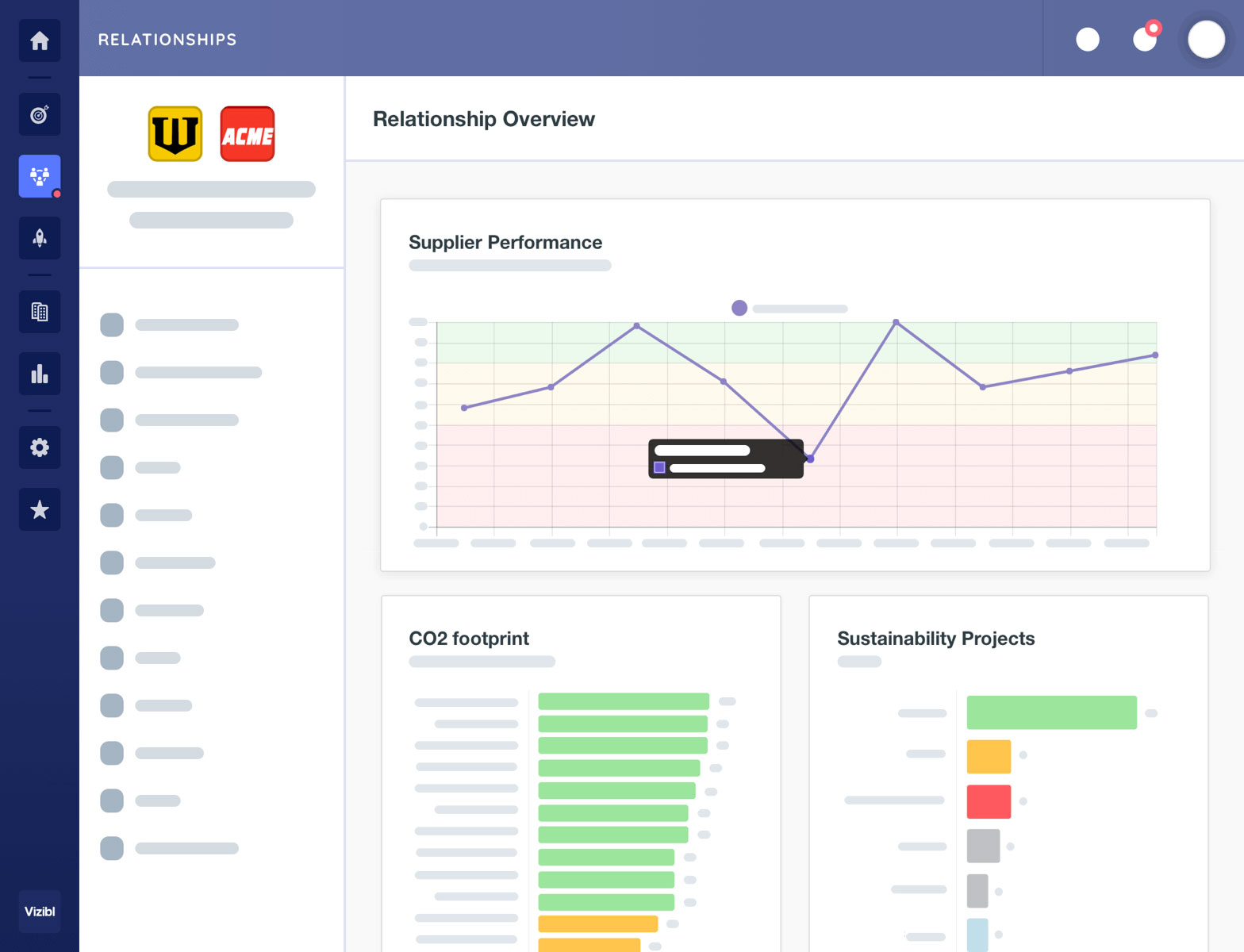
Vizibl is a shared workspace where buyers and strategic suppliers run joint goals, quarterly business reviews, 360 surveys and projects.
The product page says users can track and manage supplier performance quantitatively in real time and that suppliers can see their own performance. Data can be pulled in from other sources or requested from the supplier directly. Out-of-the-box and custom dashboards cover supplier spend, risk and performance. A sustainability module supports CDP and SBTi frameworks or custom frameworks, with per-supplier and rolled-up scores and roadmaps of incremental targets. The public pages name no scorecard structure, KPI list or weighting, and no ERP-based scoring. Instead of a transaction-fed scorecard, it fits relationship-led performance work more than a transaction-fed scorecard.
- the main goal is joint projects and digital QBRs with a small set of strategic suppliers on a shared plan
- supplier innovation or sustainability programs need a shared workspace rather than a KPI scorecard tool
- you need a weighted KPI scorecard: none is documented on the pages read
- you need a published price or a named ERP integration: neither is published
How it works in practice
Vizibl has no reviews on G2 or TrustRadius, so there is no independent rating to quote. The vendor doesn't publish a price on its own site, and G2 shows a vendor-provided Basic price of 1,000 pounds with no period or scope, which we can't interpret. Ask what a strategic supplier cohort costs.
- Starting price
- Not published
- Review loop
- Digital QBRs tied to a Shared Vision and Joint Business Plan
- Relationship health
- 360 degree surveys from both sides
- Workspace
- Joint projects, tasks, documents and value trackers
- Score inputs
- Supplier-provided data, shared goals, 360 surveys
- Weak score
- Roadmaps of targets; no general corrective action workflow documented
- Not documented
- KPI list, weighting, SLA tracking, ERP integrations
Suite modules for source-to-pay buyers
The six tools below score suppliers inside a source-to-pay suite. The advantage is that delivery, invoice and contract data are already in the suite, but the catch is that the scorecard is one module of a large purchase, and prices are quoted for the whole platform.
Zycus
Zycus
Zycus is a source-to-pay suite whose supplier management and iRisk modules score suppliers against buyer-defined KPIs and contracted SLAs, with AI agents, risk cards and supplier corrective action requests.
Zycus is a source-to-pay suite whose supplier management and iRisk modules score suppliers against buyer-defined KPIs and contracted SLAs using AI agents.
The buyer defines the KPIs and assigns weights. Internal signals named on the vendor's pages are delivery, quality and accounts payable history, and external risk data comes through integrations with Dun & Bradstreet, RapidRatings and EcoVadis. Agents continuously score active suppliers, track performance against contracted SLAs, and raise real-time alerts. For performance gaps the buyer can send a supplier corrective action request, and the Merlin assistant recommends mitigation actions. Merlin Community Intelligence compares suppliers against industry benchmarks, and risk cards and dashboards show financial, ESG, legal and compliance risk. Vendor master data syncs with SAP, Oracle and Workday.
- You want AI agents scoring suppliers against contracted SLAs with risk data from D&B, RapidRatings and EcoVadis in the same suite.
- You want SCAR workflow plus industry benchmarking (Merlin Community Intelligence) alongside source-to-pay.
- You need a documented KPI library, survey tooling or segmentation model; the public pages do not describe them.
- You want a published price or a large body of supplier-management-specific user reviews; neither is available.
How it works in practice
Zycus has no dedicated rating for supplier management. One G2 review of the Zycus source-to-pay listing says the supplier management system needs many checks filled in by suppliers, which is hard for suppliers to adopt. The vendor doesn't publish a price.
- Starting price
- Not published
- Scoring inputs
- Internal delivery, quality and AP history plus external risk data
- Risk data partners
- Dun & Bradstreet, RapidRatings, EcoVadis
- Corrective action
- SCAR (supplier corrective action requests)
- Pricing
- Not published
- Score inputs
- Delivery, quality, AP history, external risk data
- Weak score
- SCAR and AI-recommended mitigation
- Not documented
- KPI library, survey tooling, segmentation, cadence
Ivalua
Ivalua
Ivalua is a source-to-pay suite whose supplier management module runs a branded supplier portal for onboarding and compliance and adds a supplier information management offering that cleanses supplier records and updates ERP records in bulk.
Ivalua is a source-to-pay suite whose supplier management module offers scorecard templates, structured assessments and issue management, and can tie weak scores to the contract.
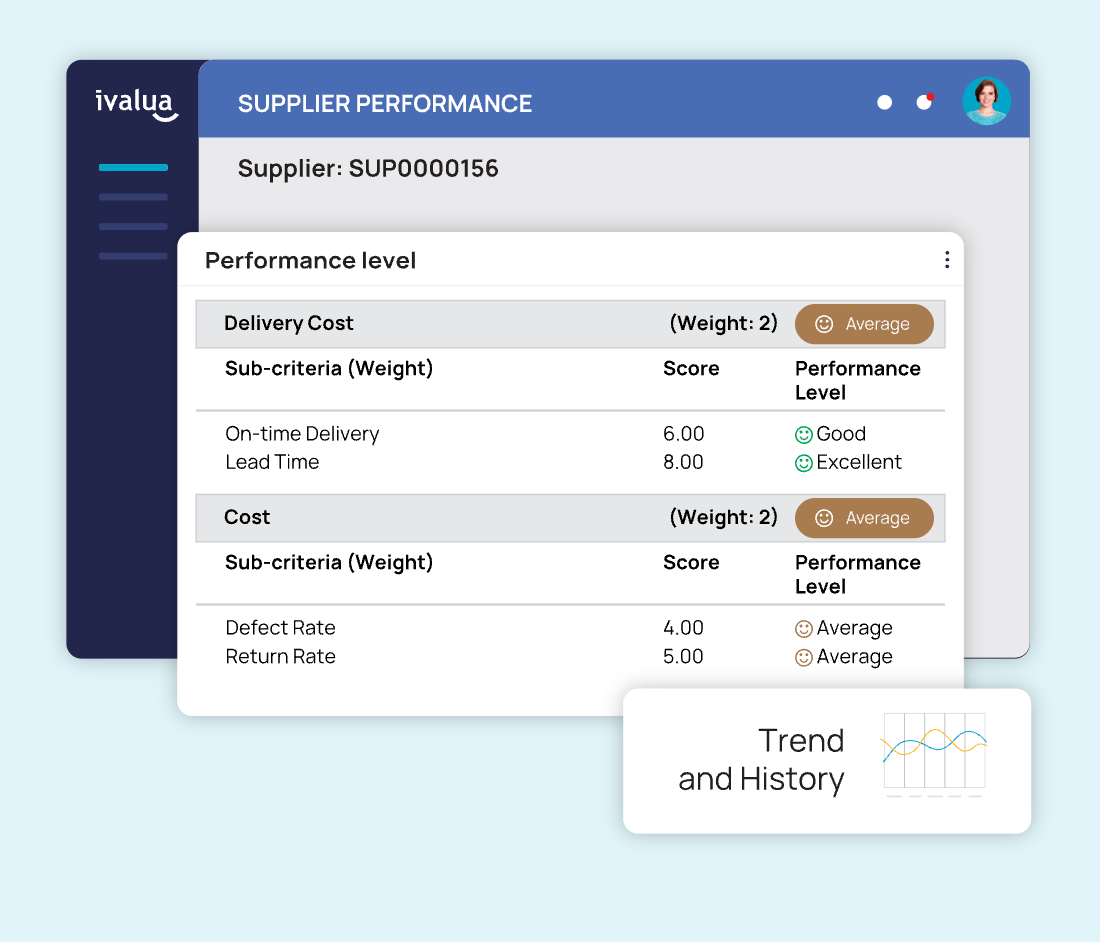
The vendor's pages describe AI-enabled scorecards and KPIs, and its blog frames typical scorecard dimensions as cost, quality, delivery and contract compliance, with risk, ESG and innovation as options. Scorecards use recurring logic, thresholds and weighting, and the blog describes quarterly composite scores used in renewals. Operational KPIs are combined with compliance data and external risk indicators, normalized across multiple ERPs. Corrective actions and AI-powered improvement plans carry owners and tracking, issue management has categories, alerts and follow-up, and a shared buyer-supplier portal holds action plans with logged steps. A weak score can be linked to contract lifecycle management to trigger a review.
- you run several ERPs and want supplier records cleansed on demand in a review workbench and bulk-updated back to those ERPs
- you want onboarding, ESG disclosures, banking details and certifications collected through one branded supplier portal inside a source-to-pay suite
- you want a published price: Ivalua shows only demo and contact buttons
- you need named tax-ID or bank-check providers confirmed: the published vendor pages describe validation but name no provider
How it works in practice
On G2, Ivalua shows 4.3 out of 5, and reviewers describe an interface favored by enterprise users (G2 reviews). Ivalua doesn't publish a price. A third-party report puts a buyer-reported floor near $150,000 per year, which we could not confirm with the vendor.
- Starting price
- Not published, quote only (a third party reports a buyer-reported floor near $150,000 per year)
- Supplier portal
- Branded portal for onboarding, compliance and document sharing
- Record cleanup
- On-demand cleansing with a review workbench, bulk updates to ERP supplier records
- Approvals
- Smart approval workflows for governance
- Sourcing events
- RFI, RFP and RFQ from templates with multi-round RFx; multi-lot Dutch, English and Japanese auctions
- Award analysis
- Sourcing Decision Center uses AI and mathematical optimization, a scenario library and natural-language rule-based scenarios
- Supplier discovery
- Search the supplier repository or the web using the event's criteria
- Handoff after award
- Native link to Ivalua Contract Management; PO creation from an award is not described
- Spend classification
- Spend is classified on demand with standard or custom taxonomies. Business users create and edit classification rules without coding, and classifications refresh as new data arrives. Direct, indirect and T&E spend can be analyzed together.
- Category strategy
- Category management module offers an AI-assisted category cockpit: flag strategic categories, build action plans using AI-generated category intelligence, and share the strategy with stakeholders.
- Savings tracking
- Spend analysis ranks savings, sourcing and consolidation opportunities by financial impact, risk and feasibility, links them to sourcing workflows and tracks results. The category module adds configurable analytics for savings and compliance.
- Category supplier view
- Supplier segmentation is described as a category management activity, not as a standalone module feature. The spend analysis page says little about supplier performance beyond risk monitoring and supplier consolidation.
- Score inputs
- Operational KPIs, compliance data, external risk indicators across ERPs
- Weak score
- Corrective actions, issues and shared action plans; can trigger a contract review
- Not documented
- KPI library, default weights, surveys, SLA tracking, benchmarking
SAP Ariba
SAP Ariba
SAP's source-to-pay suite covering sourcing events with scoring and award simulation, buying and invoicing, contracts and supplier collaboration through SAP Business Network.
SAP Ariba Supplier Lifecycle and Performance is the supplier management module of SAP's source-to-pay suite, with scorecards whose KPI values mostly come from stakeholder surveys.
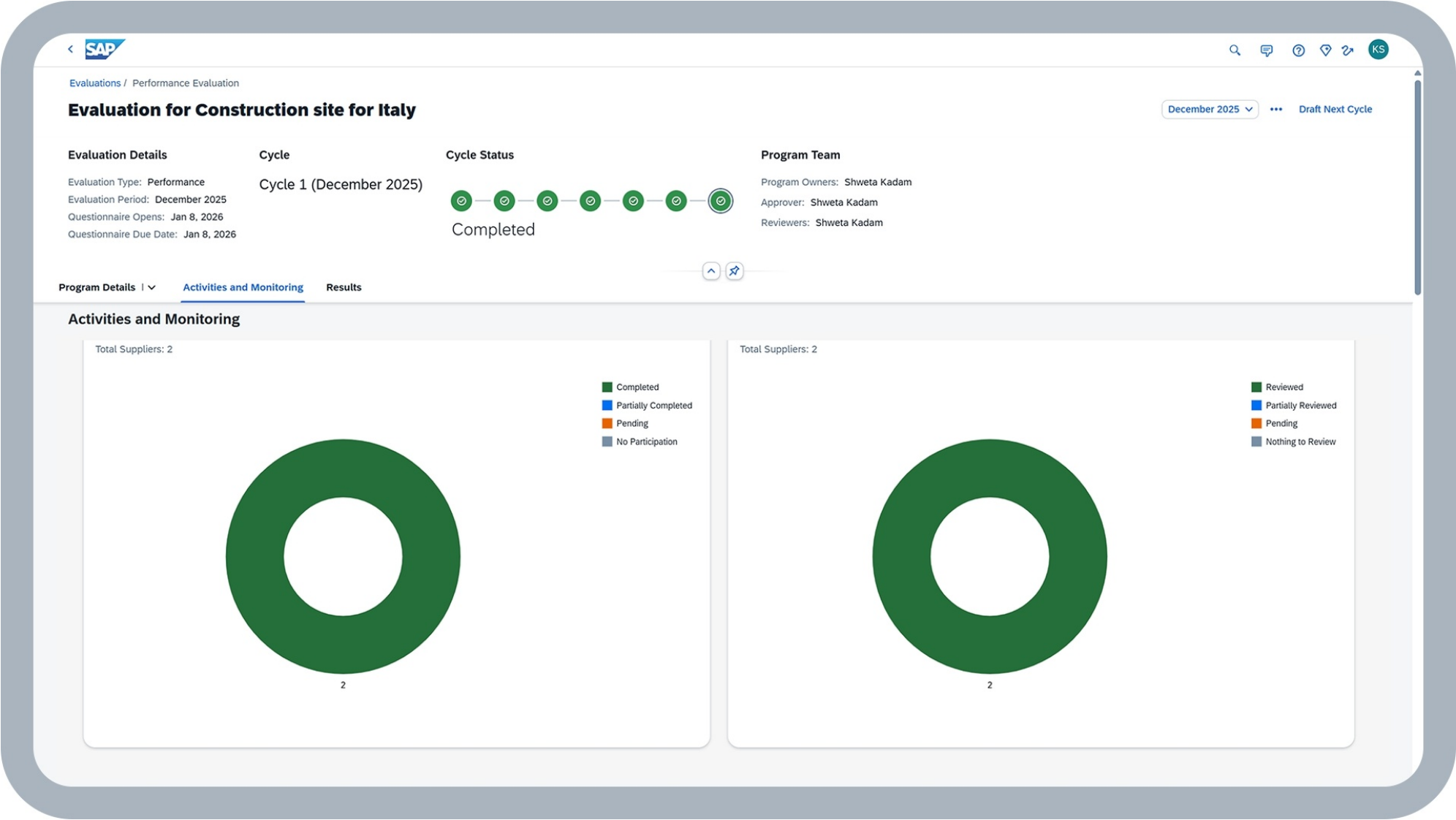
Scorecards are copied from template masters that hold sections and KPIs, including KPI weights, target grades and pre-grades. KPIs should be master KPIs created in the sourcing library so reports can roll up the same KPI across projects. KPI values can come from surveys, which is the most common source, from Ariba reports or from manual entry by the scorecard owner. Weights can be changed per scorecard, but SAP notes this reduces comparability between suppliers, and it names contractual SLAs as one reason to adjust them. Periodic scorecards and surveys are generated from master documents on a recurrence. A scorecard can hold an issue resolution plan, according to SAP training material.
- your purchasing design is closely tied to SAP processes and master data
- supplier collaboration through SAP Business Network is a central buying requirement
- you want a published buyer price and a quick rollout
- your only requirement is renewal-owner reminders without a source-to-pay suite
- Users like
- Punch-out catalogs and guided buying with approval workflows that standardize how people buy.
- Users dislike
- An outdated interface, weak reporting and hard integration with non-SAP ERPs.
- Source: TrustRadius, 770 ratings
How it works in practice
On G2, the SAP Ariba listing holds 4.1 out of 5 from 817 reviews, and the category summary tags ease of use as the top pro and complexity as the top con. That rating covers the whole Ariba product line, not only this module. SAP offers the module on a price-upon-request basis.
- Starting price
- Price upon request, no public buyer rate
- Buying and Invoicing pricing
- Price upon request, priced on processed spend
- Standard supplier account
- Free on SAP Business Network, unlimited documents
- Enterprise supplier account
- Fixed subscription level fee plus transacted volume
- Supplier order flow
- PO confirmation, ship notices, PO flip invoices, invoice and payment status
- Sourcing events
- RFI, RFP, multi-round bidding and English, Dutch, Japanese, total-cost, traffic-light, basket and lot auctions (SAP slides dated May 2022)
- Award analysis
- Scoring and grading, bid comparison report, award scenario comparison and one-click awarding; AI bid summaries and award simulation on the product page
- Supplier discovery
- Search by industry, item or service in SAP Business Network Discovery; profiles show certifications and ESG data
- Handoff after award
- Follow-on documents such as POs, purchase info records and scheduling agreements in an external system; links to SAP Ariba Contracts
- Spend classification
- The newer Spend Analysis and Insights offer maps spend to UNSPSC (incl. v25) or a custom taxonomy, with a stated 95% accuracy, and ingests SAP Cloud ERP, Ariba, Fieldglass, Concur plus non-SAP data.
- Category strategy
- Guided strategy process with category profiles, hierarchy management, Kraljic, PESTLE, SWOT and Porter's Five Forces frameworks, AI-curated market intelligence (third-party content from Beroe), generative AI drafts, and approval workflow.
- Savings tracking
- Managers pick value levers, goals and KPIs per category, document initiatives with owners, timelines and estimated outcomes, and follow them in a monitoring workbench, dashboard and calendar view. Savings accounting rules are not detailed publicly.
- Category supplier view
- Category segmentation and cost structure analysis are listed features, and the Kraljic matrix segments categories or suppliers by supply risk and profit impact. Supplier performance scorecards belong to separate Ariba supplier management modules.
- Score inputs
- Survey answers, Ariba reports, manual entry
- Weak score
- Issue resolution plan on the scorecard
- Not documented
- Dedicated SLA tracking, segmentation, benchmarking, ESG or financial-health feeds
JAGGAER
JAGGAER
JAGGAER is a source-to-pay suite whose supplier management module gives suppliers a portal with guided self-service onboarding, compliance checks and configurable workflows, plus automated verification of uploaded documents.
JAGGAER's supplier management offering includes configurable dashboards and scorecards that track metrics such as delivery times and product quality, and it starts improvement plans automatically.
Scoring runs from existing business systems through pre-built connectors to SAP, Oracle, Workday, Infor, NetSuite and more than 1,000 other applications. The vendor describes real-time, continuous evaluation across the supplier lifecycle and a 360 supplier snapshot that shows performance, risk and compliance in one view. Development and corrective action plans, marketed as AI-powered, start automatically when performance declines, and supplier corrective action requests are listed under supplier quality for manufacturers. Risk models cover factors such as financial stability and geographic risk, and ESG data from EcoVadis and CDP is scored against the customer's own policy.
- you want guided supplier self-service onboarding with configurable workflows inside a larger source-to-pay suite
- you want uploaded supplier documents verified automatically to cut manual review
- you need documented duplicate detection or change-approval rules: the supplier management page covers neither
- you want a published price: JAGGAER sells by custom quote only
- Users like
- Flexibility and configurability, strong support and consulting teams.
- Users dislike
- An inconsistent interface across modules, setup complexity and supplier-side feature limits.
- Source: G2, 86 reviews
How it works in practice
On G2, JAGGAER holds 4.1 out of 5 from 86 reviews. The category summary says reviewers praise flexibility and adaptability and a strong support team, and complaint themes were not readable (G2 reviews). JAGGAER sells by custom quote.
- Starting price
- Not published, custom quote
- Supplier portal
- Guided self-service with built-in compliance checks
- Documents
- Automated document validation (JAI)
- Integration
- Integrates with existing business systems, no ERPs named on the page
- Sourcing events
- RFI, RFP and RFQ from templates; reverse, forward, Dutch, Japanese and ranked auctions
- Award analysis
- Weighted scorecards, BAFO rounds and constraint-based optimization with unlimited what-if scenarios and line-level split awards
- Supplier discovery
- AI supplier recommendations, risk flags and Smart Quote suggested suppliers
- Handoff after award
- Sourcing feeds Contracts and Procure-to-Pay on one data layer; the steps are not detailed
- Integrations
- 40+ pre-built, including SAP, Oracle, Workday, NetSuite, Infor and JD Edwards
- Spend classification
- Automatic Spend Classification uses NLP on invoice text or product numbers to predict eCl@ss codes, and the same method can predict UNSPSC. It runs on demand or in batch. No accuracy figures published. Press release dates from 2019.
- Category strategy
- Category management page lists built-in Kraljic, SWOT and Porter frameworks, a stage-gated process with standard approvals and templates, and market intelligence such as commodity, FX and price indices plus 800+ category reports.
- Savings tracking
- A savings pipeline covers idea capture, validation and tracking from identified through realized. Mapping of savings to category targets or baselines is not detailed on the page.
- Category supplier view
- Page mentions a unified view of spend, supplier performance and market data, with category risk scored across supplier, financial, ESG and geopolitical factors. Supplier segmentation per category is not explicitly described.
- Score inputs
- Existing business systems through connectors
- Weak score
- Automatic development and corrective action plans
- Not documented
- KPI list, weights, surveys, SLA tracking, supplier-versus-peer ratings
GEP SMART
GEP SMART
GEP's source-to-pay platform, presented under the GEP Quantum Intelligence brand, runs RFx events and e-auctions in one place and moves awarded suppliers into contracting.
GEP SMART is a source-to-pay suite whose supplier management supports qualitative and quantitative scorecards with SLA monitoring and trend analysis by category, region and business unit.
Scorecards can be set up per category, country, supplier group or supplier and run on a schedule, for example quarterly. They draw on ERP, accounts payable, sourcing and contracting data, and a customer scorecard manual shows suppliers evaluating themselves in the portal. A Performance Monitor agent tracks supplier KPIs and trends and sends alerts when performance declines. Improvement is handled as structured, collaborative action plans with milestones, notifications, assignments and an audit trail. Further agents summarize financial, ESG and performance risk, and the vendor lists integrations with EcoVadis, OneTrust, Moody's, Dun & Bradstreet and others. ESG tracking is sold as a separate module.
- you want RFx, e-auctions and contracting from one vendor, since awarded suppliers flow into contracting
- you already run SAP Ariba, Coupa or an ERP and want a sourcing layer GEP lists as integrating with them
- you need a public price or a self-serve trial: GEP publishes neither
- you need detailed scenario award modeling documented: public pages describe it only at agent-summary level
How it works in practice
GEP SMART has no rating we could read on G2. The vendor doesn't publish a price.
- Starting price
- Not published
- Sourcing events
- RFx events including RFPs, plus e-auctions and live auctions
- Award analysis
- AI agents score bids against value drivers and model price, risk and performance tradeoffs; field-level setup is not shown
- Supplier discovery
- Supplier intelligence across categories and regions; a Supplier Discovery Agent uses performance and public data
- Handoff after award
- Awarded suppliers move into contracting; PO handoff is not described
- Integrations
- ERPs and S2P suites such as SAP Ariba, Coupa, Ivalua, SAP, Oracle and Microsoft Dynamics
- Spend classification
- Supports UNSPSC, SIC and custom enterprise taxonomies. An AI engine cleanses, normalizes and classifies each spend line, adds supplier parent-child links and duplicate detection. No accuracy figures published.
- Category strategy
- A Cat Strategy Agent drafts category strategies and updates them as markets move, recommending generic, specific or hybrid sourcing approaches. The page gives little detail on the step by step plan workflow.
- Savings tracking
- Opportunities become savings projects with milestones and live metrics. The pipeline moves projected savings to realized and checks results against targets. A sample view shows a 284,000 USD IT hardware opportunity.
- Category supplier view
- Supplier Intelligence monitors performance, risk and financial health continuously. A Performance Monitor Agent tracks supplier KPIs. No scorecard design or category based segmentation method is described.
- Score inputs
- ERP, AP, sourcing and contracting data, supplier self-evaluation
- Weak score
- Action plans with milestones and an audit trail
- Not documented
- KPI names, weighting, survey design, benchmarking
Coupa
Coupa
Enterprise source-to-pay suite whose requisitions run through guided buying, punchout and prioritized approval chains with budget meters.
Coupa's supplier risk and performance module sits inside its spend management platform and combines scorecards, health ratings, risk data feeds and performance feedback captured in transactions.
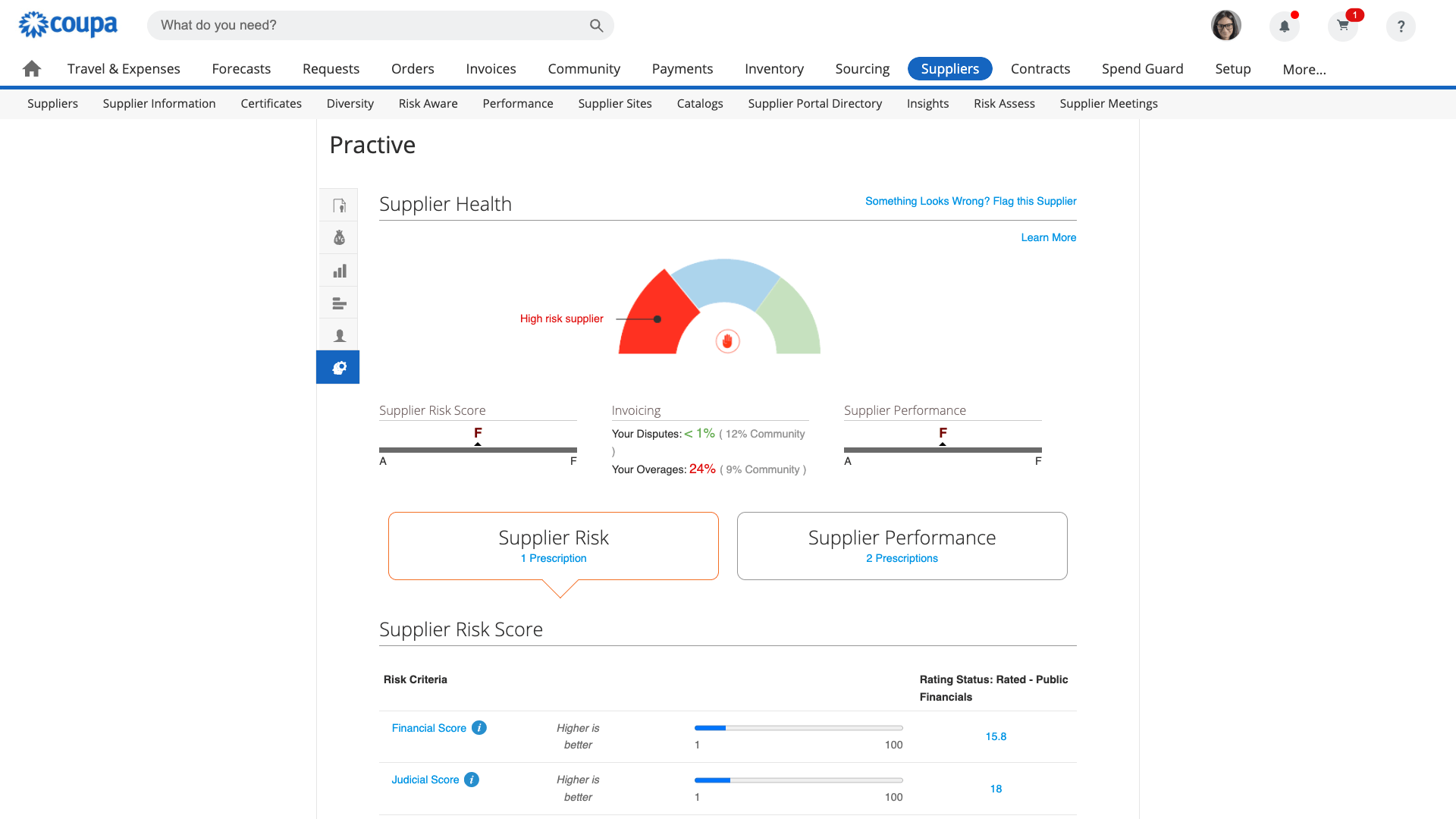
Users give performance feedback in the context of transactions, and Coupa adds outside data sources, community data and risk feeds. The vendor's datasheet describes scorecards and overall supplier health ratings, with KPIs charted automatically and compared with benchmarks. When a rating changes, the product page describes prescriptive recommendations such as putting a high-risk supplier on hold or reviewing alternatives, and risk teams can stop all transactions from purchasing to invoicing for a supplier. The Advanced tier lists risk scoring across relationship types and tiers and third-party risk mitigation plans. Named KPIs, weighting and survey cadence aren't documented on the public pages.
- you need fine-grained approval chains by account, commodity, item and amount across entities
- contract-compliant guided buying and punchout matter more than a quick rollout
- you're a small or mid-size team that wants a published price and a rollout in weeks
- your only requirement is renewal-owner reminders without enterprise spend management
- Users like
- Approval routing and spend compliance for indirect buying, with clear purchase limits per person.
- Users dislike
- Heavy integration work with ERPs such as SAP, and a supplier portal that confuses vendors asked to create profiles.
- Source: TrustRadius, 171 ratings
How it works in practice
On G2, Coupa holds 4.2 out of 5 from 570 reviews, and reviewers praise ease of use. That rating covers the whole Coupa platform, not this module. Coupa doesn't publish a price, and its datasheet says fees may apply for the risk data service.
- Starting price
- Custom buyer quote; no public US rate card verified
- Standard supplier portal
- Free for suppliers; Coupa Advanced is a paid supplier tier (SSO, API, QuickBooks and NetSuite sync)
- Buyer-side platform
- No verified public universal USD rate
- Requisition API
- Create and submit for approval
- Process Automator
- Document events and API call outs
- Supplier join
- Buyer invitation (link expires after 30 days), self-registration or a PO email
- Budget meters
- Show remaining budget per budget item before commitment
- Hard stop
- A budget-line setting blocks requisition submission over budget
- Dashboards
- Out-of-the-box dashboards, KPI benchmarking and savings insights
- Sourcing events
- RFP, RFI, RFQ and reverse auctions are listed in the FAQ (answer text not visible); routine events run from preapproved templates
- Award analysis
- Coupa Sourcing Optimization sets per-supplier caps, geography, tariffs and freight as constraints and compares scenarios side by side, with manual overrides
- Supplier discovery
- Pre-rated, pre-enabled suppliers filterable by diversity, rating or geography; AI suggests suppliers from category performance
- Spend analysis
- Cross-platform spend visibility, automatic classification and suggested opportunities such as expiring contracts
- Handoff after award
- Winning terms and rate cards pass into draft contracts in Coupa CLM and into catalogs on approval
- Spend classification
- AI engine maps transactions to a proprietary Coupa taxonomy of roughly 60 primary categories and 1,800 sub-categories, built for category management. It classifies by supplier first, using invoice and PO descriptions. Source post dates from 2022.
- Category strategy
- Coupa Category Strategy starts from a category taxonomy built on Coupa data, uses AI-guided stakeholder interviews and the Navi assistant for recommendations, and rolls every strategy into one portfolio view using a single methodology.
- Savings tracking
- Coupa describes tracking value through stages identified, negotiated, contracted and realized, to link negotiated savings to P&L impact. Initiative value can include non-cost benefits such as supplier relationships and resilience.
- Category supplier view
- Category Strategy page says it pairs with Coupa Supplier Information & Risk Management to segment suppliers, track performance and manage risk. Sourcing suggests suppliers from category performance. Segmentation criteria are not detailed publicly.
- Supplier risk module (checked 2026-11-06)
- Coupa Supplier Risk & Performance: monitoring of outside data sources, alerts, next-step recommendations and a supplier hold that can block transactions from purchasing to invoicing
- Risk datasheet (2021)
- Standard (onboarding, monitoring, scorecards) and Advanced (multi-domain assessments, inherent and residual scoring, multi-tier, mitigation plans); fees may apply for the Coupa risk data service
- Risk Assess
- Questionnaires across domains such as InfoSec, ABAC and GDPR, with alerts when risk increases
- Supplier risk price
- Not published, demo request only
- Score inputs
- Transaction-time feedback, outside and community data, risk feeds
- Weak score
- Recommendations and supplier holds
- Not documented
- KPI list, weights, scorecard cadence, SLA tracking, formal improvement plans
Vendor performance management for service and IT providers
Vendor performance management software is built for suppliers of services, software and IT, where the contract is a service level agreement (SLA) and performance means whether the service was delivered as promised. An SLA is a binding commitment that defines quality of service, availability and responsibilities. Typical objectives are uptime, mean time to repair, response time against resolution time and first-call resolution. A goods scorecard built on on-time delivery and defect rate doesn't fit that, so check how the tool takes in service levels.
Three tools in this list document service-level handling. Gatekeeper compares contracted amounts with actual invoices, flags overruns at 80% of contract value, and uses an AI agent to check reported service levels against contracted targets. Zycus says its agents track supplier performance against contracted SLAs. GEP SMART lists SLA monitoring. Vizibl takes a different route: shared goals and quarterly business reviews with the vendor. For IT vendors that also handle sensitive data, add a risk view, covered in our guide to third-party risk management software.
How to choose supplier performance management software
Start from your data, not from the feature list. A scorecard is only as good as the numbers behind it, so the first question is where delivery and quality data lives today and how it would reach the tool.
- Where does your supplier data live? If it sits in one ERP, a suite module or a tool with a native connector can score it automatically. If it sits in several ERPs, spreadsheets and people's heads, a tool that scores from surveys (Gatekeeper, SAP Ariba, Kodiak Hub) gets you started sooner.
- Do you want a standalone tool or a suite module? A standalone tool is quicker to adopt and can sit beside any ERP, but a suite module reuses the invoices, contracts and supplier master you already have but is priced and scoped with the whole platform.
- Which industry rules apply? Regulated manufacturers need quality measures, audits and corrective actions on file, which points to Kodiak Hub, JAGGAER or Zycus. Services and IT buyers need service levels, which points to Gatekeeper or Zycus.
- Who has to feed it? Survey-driven scorecards depend on business owners answering on time. Transaction-fed scorecards depend on clean ERP data. Ask what the tool does when neither arrives, because that's the usual failure.
- What happens to a weak score? Look for an action with an owner, a due date and a status, and a link to the contract or renewal.
- Which KPIs come with the product, and can we add our own?
- How are weights set, and can they differ by supplier category without breaking comparison?
- Does the score come from ERP data, surveys or both, and who answers the surveys?
- How often is a scorecard generated, and is the history kept per period?
- Can suppliers see their own score and respond in a portal?
- What does a weak score create: an action, a SCAR, a flag at renewal?
- How are service levels from contracts loaded and tracked?
- What is the price at our supplier count, and does it include the risk data feeds?
If your main problem is the supplier record itself rather than scoring, see our guides to supplier management software and supplier onboarding software.
What happens after a weak score?
A weak score is a prompt to act, yet the cleanest moment to act is before a contract renews. The scorecards above hold the evidence. They don't decide whether to renew, renegotiate or cancel, and they don't watch the notice deadline. Our guide to the contract renewal checklist lists what to confirm before that decision, and the notice period guide explains why missing the deadline is expensive.
Frequently asked questions
What is supplier performance management software?
Supplier performance management software collects delivery, quality, cost and service data about each supplier, scores it on a scorecard against agreed targets and tracks the actions that follow when a score drops.
What is the difference between supplier performance management and supplier relationship management?
Supplier performance management checks that a supplier delivers what the contract promises. Supplier relationship management is the wider, two-way work with strategic suppliers, and performance is one input to it.
Which KPIs should a supplier scorecard track?
Most scorecards start with on-time delivery or on-time in-full, defect rate, price variance against the contract and responsiveness. For service vendors, SLA attainment such as uptime and response and resolution times replaces the delivery and defect measures.
How often should suppliers be scored?
Quarterly is a common cadence for active suppliers, and the US federal acquisition rules require contractor evaluations at least annually and when work completes. Score more often for critical suppliers or after a serious miss.
Can a spreadsheet replace supplier performance management software?
For a handful of suppliers and one or two measures, yes. It stops working when the data has to come from an ERP, when several people must score the same supplier, or when you need a history of dated scores and tracked corrective actions for an audit.
How much does supplier performance management software cost?
None of the nine tools in this list publishes a price on its own site. Gatekeeper sizes plans by the number of third parties, and the others quote for the whole platform or module, so ask for a number at your supplier count.