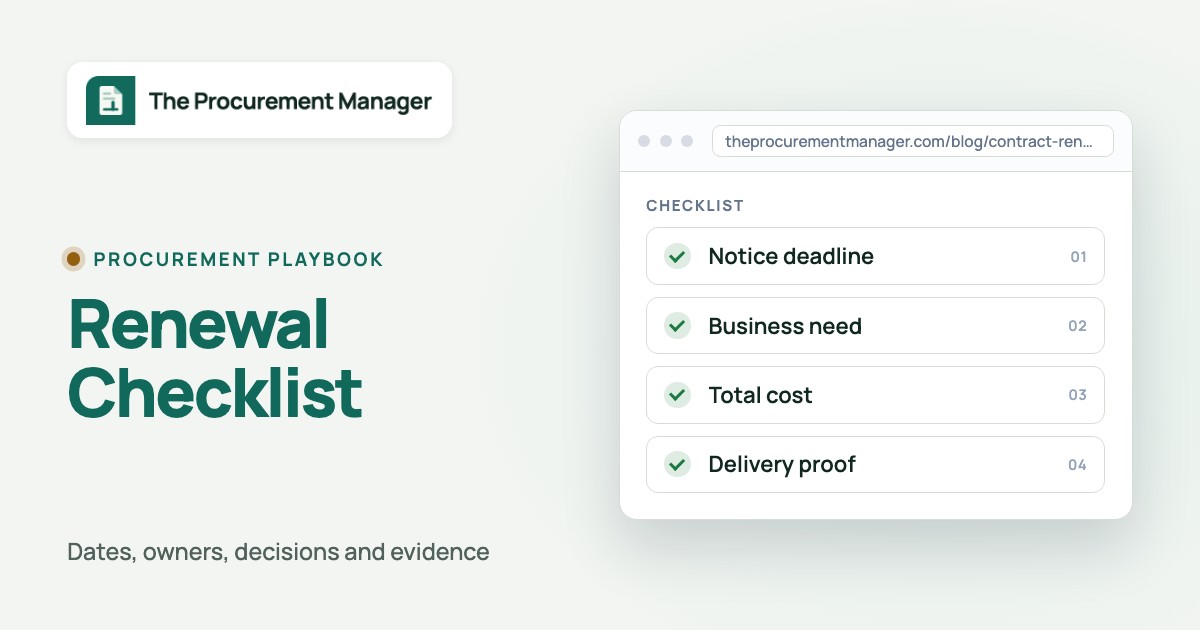
A contract renewal checklist gives procurement a repeatable way to decide whether a supplier agreement should continue, change, or end before a notice deadline closes off options. The useful version isn't a list of things to remember. It's a decision record with the executed contract, a verified deadline, a named owner, performance evidence, commercial options, and proof that the decision was carried out.
This guide includes a checklist you can copy, a working 120-to-14-day schedule, a renewal decision template, and an example of calculating a notice date. The schedule's an internal planning recommendation, not a universal contractual or legal deadline. Your signed agreement and applicable rules control what must happen and when.
- Read the executed agreement and every amendment before calculating dates.
- Work backward from the notice deadline, not only the expiration date.
- Give procurement one coordinator and each decision a named accountable owner.
- Compare renew, renegotiate, compete, and exit with evidence.
- Keep delivery proof for notices and update the contract register after the decision.
Contract renewal checklist you can copy
A usable contract renewal checklist covers the agreement, deadline, business need, vendor performance, cost, risk, alternatives, approval, notice, and follow-through. Copy the items into a shared record and add an owner, due date, evidence link, and status to each one. A checkmark without evidence doesn't tell the next procurement manager what happened.
- Locate signed agreement, order forms, amendments, and applicable schedules
- Record contract owner, procurement coordinator, legal reviewer, and approver
- Verify term end, auto-renewal language, notice period, method, and recipient
- Calculate notice deadline and earlier internal decision date
- Confirm business need, current scope, and next-term demand
- Review service levels, incidents, support tickets, and unresolved remedies
- Reconcile invoices, consumption, commitments, credits, and proposed fees
- Refresh supplier security, privacy, continuity, and concentration review as needed
- Compare renewal, renegotiation, competition, consolidation, and exit
- Approve negotiation limits, fallback, and authority to sign
- Send any required notice by the contractually specified method
- Store notice proof, final agreement, decision rationale, and next reminder
The first four items deserve attention before anyone discusses a discount. A team can negotiate excellent pricing and still lose the right to opt out if it misses a contractual notice deadline. Conversely, a supplier may be willing to amend terms after the deadline, but procurement shouldn't treat that possibility as an entitlement.
Assign each checklist line one of four statuses: not started, in progress, evidence received, or closed. Use an exception status when the underlying agreement's missing or the notice language's disputed. That forces the issue into an owner's queue rather than hiding it behind a completed task.
Start the renewal review before the notice deadline
A contract renewal review should start early enough to inspect the actual notice clause, gather performance and cost evidence, negotiate, obtain approvals, and preserve the option to exit. The sample 120/90/60/30/14-day sequence below is a procurement operating cadence, not a promise that every contract gives you that much time, so don't assume yours does. Start earlier for critical suppliers, lengthy transitions, or contracts with long notice periods.
| Internal checkpoint | Procurement owner action | Evidence to save |
|---|---|---|
| 120 days before the controlling deadline | Confirm agreement, dates, owners, and exit lead time | Executed documents and deadline calculation |
| 90 days before the controlling deadline | Request usage, performance, risk, and spend evidence | Owner responses and issue log |
| 60 days before the controlling deadline | Compare options and open commercial discussions | Alternatives matrix and negotiation brief |
| 30 days before the controlling deadline | Obtain decision and legal review of any required notice | Signed decision record and reviewed notice |
| 14 days before the controlling deadline | Verify delivery method, recipient, and receipt evidence | Transmission record and acknowledgement, if available |
For an agreement with a short notice window, the first checkpoint may need to happen months before the renewal date. Use the earliest controlling deadline among cancellation notice, price objection, non-renewal election, budget approval, and any other contractual action that could change the decision. The team shouldn't assume those deadlines are identical.
A calendar reminder's a prompt, not a control. Put the responsible person's name, backup owner, escalation path, and evidence link next to the reminder. If the owner leaves, the contract won't manage itself.
Calculate the contract renewal notice date correctly
The contract renewal notice date's calculated from the executed agreement's specific trigger and notice language. When a contract says notice must arrive at least a stated number of calendar days before the term ends, a planning calculation subtracts those days from the end date. The result must still be reviewed for delivery rules, time zones, business-day definitions, amendments, and any clause-specific exceptions.
For example, suppose an agreement ends on June 30, 2027 and requires notice at least 60 calendar days before the end of the term. Subtracting 60 calendar days gives May 1, 2027 as the mathematical date. It's an illustrative calculation, not legal advice or a determination that delivery on May 1 would satisfy a particular contract. Procurement should set an earlier internal target and have counsel confirm the operative deadline where the wording matters.
| Renewal register field | Example entry | Why it matters |
|---|---|---|
| Agreement | Example SaaS subscription | Identifies the controlling contract |
| Term end | June 30, 2027 | Input to the illustrative calculation |
| Notice requirement | 60 calendar days | Must come from the executed clause |
| Calculated date | May 1, 2027 | Mathematical result before legal review |
| Internal target | April 15, 2027 | Example buffer chosen by the team |
| Delivery method | Per executed agreement | Determines the acceptable channel |
| Owner and backup | Procurement lead / legal ops | Prevents orphaned deadlines |
When a contract renews automatically, don't assume an ordinary email to the account manager's enough. Some agreements specify a legal address, a portal, a delivery method, or a recipient. Capture the relevant clause and keep the notice evidence with the contract. If the clause's unclear, involve legal counsel rather than guessing.
Confirm the contract baseline and decision rights
The contract baseline's the set of executed documents that determines the supplier's obligations, pricing, term, and renewal mechanism. Procurement should reconcile the master agreement, order forms, statements of work, amendments, and incorporated schedules before deciding whether to renew. A vendor's current website or an old spreadsheet entry may not reflect negotiated terms. If the executed documents are scattered, a contract repository keeps them and their dates in one place.
Create a one-page renewal record with the fields below. Store links to source documents instead of pasting confidential contract text into an open project board.
Find the governing documents
Identify the signed agreement, relevant order forms, amendments, and incorporated schedules. Flag missing versions.
Extract decision dates
Capture term end, notice triggers, delivery rules, price-change windows, and internal approval deadlines.
Name accountable people
Assign a procurement coordinator, business owner, finance reviewer, legal reviewer, and signing authority.
Confirm the possible decisions
Record renew unchanged, renegotiate, compete, consolidate, extend by agreement, or exit. Don't assume an extension is contractually available.
Open an evidence log
Attach the current document, a due date, an owner, and a source for every material assertion.
The coordinator owns the workflow, but the commercial decision isn't the coordinator's to make alone. The business owner confirms the need, finance validates the budget and cost model, legal interprets disputed terms, and authorized signers commit the company. In smaller organizations one person may wear several hats, yet the approval record still needs to show which authority was exercised.
For US federal procurement, don't substitute this commercial checklist for the Federal Acquisition Regulation. FAR 17.207 addresses exercising government contract options, including written notice within the period specified by the contract and a written determination for the contract file. Those federal rules don't automatically govern a private company's SaaS agreement. See the official FAR 17.207 text when the agreement's a federal acquisition.
Recheck vendor performance and the business need
A contract renewal review should determine whether the service's still needed, whether the supplier delivered what was promised, and whether the next term's scope matches expected demand. Procurement shouldn't rely only on a favorable stakeholder interview or a vendor's dashboard. Pair opinions with measurable service, invoice, and usage records.
Start with the business owner. Confirm the work the supplier supports, the teams using it, and any planned change in headcount, volume, geography, or workflow. A subscription that solved last year's problem may no longer fit. A mission-critical supplier may still deserve renewal even after a difficult quarter, but that decision needs a documented remediation plan.
Then review performance against the signed obligations. Useful evidence includes service-level results, incident reports, accepted deliverables, support response history, recurring defects, and unresolved credits. Record the measurement period and exclusions. A good average shouldn't hide one severe outage, while a single incident shouldn't erase a year of reliable service without context.
| Performance area | Evidence to request | Renewal decision question |
|---|---|---|
| Service reliability | Incident log and agreed SLA report | Were material obligations met? |
| Delivery quality | Accepted work and defect history | Is rework or delay recurring? |
| Support | Ticket history and escalations | Can unresolved problems be corrected? |
| Adoption | Active use by team or workflow | Is the contracted capacity still needed? |
| Remediation | Corrective-action owner and due date | Is the improvement credible and measurable? |
Give each unresolved problem a proposed contract response. It might call for a service improvement plan, revised service credits, clearer escalation rights, or a competitive sourcing process. Don't negotiate a lower price as the only remedy when the underlying service is still unreliable.
Review total renewal cost and commercial exposure
A renewal cost review compares the next term's likely cash commitment and operational workload, not just the headline subscription fee. Procurement and finance should reconcile contracted units, invoices, usage, support tiers, implementation changes, minimum commitments, indexation, and any termination or transition expense. Discounts can help, but a discount tied to excess seats or a longer term may be poor value.
Use a simple scenario model before asking the supplier for a final proposal. These numbers are fictional, and they're only there to show the calculation.
| Example scenario | Annual recurring fee (USD) | Additional consideration |
|---|---|---|
| Keep 100 seats at $30 per seat monthly | $36,000 | No usage change |
| Reduce to 70 seats at $30 per seat monthly | $25,200 | Requires supplier approval of lower quantity |
| Keep 100 seats with a 10% rate increase | $39,600 | Verify the contract's pricing clause |
In the fictional example, reducing 30 seats at $30 per seat per month would lower annual recurring fees by $10,800 if the vendor permits the reduction. Here's the formula: 30 × $30 × 12 months. That isn't a forecast of achievable savings. It excludes taxes, add-ons, minimums, implementation, and other charges.
Don't sign a renewal because the quote says 20% off list price. Compare the offer with actual paid rates, current usage, alternative proposals, and the flexibility lost through longer commitments. If a price increase's tied to an index or usage tier, ask the supplier to show the calculation in writing. The contract, not the sales slide, controls the accepted commercial terms.
Refresh security, privacy, and continuity evidence
A contract renewal checklist should refresh supplier risk evidence when the service, data access, threat profile, or vendor circumstances have materially changed. Procurement can coordinate the process, but security, privacy, legal, and business-continuity owners decide which controls and documents are required. A completed questionnaire isn't proof that every control's effective.
The US National Institute of Standards and Technology published a cybersecurity supply chain due diligence quick-start guide in July 2026. It identifies areas such as provenance, resilience, foundational cyber practices, foreign ownership or control, and supply chain tiers for information and communications technology suppliers. They're useful lenses for higher-risk technology renewals, not a blanket legal requirement for every private supplier. Read the NIST guide overview and tailor the assessment to your policy.
A practical refresh might ask whether the supplier changed subprocessors, hosting arrangements, data retention, incident notification terms, access methods, or critical subcontractors. For a facilities supplier, physical continuity and insurance may matter more than software security attestations. Record the risk decision and who accepted any exception.
Plan for an exit before the relationship becomes urgent. Check data export, migration assistance, configuration portability, deletion confirmation, credential removal, transition support, and operational dependencies. An agreement that can technically be canceled may still require months of practical transition work.
Compare renew, renegotiate, compete, and exit
The contract renewal decision should compare the feasible options against business fit, total cost, supplier performance, risk, and transition time. Renewal's often the lowest-friction option, but it isn't always the best one. An alternative that looks cheaper on paper isn't cheaper once migration and retraining are counted.
| Decision option | Best reason to choose it | Evidence required |
|---|---|---|
| Renew unchanged | Service meets needs and terms remain acceptable | Performance, budget, and risk sign-off |
| Renegotiate | Core supplier is useful but price or obligations need changes | Issue list, commercial model, approved redlines |
| Compete | Market alternatives could materially improve fit or value | Requirements, comparison criteria, transition estimate |
| Consolidate | Overlapping suppliers serve the same workflow | Usage map, migration plan, ownership agreement |
| Exit | Need has ended or risk is unacceptable | Notice plan, continuity plan, offboarding owner |
Don't turn the comparison into a score that conceals a non-negotiable condition. A supplier can score well overall and still fail a mandatory security requirement or an essential business capability. Put hard constraints in a separate column, then use weighted criteria for tradeoffs among eligible options.
A short renewal decision memo can fit on one page: recommendation, alternatives considered, evidence, total cost, material risks, notice deadline, approval record, and next action. Attach the underlying analysis rather than forcing executives to read a folder of unstructured files.
Negotiate, approve, and execute the renewal
Renewal negotiation should begin with an approved position and end with a controlled record of what was agreed. The procurement lead needs a clear mandate: must-have changes, acceptable tradeoffs, budget ceiling, fallback plan, and escalation owner. The final agreement should match that mandate before an authorized person signs.
Start by separating scope from price. A lower fee for fewer deliverables isn't necessarily a better deal, and a larger discount may require a commitment that the business doesn't want. Ask for redlined contract language when a supplier promises service credits, exit assistance, or new cancellation rights. An email saying the vendor'll be flexible isn't a substitute for executed terms.
After the decision, follow the correct branch. If the company's renewing, reconcile the signed order form and amendments to the approved price, term, entities, and services. If it's not renewing, send the notice in the form required by the contract and preserve evidence. If the parties agree to a temporary extension, document it rather than assuming the old agreement continues automatically.
Close the loop in the contract register. Update the executed documents, purchase orders, approved budget, vendor owner, new term, next notice date, and any promised service changes. Give every outstanding obligation a due date and a person responsible for confirming delivery.
Contract renewal decision record template
A contract renewal decision record should be short enough for a busy approver but complete enough to support the next renewal. Copy the template below into your procurement workspace and link the executed documents. The fields distinguish factual inputs from the recommendation, which reduces the chance that a draft negotiation position becomes mistaken for an approved commitment.
| Record section | Fields to complete |
|---|---|
| Header | Vendor / agreement ID; Business owner / procurement coordinator; Signed agreement and amendments (links); Term end / renewal mechanism; Notice deadline / method / recipient; Internal decision date / backup owner |
| Current state | Business need and forecast demand; Contracted scope and actual usage; Performance evidence / unresolved incidents; Current fees / proposed fees / total cost assumptions; Security, privacy, continuity, and legal review status |
| Decision | Options considered (renew / renegotiate / compete / consolidate / exit); Recommended option and why; Hard constraints and unresolved risks; Negotiation mandate and fallback; Finance approver / legal reviewer / authorized signer; Decision date and approval evidence |
| Execution | Notice requirement, exact clause, and deadline; Notice sent / method / proof link; Final agreement and purchase order links; Owner of next milestone and review date |
Don't paste sensitive supplier financials, personal data, or privileged legal advice into a broadly shared board. Store those records in systems with appropriate access controls and link them from the decision record. The template's an operational aid, not legal advice or an authorization to renew a contract.
Contract renewal mistakes procurement teams can prevent
The most damaging renewal mistakes often happen between functions rather than inside the contract file. Procurement tracks the term, finance owns the budget, legal understands the notice clause, and IT owns the data migration. The checklist only works when those people share a deadline and a documented decision.
A common failure is treating the expiration date as the only date that matters. Another is trusting a contract summary that omits an amendment. Teams also renew seats nobody's using, negotiate without an approved fallback, ignore transition costs, or send notice through an unapproved channel. Each failure has a simple fix, and it's rarely clever: a source document, a named owner, a date, and saved evidence.
The stronger habit's to close each renewal with a short retrospective. Record which inputs arrived late, which supplier issues were unresolved, and whether the next reminder should trigger earlier. A checklist that improves after every cycle's more useful than one that only looks complete on signing day.
Contract renewal checklist FAQ
A contract renewal checklist works best when owners understand the difference between a planning date, a contractual obligation, and an internal approval. The answers below clarify common renewal questions without assuming every agreement uses the same terms.
What should a contract renewal checklist include?
A contract renewal checklist should include signed documents, notice terms, owners, business need, performance, total cost, risk, alternatives, approvals, delivery proof, and the next review date.
How far in advance should a contract renewal start?
A contract renewal should start before the earliest controlling notice deadline, with enough time for evidence, negotiation, approvals, and a possible exit. A 120-day internal runway is an example, not a universal requirement.
How do you calculate a contract renewal notice deadline?
A contract renewal notice deadline depends on the executed clause's trigger, day-count method, and delivery requirement. Subtract the stated notice period from the correct trigger date as a planning calculation, then verify the result against the agreement.
Who is responsible for renewing a supplier contract?
The business owner normally decides whether the service's needed, procurement coordinates the process, and authorized approvers commit the company. Legal, finance, security, and IT may need to review specific risks or terms.
Can an automatically renewing contract be canceled by email?
An automatically renewing contract can be canceled by email only when the agreement and applicable rules permit that method. Verify the recipient, timing, and proof requirements rather than assuming a message to the account manager is sufficient.