Precoro pricing starts at $499 per month for Core, billed annually. Automation starts at $999 per month, Enterprise requires a custom quote and a separate AP Module also starts at $499 per month. Those are starting prices, not a guaranteed invoice for your particular team. The critical buying questions are how many users you need, whether your workflow requires Automation features and which extras appear on the order form.
For procurement leaders, the subscription number isn't the entire decision. Precoro's published terms also define user tiers, automatic renewal and a written notice deadline. You can avoid a costly mismatch by checking those conditions before signing, rather than treating the monthly headline as the complete commitment.
- Core starts at $499/month, billed annually, for purchase requests, orders, invoice handling and approvals.
- Automation starts at $999/month, billed annually, adding intake, supplier collaboration, advanced AP and real-time budget tracking.
- Enterprise has custom pricing and unlimited users; a standalone AP Module starts at $499/month.
- The published terms use user tiers and automatic renewal, with written nonrenewal notice at least 30 days before term end.
How much does Precoro cost?
Precoro costs at least $499 per month on Core or $999 per month on Automation, with both advertised as billed annually. Enterprise pricing is custom, while the standalone AP Module starts at $499 per month. The following amounts are published US-dollar starting prices checked October 30, 2026, not fixed quotes for every user count.
| Precoro option | Monthly starting price | Annualized starting cost | Billing | Best-fit purchase |
|---|---|---|---|---|
| Precoro Core | $499 | $5,988 | Annually | Requisitions, POs, receiving and basic invoice workflows |
| Precoro Automation | $999 | $11,988 | Annually | Intake, AI-assisted AP, supplier portal and live budget tracking |
| Precoro Enterprise | Custom quote | Not published | Annually | Unlimited users, advanced administration and ERP needs |
| Precoro AP Module | $499 | $5,988 | Annually | AP-focused teams that don't need the full purchasing workflow |
The annualized amounts multiply the published monthly starting rates by twelve. They aren't promises that your actual quote will equal the minimum. Precoro's own homepage says pricing depends on the plan and number of users, and its Terms of Service specify a user cap for each non-unlimited tier.
- CoreFrom $499 /month, billed annually
- Purchase requests, orders and receipts
- Invoice management and matching
- Approval workflows and supplier records
- AutomationFrom $999 /month, billed annuallyExpanded workflows
- Core plus intake and inventory
- Intelligent AP and real-time budgets
- Supplier portal, RFPs, API and SSO
- EnterpriseCustom quote billed annually
- Automation plus unlimited users
- ERP and custom integrations
- Advanced controls and regional hosting
- AP ModuleFrom $499 /month, billed annually
- Invoice and AP automation focus
- Payments, budget and supplier tools
- Accounting integrations, API and SSO
Starting USD rates on Precoro's official pricing page, checked October 30, 2026. Final price and any paid add-ons require a quote.
A monthly figure on a vendor page doesn't establish monthly billing. Precoro explicitly labels the published packages as billed annually. Ask the salesperson to show the invoice schedule and committed subscription term separately, especially if your finance team budgets by quarter.
What does Precoro Core include for $499 per month?
Precoro Core includes the essential purchase-to-invoice workflow: purchase requisitions, purchase orders, receipts, invoice management, matching and automated approvals. It also lists supplier management, a contract repository, expense management, reporting and integrations with QuickBooks Online, Xero and Slack. Core is the sensible starting point when procurement's problem is controlling who can request and approve purchases, not building a large supplier intake operation.
Consider a purchasing manager whose employees submit requests by email. The team can configure approval routing, issue an approved PO, record a receipt and compare the invoice with the purchasing record. Precoro's help center explains that three-way matching can hold an invoice in Pending Receipt until receiving is confirmed. That matters because an approved PO alone isn't proof that the goods arrived.
Core also includes invoice handling, but it isn't the same as the higher tier's Intelligent AP Automation. Precoro distinguishes basic invoice creation, approval, verification and tracking from AI-powered capture and mapping. If your accounts payable team expects scanned invoices to become structured documents with little manual entry, you shouldn't buy Core on the assumption that all AP automation is included.
The contract repository is relevant to renewal management, too. Precoro's help documentation describes linking POs and invoices to supplier contracts, tracking contract spending and sending expiration reminders. A repository can help surface a deadline, but it doesn't automatically make the business owner, Finance and IT agree on the renewal decision. That ownership process still has to be designed.
What does Precoro Automation add for $999 per month?
Precoro Automation adds intelligent AP automation, intake management, supplier onboarding, a supplier portal, RFPs, inventory, PunchOut purchasing, real-time budget tracking, API access and SSO. It starts $500 per month above Core, which is a $6,000 annualized difference at the advertised minimum rates. The upgrade is worthwhile when those workflows remove a specific operational bottleneck, not merely because it is the higher tier.
Take an intake-heavy procurement team. Employees need a controlled front door for purchases, supplier information needs review and Finance wants to see commitments against live budgets before a PO goes out. Automation addresses that broader chain. A team that only creates a small number of POs and matches invoices manually may not need the additional surface area.
The supplier portal and vendor onboarding tools also change who does the work. Instead of procurement chasing every supplier detail in an email thread, the workflow can put information collection and approval into the system. That doesn't remove the need for an internal decision owner. Someone must still determine whether the supplier is acceptable and whether the purchase fits the budget.
Precoro's help center identifies a Contract Agent in beta for Automation customers. It can extract information from uploaded contracts, but the documentation warns that AI-generated insights shouldn't replace legal, procurement or finance review. Buyers shouldn't treat beta availability as a guaranteed contract term. Ask whether the agent is enabled in your account, what documents it accepts and what human verification remains.
When does Precoro Enterprise make sense?
Precoro Enterprise makes sense when you need unlimited users, advanced administrative controls, ERP or custom-built integrations, regional server selection or IP whitelisting. The price is custom and billed annually, so a useful Enterprise quote must specify the actual modules, service scope and access rules rather than merely naming the tier.
Enterprise isn't automatically necessary for every company that uses an ERP. Precoro lists QuickBooks Online and Xero with Core and describes broader integrations in Automation. The Enterprise tier explicitly calls out ERP systems and custom-built integrations. Ask for a connector-by-connector matrix and a live data-flow demonstration before accepting a blanket statement that your ERP requires Enterprise.
For a multi-entity business, confirm which legal entities share one account, how budgets are separated and who can see each entity's contracts. Precoro advertises multi-company management as a recommended add-on, so its presence in a product demo doesn't establish that it's included in your base quote. The order form should say whether that add-on is included and how much it costs.
An IT reviewer should also distinguish SSO from regional hosting. Precoro lists SSO under Automation, while Enterprise adds regional server selection and IP whitelisting. If your security policy requires a US-hosted environment, request that specific region in the written agreement instead of relying on a general security statement.
Is the Precoro AP Module cheaper than buying procurement and AP together?
Precoro's standalone AP Module starts at $499 per month, billed annually, matching Core's advertised starting rate but solving a different job. It focuses on invoice processing, intelligent AP automation, e-invoicing, budget management, payments, vendor management and accounting connections. It's a better candidate when your purchase requests and POs already live elsewhere and your main pain is handling supplier invoices.
A finance team might have a stable purchasing system but spend hours moving invoices between inboxes and approvers. The AP Module deserves a demo in that case. A procurement team that needs requester intake, PunchOut catalogs and a supplier portal should compare Automation instead of assuming the AP Module is a cheaper route to the whole procure-to-pay suite.
Precoro lists API access and SSO with the AP Module. That doesn't guarantee every integration is included without a fee. The help center's Integrations page distinguishes free integrations from integrations that can be purchased. Ask the seller to identify exactly which connector, sync direction and support arrangement the quoted AP Module includes.
What changes the final Precoro quote?
Precoro's final quote can change with user tiers, the selected package, integrations, optional services and the contractual term. The official pricing page publishes starting rates but doesn't give a complete self-serve calculation for every team size. Use the following cost drivers to turn the demo into a comparable commercial proposal.
| Precoro cost driver | What is publicly established | What to request in the quote |
|---|---|---|
| Precoro user tier | Core and Automation have tier-based user limits | Included users, approvers, requesters and overage step |
| Precoro integration | Core lists QuickBooks Online, Xero and Slack; other connections vary | Connector name, direction, setup and recurring charge |
| Precoro multi-company setup | Multiple Companies appears under recommended add-ons | Included entities and any extra entity fee |
| Precoro onboarding | Standard and Concierge Setup are described separately | Included sessions, migration work and extra fee |
| Precoro dedicated support | Dedicated Support appears under recommended add-ons | Response expectations, coverage and fee |
| Precoro renewal | Terms permit renewal price changes | Renewal price basis and nonrenewal notice address |
User tiers. Precoro's Terms define a Payment Plan as a feature set plus a user tier. Section 5.6 says that exceeding the maximum users means upgrading or paying additional fees. Don't assume a flat starting price means unlimited requesters, approvers and administrators. Get a role-by-role user inventory before asking for the final price.
Integrations. An integration can be available in the product without being included in your subscription. Precoro's help center says its Integrations page allows customers to purchase new integrations and connect to free ones. The relevant question isn't whether a connector exists. It's whether your quoted package covers the data objects, entities, direction and error-handling workflow you need.
Services. Precoro describes Standard onboarding and a separate Concierge Setup option. Ask whether configuration, historical supplier imports, training and a post-launch test period are part of the base fee. Get the services scope and its price in writing before you budget for it.
Taxes and renewal. Precoro's Terms say fees exclude applicable taxes and allow price changes at renewal. The actual invoice and signed order form control your commitment. Treat any first-year promotional discount as a temporary commercial term unless the renewal price is specified.
- List each user role and the maximum included user count.
- Confirm Core, Automation, Enterprise or AP Module in the order form.
- Specify every connector, direction and recurring integration fee.
- List legal entities and any multi-company add-on.
- Record onboarding deliverables and support coverage.
- Write down annual invoice timing, taxes and renewal price terms.
- Identify the written nonrenewal notice recipient and deadline.
How much would Precoro cost over a year or several years?
Precoro's minimum published annualized cost is $5,988 for Core or the AP Module and $11,988 for Automation. A two-year illustration at unchanged minimum rates would be $11,976 for Core and $23,976 for Automation. These are arithmetic examples, not confirmed multiyear offers or commitments, and they exclude taxes, user-tier increases and paid extras.
| Precoro illustration | Year 1 minimum | Two-year illustration | Important assumption |
|---|---|---|---|
| Precoro Core | $5,988 | $11,976 | Core starting rate held flat, no increases |
| Precoro Automation | $11,988 | $23,976 | Automation starting rate held flat, no increases |
| Precoro AP Module | $5,988 | $11,976 | AP Module starting rate held flat, no increases |
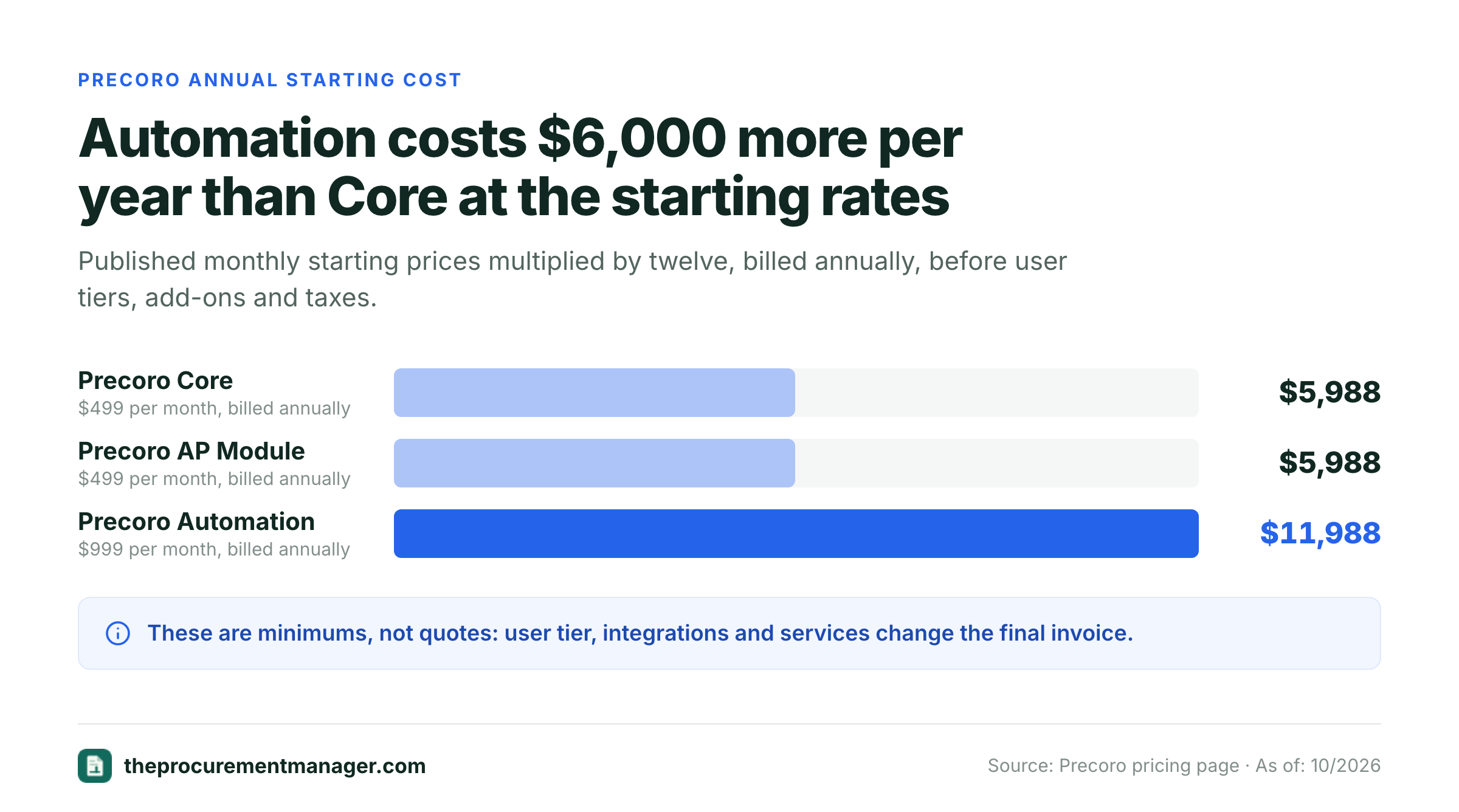
Multiplies the published starting rates by twelve for each selected year. It excludes user-tier increases, add-ons, services, taxes and renewal price changes, and it isn't a Precoro quote.
Suppose an Automation buyer adds a separately quoted implementation service. Its actual first-year total becomes the subscription quote plus that service, any connector charges and applicable taxes. Since Precoro doesn't publish a universal price for those extras, any single grand total here would be a guess.
The other cost is workflow mismatch. If the team needs supplier onboarding, SSO and live budget tracking but buys Core, the relevant comparison isn't Core against doing nothing. It's Core plus a later upgrade against Automation from day one. If those capabilities aren't used, the lower tier may be the more defensible purchase.
What are Precoro's contract, cancellation and renewal terms?
Precoro's published Terms of Service say subscriptions renew automatically for successive periods equal to the initial term unless the order form says otherwise. Section 16.2 requires written nonrenewal notice at least 30 days before the current term ends. Section 5.3 makes payment obligations non-cancellable and non-refundable except where the Terms or the service agreement provide otherwise.
That detail matters more than a casual reading of the pricing FAQ. The FAQ says cancellation can be requested with 30-day notice and access lasts through the billing period. The Terms add the automatic renewal rule and the effect of an existing commitment. Don't read the FAQ as a promise that prepaid annual fees are refundable or that a cancellation immediately ends a committed term.
Precoro also says a separate formal contract isn't always required because account creation accepts its Terms. That doesn't mean there is no contractual commitment. A purchase order, service agreement or order form may add different commercial terms. Procurement should retain the accepted Terms version and the final order form together.
Capture the committed term
Record the start date, end date, billing period and whether an order form overrides Precoro's standard renewal language.
Calculate the notice deadline
Subtract the contractual notice period from the term end date. For the standard Terms, use at least 30 days before term end, then add your own internal approval buffer.
Assign the renewal decision
Name the business owner, Finance approver and IT reviewer. A reminder alone isn't evidence that they approved the next term.
Preserve written delivery evidence
Keep the notice message, recipient, sending timestamp and any acknowledgment alongside the contract record.
Precoro's contract-management documentation describes expiration reminders for supplier contracts. That's useful for monitoring agreements you manage inside Precoro, but don't confuse those supplier-contract reminders with your own Precoro subscription's notice obligation. The latter comes from the subscription Terms and your order form.
How long does Precoro implementation take and what is included?
Precoro's pricing FAQ says onboarding typically takes four to six weeks, while its broader pricing page describes a two-to-eight-week go-live window. Those are vendor estimates, not a project guarantee. The schedule depends on approval routing, suppliers, accounting integrations, user training and how much historical data needs to move.
Standard onboarding is described as two consultation sessions and a one-hour training session. Concierge Setup is a premium option with up to ten consultations, five training sessions, delegated data import and guided testing for each user type. Confirm the current services scope in the proposal, since the pricing page doesn't list a universal Concierge fee.
A practical rollout starts with a small approval path. Configure a requester, budget owner and purchasing approver. Test a PO, a partial receipt and an invoice discrepancy. Only then add departments and suppliers. It's cheaper to discover a broken approval rule before employees depend on the system.
If the team uses QuickBooks Online or Xero, verify which data fields sync and how failed integrations are retried. If the team uses an ERP, identify the system of record for supplier details, purchase orders and invoices. Precoro says it works alongside accounting systems rather than replacing the ERP. Your acceptance test should prove that the separation works, and that you haven't doubled any data entry.
Is Precoro worth the price for procurement teams?
Precoro is worth evaluating when purchase approvals, receiving, invoices and supplier records are scattered across email, spreadsheets and accounting software. Core gives that work a controlled route at a published starting rate. Automation is more compelling when intake, supplier collaboration, AI-assisted AP and live budgets are daily requirements.
For a small team, the biggest risk is paying for a broad suite before defining the workflow. A team that just needs to see who approved a software renewal shouldn't assume a full procure-to-pay platform is the right tool. Conversely, a procurement group processing many physical goods purchases may need receipts, three-way matching and catalog controls that a renewal tracker can't provide.
Precoro's contract repository and expiration reminders can support renewal visibility. They don't by themselves replace an evidence-backed decision packet that gathers business owner, Finance and IT sign-off before the notice date. That is a separate operational problem from placing POs and processing invoices.
- PO approvals, receipts and basic invoice controlsEvaluate Precoro Core first.
- Intake, supplier portal, RFPs, SSO or live budget trackingEvaluate Precoro Automation.
- Unlimited users, regional hosting or custom ERP workRequest an Enterprise quote.
- AI-assisted invoice handling without a new purchasing suiteCompare the standalone AP Module.
- Only contract renewal ownership and notice decisionsUse a focused renewal process rather than buying a broad P2P suite for that job alone.
For teams comparing broader procurement platforms, our Coupa pricing breakdown, Procurify pricing analysis and Coupa vs Zip comparison cover different buying paths. Compare the workflows and contractual scope, not just the headline prices.
What should you ask Precoro before accepting a quote?
Ask Precoro for the smallest package that supports your real approval, supplier and accounting workflow, with every limit and add-on written down. Procurement should be able to reproduce the proposed annual total and explain the renewal terms to Finance before approving the purchase.
- How many requesters, approvers and administrators does the quoted user tier cover?
- Which features in our demo require Automation or Enterprise?
- Which accounting or ERP integrations are included, and what costs extra?
- Are multiple legal entities included in the quoted package?
- What onboarding sessions, migration services and support are included?
- When does the subscription term start and when is the invoice due?
- What is the automatic renewal term and where must written nonrenewal notice go?
- What data can we export and how will we verify the export before exit?
Don't accept a proposal that leaves user limits or the notice channel undefined. The quote needs to survive a later handoff from the procurement buyer to the contract owner who will manage the renewal.
Precoro pricing FAQ
Precoro pricing questions usually come down to whether the advertised rate is the full commitment, what is included and how a team exits. The answers below distinguish published vendor terms from details that still need a written quote.
Does Precoro have a free plan?
Precoro doesn't publish a permanent free plan on its current pricing page. It advertises paid packages beginning with Core, and trial availability should be confirmed directly with sales.
Is Precoro billed monthly or annually?
Precoro advertises monthly-equivalent starting prices but labels Core, Automation, Enterprise and the AP Module as billed annually. Confirm the invoice schedule and term on the order form.
Does Precoro charge per user?
Precoro pricing depends on the selected plan and user tier. Its Terms say exceeding a tier's user limit can require an upgrade or additional fees, so the exact seat allowance needs a quote.
Is Precoro AP automation included in Core?
Precoro Core includes invoice management and matching, but Intelligent AP Automation is advertised with Automation and the standalone AP Module. Buyers needing automated capture should verify the exact feature scope.
Can I cancel Precoro with 30 days' notice?
Precoro's standard Terms require written nonrenewal notice at least 30 days before the term ends and generally make committed fees non-refundable. Check any signed order form for different terms.
Does Precoro have credits or usage-based pricing?
Precoro's public pricing page describes packages and user tiers rather than a published credit-rate table. Ask sales to disclose any transaction, AI or integration allowances in the order form.