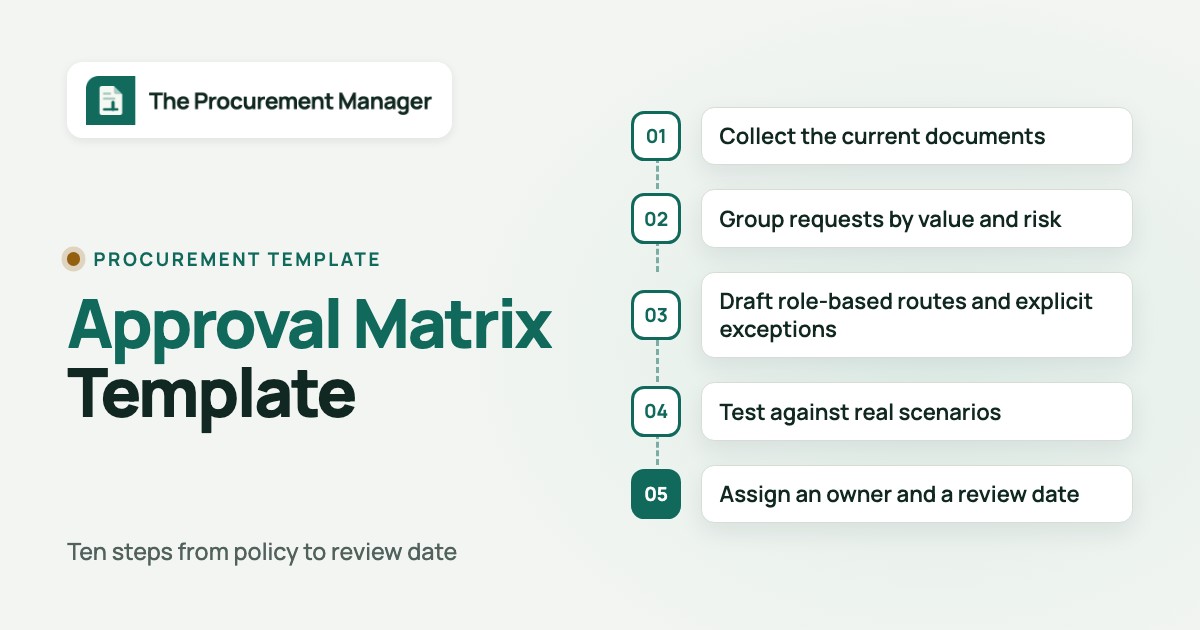
A procurement approval matrix is a written map of who can request, review, approve and release a purchase, based on commitment size, budget ownership and risk. This guide explains what the matrix covers, how to set spending bands, which roles belong in it and how to build it in ten steps. It also includes a fill-in template with Word and Excel downloads. The bands and routes are examples. Your leadership and finance team set the real limits, and you shouldn't treat ours as a benchmark.
- Define the total commitment first (full term, optional extensions, variable usage), then set approval bands against that number.
- List roles, not names, and keep a separate role directory with owners and deputies.
- Add risk triggers such as personal data, administrator access or nonstandard liability, because value alone misses the risky small purchase.
- Separate approving the business case, signing the contract and paying the invoice. They're three control points.
- Write down emergency and exception routes, and assign an owner and a review date so the matrix doesn't go stale.
What is a procurement approval matrix?
A procurement approval matrix is a table that connects spending authority to risk, budget ownership and the type of commitment being made. It settles who must say yes before the organization spends money or accepts contractual obligations.
A good matrix isn't a list of job titles. It's also where you state what evidence each approver needs, the order of reviews, how exceptions work and who keeps the decision record. That makes it useful to requesters, procurement staff, finance, legal and auditors alike.
Start from the decisions people actually make, not from an idealized org chart, because that's where the matrix will be used. A low-risk replenishment order needs a different path from a new software subscription that processes customer data. The aim is consistent control without needless waiting.
Why do teams need an approval matrix?
Without an agreed process, requesters ask whichever manager's most convenient, send contracts for signature before anyone reviews them, or split a request into smaller transactions. Each habit hides total commitments and blurs accountability.
A matrix makes responsibilities visible and gives employees a predictable route to a decision. It also helps procurement separate budget authorization from supplier evaluation, which isn't the same job. A department head can confirm the business need while finance checks the budget and legal examines contractual exposure. None of those reviews replaces the others, and nobody's sign-off covers a question they weren't asked.
Clear decision rights also help when a manager's away, and they leave a usable audit trail. A matrix can't fix unclear budgets or missing supplier records, though, and it won't fix a purchasing culture that ignores it. Treat it as one part of a broader purchasing policy that's reviewed regularly, and revisit it whenever reporting lines, risk appetite or procurement systems change.
What decisions should the matrix cover?
Cover every point where the organization commits money or takes on obligations: purchase requests, purchase orders, new supplier onboarding, contract execution, renewals, amendments, emergency purchases and exceptions. Decide whether capital expenditure, operating expense and employee reimbursements follow separate rules.
The matrix should distinguish approving the business case from approving the legal agreement and from permission to pay an invoice. Those are separate control points, and merging them is how a signed contract ends up with no budget behind it. That's the failure the separation prevents.
For each decision, record four things, listed here.
- the request owner and the reviewers
- the final approver
- the supporting documents
- the system where the approval is captured
Define authority by cumulative contract value, not only the next invoice, since that's the number the organization is actually committing to. A multiyear subscription can be a far bigger commitment than its first payment suggests. Also define how you treat taxes, optional extensions, variable consumption and currency conversion, so requesters apply thresholds the same way and reporting stays comparable across departments.
How should spending thresholds work?
Use illustrative bands while you design the matrix, then replace them with limits your own leadership and finance team approve. Don't copy thresholds from another organization without thinking about its size and exposure. What's routine for a large enterprise can be a board-level decision for a ten-person company.
A sample policy might define three bands, listed here.
- Band A covers routine purchases inside an approved budget.
- Band B covers material department commitments.
- Band C covers strategic or exceptional obligations.
The bands are categories, not universal dollar values. Each one should name the authorized decision maker and any required independent review. That's what makes a band enforceable.
Pick one measure per request category and apply it consistently: the entire committed term, annualized spend or another basis you define. Write that rule next to the matrix, not in a separate conversation. If the measure is ambiguous, requesters will pick the one that lands in the lowest band, and you can't blame them for it.
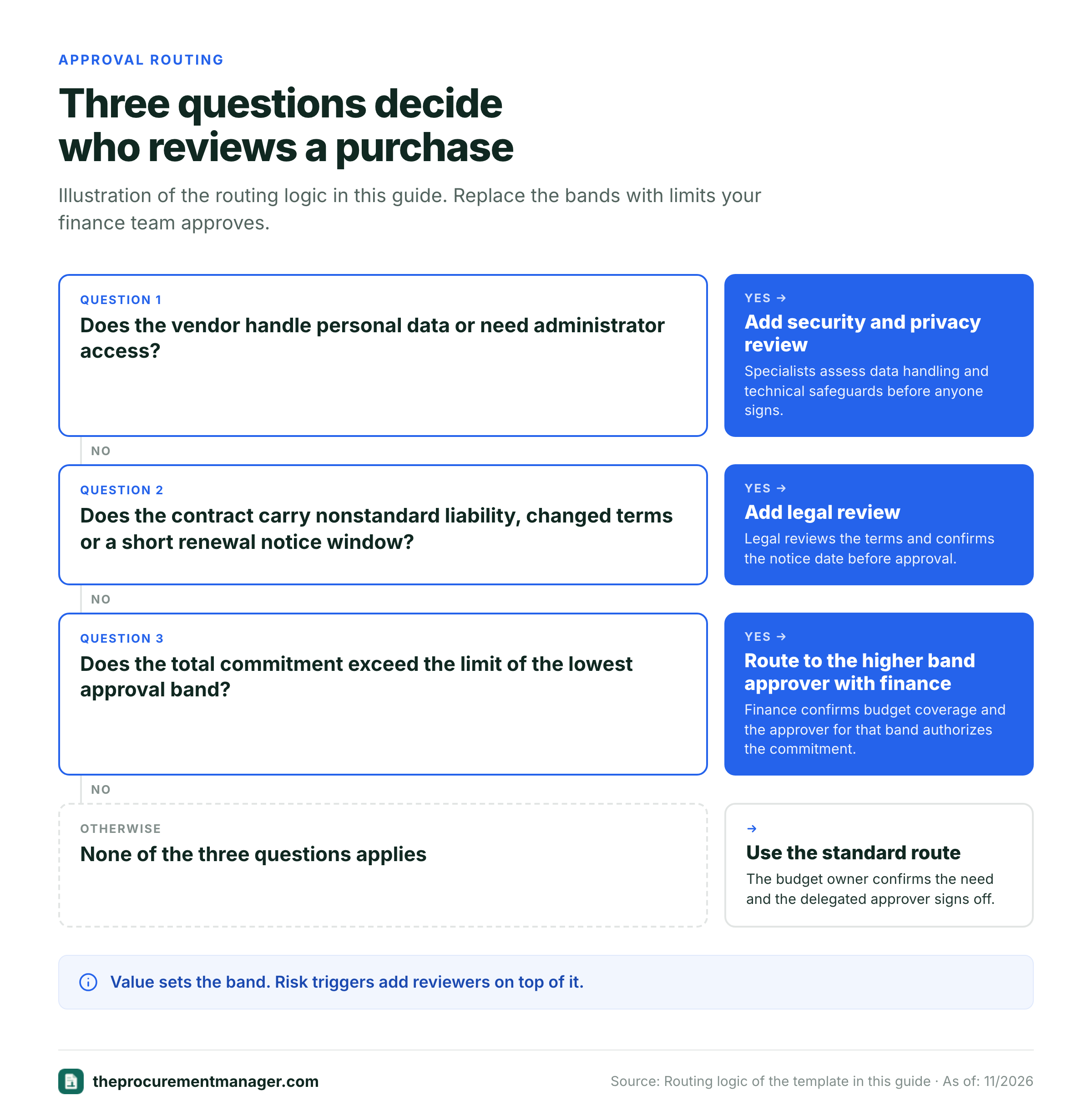
Risk overrides sit on top of the bands. A low-value purchase can still go to security or legal when it involves sensitive information, unusual contract terms or a regulated supplier. The risk-based review section below covers how to add those triggers.
Who should approve a purchase?
Each role in the route has one job, and it's easy to blur them:
- Requester: explains the need and the expected outcome.
- Budget owner: confirms funding and priorities.
- Procurement: checks the sourcing method, supplier alternatives and commercial terms.
- Finance: checks accounting treatment, budget rules and financial exposure.
- Legal: reviews contract language when the request meets defined triggers.
- Information security and privacy: review data access and processing risks.
- Delegated approver: authorizes the commitment within their assigned limit.
One person may hold several of these roles in a small company, but conflicts of interest still need attention. A requester shouldn't silently approve their own high-risk purchase, and the matrix shouldn't allow it.
Show roles, not personal names, so the matrix survives staff changes. Keep a separate role directory with the current owners and their deputies. Where two approvals are required, say whether they can happen in parallel or whether one has to wait for the other. It's a detail that's often left out.
A copyable procurement approval matrix template
The template below gives you the columns most teams end up needing, with example rows that show routing logic. They aren't prescribed approval levels. Download it as Word or Excel, or use the copy button and paste it into your own spreadsheet. Bracketed values are placeholders for the limits your finance team approves.
Procurement approval matrix
Fill in each row from your delegation-of-authority schedule. Bracketed values are placeholders, not recommended limits.
| Request category | Commitment basis | Budget owner | Procurement | Finance | Legal | Security or privacy | Final approver | Required evidence |
|---|---|---|---|---|---|---|---|---|
| Standard goods within approved budget | Single order total | Confirms need | Per sourcing policy | Per spending authority | Not normally triggered | Not normally triggered | Delegated approver, Band A | Quote, budget code, purchase description |
| New cloud software that processes personal data | Total contract value over the full term | Confirms value | Reviews vendor selection | Reviews commitment | Reviews terms | Assesses data handling | Authorized signatory, Band B or C | Vendor review, data processing terms, budget code |
| Renewal with unchanged scope and price | Annualized spend | Confirms still needed | Checks notice date | Confirms budget | Not normally triggered | Not normally triggered | Delegated approver, Band A | Prior approval, renewal notice, usage summary |
| Renewal with price or scope change | Total commitment of the new term | Confirms changed value | Re-reviews commercial terms | Checks budget coverage | Reviews changed terms | If data use changed | Approver for the new total | What changed since last approval |
| Emergency purchase | Estimated total, documented afterward | Confirms outage or safety issue | Informed, documents afterward | Informed | Informed | As the risk requires | Named emergency approver | Written reason, exception record |
| Band | Typical use | Authorized decision maker | Required independent review |
|---|---|---|---|
| Band A | Routine purchase inside an approved budget | [Role, e.g. department head] | [None or procurement] |
| Band B | Material department commitment | [Role, e.g. finance director] | [Finance and procurement] |
| Band C | Strategic or exceptional obligation | [Role, e.g. executive committee] | [Finance, legal and procurement] |
- Vendor receives or stores personal information
- Software needs administrator access or system integration
- Supplier operates in a restricted jurisdiction
- Contract contains nonstandard liability or indemnity terms
- Service is critical to daily operations
- Contract renews automatically and the notice window is short
- Policy owner
- [Head of Procurement]One accountable role
- Deputy approver path
- [Role with equivalent authority]Who approves when the approver is away
- System of record
- [Procurement system or contract register]Where approvals and evidence live
- Review date
- [YYYY-MM-DD]At least once a year and after org or policy changes
Two rows from the template show how the same matrix handles very different requests. A standard purchase inside an approved budget needs the budget owner to confirm the need, and a delegated approver signs off. Legal and security reviews aren't normally triggered. A new cloud tool that processes personal data adds a procurement review of vendor selection, finance review of the commitment, legal review of the terms and a security and privacy assessment before an authorized signatory executes the agreement.
Customize the rows to your real purchasing categories and document your assumptions. It's those assumptions that auditors ask about first. If you're also choosing a workflow tool to run the routes, our guides to approval workflow software and purchase requisition software cover what to compare.
How do you build the matrix step by step?
The matrix works best as a short project with a named owner, not a one-off document. Follow the sequence below.
Collect the current documents
Gather the purchasing policy, the delegation-of-authority schedule, the contracting policy and recent examples of delayed or disputed requests.
Interview the people involved
Talk to procurement, finance, legal, IT and a few typical business requesters. Ask which decisions are routinely escalated and which approvals duplicate each other.
Map the current request-to-contract process
Include every system and every manual email approval. The email trail is often where the real process lives, and it may differ from the written policy.
Group requests by value and risk
Create categories that people can recognize at the moment they submit a request, such as goods, software, services, renewals and emergencies.
Draft role-based routes and explicit exceptions
Write who reviews and who approves for each category and band. Name the exception route at the same time, not later.
Test against real scenarios
Run a renewal with a price increase, a supplier substitution and an urgent replacement purchase through the draft. Note where it breaks, because that's where you'll find the gaps.
Get the delegation rules approved
The policy owner and the relevant executives must sign off, because the matrix only has authority if leadership's granted it.
Publish a short requester guide
Give requesters one page with examples that shows what to submit and what happens next.
Configure the workflow
If you use a procurement system, set up the routing rules to mirror the matrix, and test them before launch.
Assign an owner and a review date
Without both, the matrix is obsolete the first time the organization changes.
How does total commitment change the band? A worked example
Take a software subscription billed at $2,000 a month on a 36-month term. The first invoice is $2,000, the annualized spend is $24,000 and the total commitment is $72,000. Those three numbers can land in three different bands, so the matrix has to say which one counts, and it's the total that matters most.
Now use illustrative bands: Band A up to $25,000, Band B from $25,001 to $100,000 and Band C above $100,000. These limits are examples for this calculation only, and they aren't a recommendation. Measured by annualized spend, the subscription sits in Band A and a department head could sign it. Measured by total commitment, it sits in Band B and needs finance involved. If the vendor processes personal data, a security and privacy review applies in both cases, because risk triggers don't depend on the band.
A second example shows why aggregation matters. If a team buys three $9,000 licence add-ons from the same supplier in one quarter, each order's small, but the supplier relationship now carries $27,000 of commitment. Measured per order, all three stay in Band A. Measured per supplier per quarter, the total crosses the Band A limit of $25,000 and moves up. Decide which measure your matrix uses before the first request arrives, and write it beside the bands so nobody's guessing.
How should risk-based reviews change the route?
Value is only one input. A small purchase can still introduce significant cybersecurity, privacy, operational, reputational or compliance risk. Add conditional review triggers that requesters can recognize without expert help. If requesters can't tell whether a trigger applies, it won't fire.
Useful triggers include the following examples.
- a vendor that receives personal information
- software that needs administrator access
- a supplier operating in a restricted jurisdiction
- a contract with nonstandard liability terms
- a service that's critical to operations
A trigger should send the request to the right specialist without automatically adding every possible reviewer. Make each specialist's decision scope clear, so it's obvious what they're approving. Security may approve technical safeguards while legal evaluates liability and finance approves funding. None of them signs off on the others' questions, and it's worth saying so in the matrix.
If a request fails a mandatory control, you'll need to document whether remediation is possible and who can authorize an exception. Some requirements can't be waived, and that's something the matrix should state plainly. Don't describe an exception process that implies management can override every legal or regulatory duty.
What about renewals and contract amendments?
A renewal isn't always a routine continuation. A change to price, usage, data processing, service scope, term length or liability can alter the original risk profile. Ask requesters to state what's changed since the last approval.
Compare the new total commitment against the applicable delegation rule and check that the previously approved budget still covers it. If the contract renews automatically, start the workflow early enough to meet the notice deadline. Our guide to the contract renewal notice period explains how those dates work, and the contract renewal checklist gives you the steps to run alongside the approval.
Evaluate amendments for their combined effect. Several small amendments to the same underlying agreement shouldn't each be treated as an isolated small request. The matrix can route unchanged low-risk renewals through a streamlined path while escalating material changes, so routine renewals aren't held up by the ones that matter.
Keep the renewal decision, the contract version and the notice date together. That makes later reviews easier and reduces dependence on one employee's memory.
How do emergency purchases and exceptions work?
Define an emergency narrowly, because it's the route everyone wants to use. A genuine operational outage or an immediate safety issue is different from a requester who waited until the last day. The policy should say who may authorize emergency commitments, which controls remain mandatory and how quickly the purchase must be documented afterward.
An exception record should hold six things, listed here.
- The business reason is stated.
- The policy requirement being bypassed is named.
- The risk assessment is attached.
- The approving authority is identified.
- Any compensating controls are listed.
- An expiry date is set, where relevant.
Don't let requesters split purchases or misclassify suppliers to stay under a threshold, because that's how limits get bypassed. If a delegated approver has a conflict of interest, route the request to an independent alternative. A useful matrix also includes a deputy path for absences.
The exception process should be visible and reviewable. It shouldn't be a private agreement between a requester and a manager, because that's exactly what auditors look for.
How can you avoid approval bottlenecks?
Measure where requests wait and whether each reviewer adds a distinct decision. A matrix that sends every purchase to every function becomes a queue instead of a control.
Six habits keep requests moving, and they're listed here.
- Separate required approvals from informational notifications.
- Allow parallel reviews when their inputs are independent, and sequence them when one decision changes the scope of another, since that's when order matters.
- Publish service expectations as internal targets, not guarantees.
- Use complete intake forms so reviewers don't repeatedly chase missing budgets, specifications, supplier details or contract drafts.
- Create standard routes for recurring low-risk categories, but keep the escalation triggers, because they're what catch the unusual case.
- Name a documented deputy with equivalent authority for every approver.
Review delayed requests by cause, because that's where the fix is: missing evidence, ambiguous ownership, a slow vendor or a real policy disagreement. Improving the intake process often saves more time than raising approval limits. If you do automate routing, procurement automation software is the category to compare, and contract approval software covers the legal side of the route.
How should you implement the matrix in a workflow?
Start by making sure the request fields match the decisions in the matrix. Capture the requester, department, category, supplier, estimated total commitment, budget code, contract term and risk indicators.
Route requests to role owners rather than hard-coded individuals wherever possible. That's what keeps the workflow from breaking when someone leaves. Record every approval with identity, timestamp, decision and supporting documents, so there's one place to look later. Stop a requester from changing material values after approval without restarting the relevant review. Give approvers a clear view of outstanding tasks and the reasons for rejection or revision, so they're not hunting through email.
Integrations with finance, contract management and supplier records can cut duplicate entry, but validate them against the systems you actually use. Test the edge cases before launch, since they're what real requesters hit first: a missing budget owner, a foreign currency, mixed purchase categories, contract changes and emergency requests.
Keep a manual fallback procedure for outages and reconcile those decisions when the system recovers.
What metrics show whether the matrix works?
Track request cycle time by category, the percentage of requests returned for missing information, the number of exceptions, approvals outside delegated limits and purchases made without the required process. Look at the distribution of waiting time by stage instead of relying on one average, because an average hides what's actually slow.
A long legal review for a complex contract can be justified. Repeated waiting for an unidentified budget owner can't be justified, and that's a delay you can fix. Watch whether users choose the correct request category, and whether delegated authority is still current.
Pull completed requests periodically to confirm the recorded approval matches the actual commitment and risk triggers. Share the findings with policy owners and business leaders. Metrics shouldn't create an incentive to rubber-stamp requests. They should prompt investigation. The purpose is timely, accountable purchasing with adequate controls, not the fewest clicks.
Common mistakes to avoid
Here's what most often makes a matrix fail in practice:
- Using a threshold without defining total commitment.
- Treating finance approval as permission to sign any contract.
- Forgetting renewals, change orders, data access and supplier onboarding.
- Naming individuals in the matrix, which makes it stale when people change roles.
- Requiring every reviewer for every request, which creates avoidable delays.
- Allowing unrestricted exceptions, which undermines the policy.
- Storing approval evidence only in personal email inboxes. The matrix should point to an accessible system of record.
Don't promise that a template guarantees compliance, because it doesn't. Legal obligations, industry rules and governance differ by organization, so review the matrix with the relevant experts before making it binding. Finally, train requesters with realistic examples. A well-built matrix doesn't help if employees don't know when or how to use it.
Final implementation checklist
- Every purchase category has a route
- Total commitment is defined and written next to the matrix
- Delegated authority is documented and approved by leadership
- Risk triggers are explicit and easy for requesters to recognize
- Budget, procurement, finance, legal, security and final signing roles appear only where relevant
- Renewals, amendments, urgent requests and conflicts of interest have rules
- The workflow has been tested with real scenarios and the failures recorded
- A policy owner, a deputy and a review cadence are assigned
- Requesters have a short guide, and approvals leave an auditable decision log
A procurement approval matrix works when employees know what to submit, reviewers understand what they must decide and the organization can explain why a purchase was authorized.
Procurement approval matrix FAQ
Does an approval matrix replace a delegation-of-authority policy?
No. The matrix operationalizes authority and review routes. The formal delegation schedule defines who is legally or organizationally empowered to approve.
Can the same person request and approve a purchase?
For material or high-risk commitments, no: route the request to an independent approver. In a very small company one person may fill several roles, but conflicts of interest still need a documented alternative.
Should all software purchases get a security review?
Use documented risk triggers, such as data access or system permissions, rather than assuming all software carries the same exposure.
How often should the matrix be updated?
Review it at least once a year and after major organizational or policy changes.
Can small businesses use a procurement approval matrix?
Yes. A compact matrix with clear budget ownership, contract signoff and exceptions can be more useful than a complex chart.
What's the first action?
Collect your current purchasing policy and delegation schedule, then list the actual purchasing decisions and the person accountable for each one.