Procurement analytics software is software that pulls purchasing data from your ERP and procurement systems, classifies it into spend categories and turns it into dashboards, savings opportunities and supplier insight a buyer can act on. Seven products cover that job for enterprise teams: Sievo, Coupa, SAP Ariba, Ivalua, GEP SMART, Zycus and JAGGAER. They differ less in how many charts they draw than in how they classify spend, which source systems they read and what happens after an insight is found.
This page compares the seven for the procurement lead or operations manager who has to choose one. Each entry says what the vendor documents about data sources, classification, analysis and the step after the insight, what the tool costs or that it is quote only, what reviewers report and who should skip it. No vendor publishes a rate card for these products, so the price column states how each one sells.
What is procurement analytics software?
Procurement analytics software collects spend, supplier and contract data from source systems, cleans and classifies it, and reports it so buyers can find savings, control compliance and judge suppliers. The source data is mostly purchase orders, invoices, the supplier master and general ledger accounts. The output is a classified view of what the company buys, from whom and at what price.
It sits between two neighbors. A spend management tool controls purchases before they happen, with budgets and approvals. A sourcing tool runs the bid and award. Analytics reads what was already bought and tells you where to point those two. Our guides to spend management software and strategic sourcing software cover the neighbors, and category management software covers the planning that follows an analysis.
The four types of procurement analytics
Procurement analytics has four types, descriptive, diagnostic, predictive and prescriptive, and a tool is only as useful as the highest level your data can support. Most buyers start at the first level and stay there for a year, which is fine as long as the data underneath is classified correctly.
| Type | Question it answers | Typical procurement example | Data it needs |
|---|---|---|---|
| Descriptive | What did we buy? | Spend by category, supplier and business unit | Classified invoices and purchase orders |
| Diagnostic | Why did spend change? | Price drift on one item, spend outside the contract | Contract prices, item data and supplier history |
| Predictive | What will happen next? | Expected price movement for a commodity | Several years of history and market indices |
| Prescriptive | What should we do? | Ranked savings opportunities and suggested next steps | All of the above, plus feasibility and risk inputs |
The tools in this guide all cover the descriptive level and most describe parts of the diagnostic and prescriptive levels, such as ranked opportunities and savings tracking. Predictive features appear mostly as market price indices and AI summaries, so ask a vendor to show a forecast built on your own history before you count on one, and don't accept a sample forecast as proof.
Best procurement analytics software at a glance
Pick by the step that fails first in your company. If the numbers disagree between systems, the problem is data in and classification. If everyone agrees on the numbers but savings never reach the P&L, you need tracking after the insight. The tag under each name says which job the vendor's own pages support best.
 Best for savings tracked against baselinesSievoClassified direct and indirect spend feeds Initiative Management, which measures savings against baselines and keeps an approval audit trail. Quote only.
 Best when analytics sits inside the buying suiteCoupaDashboards, KPI benchmarking and savings insights share a platform with sourcing and spend. Savings move through identified, negotiated, contracted and realized. Custom quote.
 Best when spend data starts in SAPSAP AribaSpend Analysis and Insights reads SAP Cloud ERP, Ariba, Fieldglass and Concur data plus non-SAP data and states 95% classification accuracy. Price upon request.
 Best for classification rules that business users editIvaluaBusiness users create and change classification rules without coding, and opportunities are ranked by financial impact, risk and feasibility. Quote only.
 Best for cleansing messy supplier and spend recordsGEP SMARTAI cleanses, normalizes and classifies each spend line, links parent and child suppliers and flags duplicates. Quote only.
 Best for multilingual spend and tail spendZycusThe AutoClass engine classifies spend in over 13 languages, and tail spend management flags cost variances. Price not published.
 Best for classification plus market price contextJAGGAERNLP predicts eCl@ss or UNSPSC codes from invoice text, and category management adds commodity, FX and price indices. Custom quote only.
Procurement analytics software compared
Only the classification method and the price status are comparable across all seven, so the table shows those and the review basis. Ratings use different scales and review counts, so an 8.8 out of 10 from two reviews does not outrank a 4.1 out of 5 from 86.
| Tool | How it classifies spend | Price status (USD) | Review rating |
|---|---|---|---|
| Sievo | AI classification on cross-customer data, direct spend by material number, indirect by GL account, custom taxonomies | Quote only | 8.8/10 (TrustRadius, 2) |
| Coupa | AI engine on a proprietary taxonomy of about 60 primary and 1,800 sub-categories | Custom quote | 6.9/10 (TrustRadius, 171) |
| SAP Ariba | UNSPSC (including v25) or a custom taxonomy, stated accuracy of 95 percent | Price upon request, priced on processed spend | 7.6/10 (TrustRadius, 770) |
| Ivalua | Standard or custom taxonomies, rules edited by business users without coding | Quote only | No reviews yet |
| GEP SMART | UNSPSC, SIC or custom taxonomies, AI cleansing, duplicate detection | Quote only | No reviews yet |
| Zycus | AutoClass engine, over 13 languages, four classification levels | Not published | No reviews yet |
| JAGGAER | NLP on invoice text or product numbers, eCl@ss and UNSPSC prediction | Custom quote only | 4.1 (86) |
 The Procurement Manager Our product | Routes renewal reviews to the business owner, Finance and IT before the notice deadline | From $49 per month, flat, no per-seat fees (Starter, up to 50 contracts) | No reviews yet |
Prices checked between October 24 and November 17, 2026. Ratings are from the review site named in each row.
How spend data moves from source to action in each tool
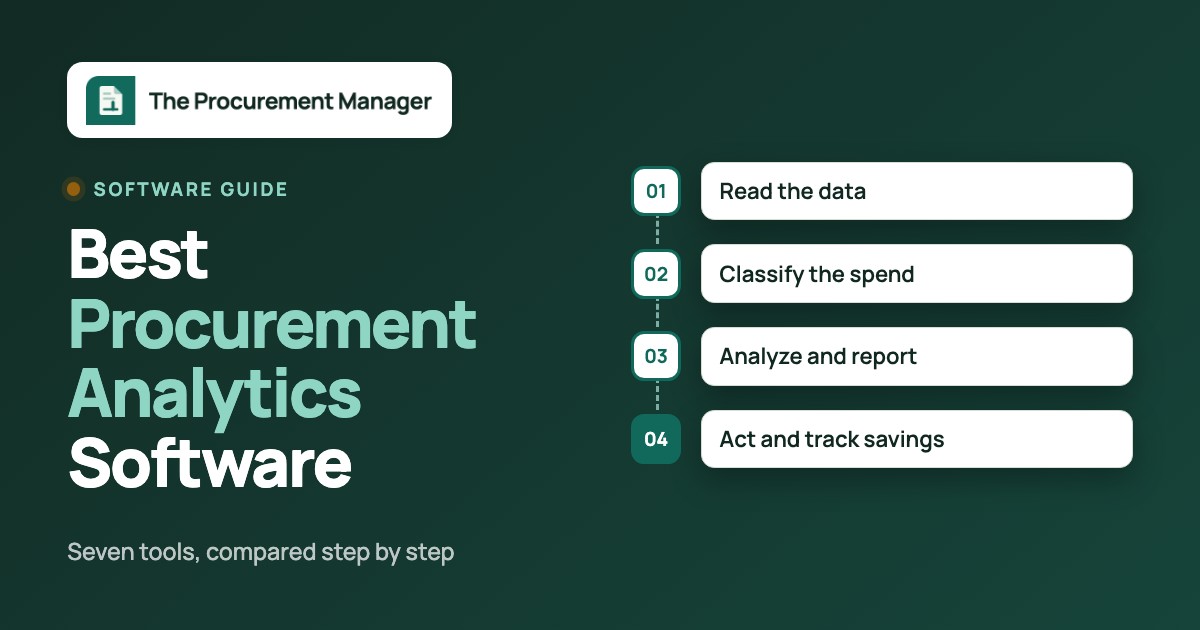
Every tool here runs the same four steps: read the data, classify it, analyze it and act on what the analysis finds. Each column below names the step and the tools whose vendor pages document it in the most detail. The line underneath says what goes wrong when the step is weak. A tool missing from a column isn't proof that it lacks the feature, only that its public pages do not describe it, so ask for a demo of that step.
- Step 1Read the data
- Sievo
- SAP Ariba
- JAGGAER
- GEP SMART
Breaks when a source system is left out, so the spend cube is incomplete - Step 2Classify the spend
- Ivalua
- Zycus
- Coupa
- Sievo
Breaks when the taxonomy maps a supplier to the wrong category - Step 3Analyze and report
- Coupa
- Zycus
- Ivalua
- JAGGAER
Breaks when dashboards disagree with the finance report - Step 4Act and track savings
- Sievo
- Coupa
- GEP SMART
- SAP Ariba
Breaks when a found saving never reaches the P&L
Procurement analytics software reviews
We read vendor pages, help documentation and review-site listings and did not run these products. Each entry follows the same four steps and ends with price, review basis and a skip-if.
Sievo
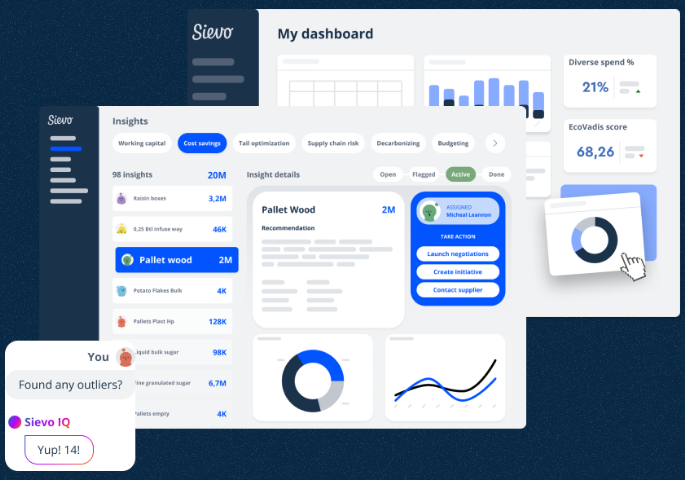
Sievo is a spend analytics platform for large enterprises that classifies spend, surfaces savings opportunities and tracks initiatives against baselines. It is analytics-led rather than a sourcing suite, so category teams pair it with an RFx tool.
Sievo is the one analytics-first product on this list: it classifies and reports spend and tracks savings, and it leaves the sourcing event to another tool.
Read. Sievo pulls invoices, purchase orders and master data from ERPs, MRPs, data lakes and procurement systems. The vendor cites more than 1,060 data sources.
Classify. AI classification uses cross-customer Community Data, runs with every data refresh and is covered by an SLA. Direct spend is mapped through material numbers and SKUs, indirect spend through GL accounts, cost centers and supplier data. Custom taxonomies are supported.
Analyze. A direct procurement page describes tracking supplier on-time-in-full delivery against contract expectations, and Sustainability Analytics links spend to supplier CSR ratings.
Act. Initiative Management tracks an initiative from idea to realization, measures savings against baselines and separates controllable from non-controllable factors. Approval stages leave an audit trail. Guided actions can email suppliers or assign tasks from an insight.
What users report. TrustRadius shows 8.8 out of 10 from two reviews. One reviewer praises savings project tracking and the pipeline view, and one finds DIO tracking hard to use. Two reviews are too few to rely on.
- you are a large enterprise that wants classified direct and indirect spend feeding savings tracked against baselines
- you want ERP-connected analytics with market price benchmarks and commodity indexes behind category plans
- you need built-in RFx or sourcing events, because none are documented
- you want a published price or a mid-market tool, since pricing is quote only and the vendor targets large enterprises
- Users like
- Savings project tracking, the project pipeline view and spend overview by region and payment terms analysis.
- Users dislike
- One reviewer finds DIO tracking hard to use.
- Source: TrustRadius, 2 ratings
- Starting price
- Not published, quote only
Coupa
Enterprise source-to-pay suite whose requisitions run through guided buying, punchout and prioritized approval chains with budget meters.
Coupa fits a team that already buys through Coupa and wants the analytics in the same platform as sourcing, contracts and spend.
Read. Coupa describes cross-platform spend visibility across the data in its own platform. Coupa's public pages list no external source systems.
Classify. An AI engine maps transactions to a proprietary Coupa taxonomy of roughly 60 primary categories and 1,800 sub-categories built for category management. It classifies by supplier first, using invoice and purchase order descriptions. That figure comes from a 2022 vendor post.
Analyze. Out-of-the-box dashboards, KPI benchmarking and savings insights are listed. Suggested opportunities include expiring contracts.
Act. Coupa tracks value through the stages identified, negotiated, contracted and realized, to link negotiated savings to P&L impact. Initiative value can include non-cost benefits such as supplier relationships and resilience.
What users report. 6.9 out of 10 from 171 reviews on TrustRadius. Reviewers praise approval routing and spend compliance for indirect buying. They report heavy integration work with ERPs such as SAP.
- you buy or source in Coupa and want dashboards, KPI benchmarking and savings insights on the same data
- you want savings tracked through named stages from identified to realized
- you want standalone analytics over several ERPs, because the strongest documented analytics sit inside the Coupa platform
- you want a published price or a short rollout, since Coupa sells by custom quote
- Users like
- Approval routing and spend compliance for indirect buying, with clear purchase limits per person.
- Users dislike
- Heavy integration work with ERPs such as SAP, and a supplier portal that confuses vendors asked to create profiles.
- Source: TrustRadius, 171 ratings
- Starting price
- Custom buyer quote; no public US rate card verified
SAP Ariba
SAP's source-to-pay suite covering sourcing events with scoring and award simulation, buying and invoicing, contracts and supplier collaboration through SAP Business Network.
SAP Ariba fits a company whose purchasing data already lives in SAP and wants analytics that reads it without a separate data project.
Read. The newer Spend Analysis and Insights offer ingests SAP Cloud ERP, Ariba, Fieldglass and Concur data plus non-SAP data.
Classify. Spend maps to UNSPSC, including version 25, or to a custom taxonomy. SAP states 95% accuracy. That is a vendor figure.
Analyze. Category segmentation and cost structure analysis are listed features, and a Kraljic matrix segments categories or suppliers by supply risk and profit impact. Supplier performance scorecards belong to separate Ariba supplier management modules.
Act. Managers pick value levers, goals and KPIs per category, document initiatives with owners, timelines and estimated outcomes, and follow them in a monitoring workbench, dashboard and calendar view. Savings accounting rules are not detailed publicly.
What users report. 7.6 out of 10 from 770 reviews on TrustRadius. Reviewers praise punch-out catalogs and guided buying. They criticize an outdated interface, weak reporting and hard integration with non-SAP ERPs.
- your spend data starts in SAP Cloud ERP, Ariba, Fieldglass or Concur
- you want a custom or UNSPSC taxonomy and category-level savings initiatives with owners and timelines
- you want a published price, because Ariba is price upon request
- you run mostly non-SAP ERPs, where reviewers report hard integration
- Users like
- Punch-out catalogs and guided buying with approval workflows that standardize how people buy.
- Users dislike
- An outdated interface, weak reporting and hard integration with non-SAP ERPs.
- Source: TrustRadius, 770 ratings
- Starting price
- Price upon request, no public buyer rate
Ivalua
Ivalua is a source-to-pay suite whose supplier management module runs a branded supplier portal for onboarding and compliance and adds a supplier information management offering that cleanses supplier records and updates ERP records in bulk.
Ivalua fits a team that wants to change classification rules itself and see ranked opportunities that lead into sourcing workflows.
Read. Ivalua's pages describe analyzing direct, indirect and travel and expense spend together but name no source systems.
Classify. Spend is classified on demand with standard or custom taxonomies. Classifications refresh as new data arrives.
Analyze. Configurable analytics for savings and compliance sit in the category module. Spend analysis says little about supplier performance beyond risk monitoring and supplier consolidation.
Act. Spend analysis ranks savings, sourcing and consolidation opportunities by financial impact, risk and feasibility, links them to sourcing workflows and tracks results.
What users report. No public rating or review count is available for Ivalua.
- you want business users to create and edit classification rules without coding
- you want opportunities ranked by financial impact, risk and feasibility and linked to sourcing workflows
- you want a published price, because Ivalua sells by quote and a third party reports a buyer-reported floor near $150,000 per year
- you need supplier segmentation inside the analytics, which the spend analysis page does not describe
- Starting price
- Not published, quote only (a third party reports a buyer-reported floor near $150,000 per year)
GEP SMART
GEP's source-to-pay platform, presented under the GEP Quantum Intelligence brand, runs RFx events and e-auctions in one place and moves awarded suppliers into contracting.
GEP SMART fits a company whose supplier and spend records are messy and that wants AI to clean them before anyone builds a report.
Read. GEP lists integrations with ERPs and source-to-pay suites such as SAP Ariba, Coupa, Ivalua, SAP, Oracle and Microsoft Dynamics.
Classify. UNSPSC, SIC and custom enterprise taxonomies are supported. An AI engine cleanses, normalizes and classifies each spend line, adds supplier parent-child links and detects duplicates.
Analyze. Supplier Intelligence monitors performance, risk and financial health continuously, and a Performance Monitor Agent tracks supplier KPIs. A Category Strategy Agent drafts category strategies and updates them as market data changes.
Act. Opportunities become savings projects with milestones and live metrics. The pipeline moves projected savings to realized and checks results against targets.
What users report. No public rating or review count is available for GEP SMART.
- you want AI to cleanse, normalize and classify every spend line and to flag duplicate suppliers
- you want identified opportunities turned into savings projects with milestones and live metrics
- you want a published price or a self-serve trial, since GEP publishes neither
- you need classification accuracy figures, because none are published
- Starting price
- Not published
Zycus
Zycus is a source-to-pay suite whose supplier management and iRisk modules score suppliers against buyer-defined KPIs and contracted SLAs, with AI agents, risk cards and supplier corrective action requests.
Zycus fits a multinational that needs spend classified across languages and wants tail spend and non-compliance flagged inside a source-to-pay suite.
Read. The spend analysis page describes data access in over 13 languages. It does not list source systems.
Classify. The AutoClass engine classifies spend across languages, and four classification levels are offered. Hybrid Taxonomy adds custom reporting parameters.
Analyze. iAnalyze provides drag-and-drop reports, guided browsing and pre-packaged reports for common analyses. Alerts cover non-compliance and price changes. The iCost module tracks commodity trends and lists more than 300 cost models. A Merlin Analytics Agent answers procurement questions conversationally.
Act. Tail spend management flags cost variances across suppliers, categories and regions, and the page ties maverick spend findings to supplier term renegotiations. Savings tracking is not described in detail.
What users report. The vendor page shows 4.6 out of 5 from 173 reviews on a source-to-pay suite listing and names no review site, so we do not treat it as independent.
- your spend data comes in many languages and you want it classified in one engine
- you want tail spend, price-change and non-compliance alerts plus drag-and-drop reporting
- you want a published price or documented classification accuracy, since neither is on the page
- Starting price
- Not published
JAGGAER
JAGGAER is a source-to-pay suite whose supplier management module gives suppliers a portal with guided self-service onboarding, compliance checks and configurable workflows, plus automated verification of uploaded documents.
JAGGAER fits a team that wants invoice text classified automatically and category plans backed by market price data in one suite.
Read. More than 40 pre-built connectors are listed, including SAP, Oracle, Workday, NetSuite, Infor and JD Edwards.
Classify. Automatic Spend Classification uses NLP on invoice text or product numbers to predict eCl@ss codes, and the same method can predict UNSPSC. It runs on demand or in batch.
Analyze. The category management page lists built-in Kraljic, SWOT and Porter frameworks and market intelligence such as commodity, FX and price indices plus more than 800 category reports. It describes a unified view of spend, supplier performance and market data.
Act. A savings pipeline covers idea capture, validation and tracking from identified through realized. Mapping savings to category targets or baselines is not detailed on the page.
What users report. 4.1 out of 5 from 86 reviews on G2. Reviewers praise flexibility, configurability and strong support and consulting teams. They criticize an inconsistent interface across modules, setup complexity and supplier-side feature limits.
- you want NLP to predict eCl@ss or UNSPSC codes from invoice text or product numbers
- you want built-in category frameworks plus commodity, FX and price indices and category reports
- you want documented classification accuracy, because none is published and the press release that describes it dates from 2019
- you want a published price, since JAGGAER sells by custom quote only
- Users like
- Flexibility and configurability, strong support and consulting teams.
- Users dislike
- An inconsistent interface across modules, setup complexity and supplier-side feature limits.
- Source: G2, 86 reviews
- Starting price
- Not published, custom quote
Which tool fits which analytics goal
The right tool follows the goal, not the longest feature list. Use the table to match the job you need done this year to the product whose pages describe it.
- You need savings tracked against baselines, with an audit trailSievo
- You buy and source in one platform and want the analytics there tooCoupa
- Your purchasing data starts in SAP systemsSAP Ariba
- Business users must own the classification rulesIvalua
- Supplier and spend records are duplicated and uncleanGEP SMART
- Spend comes in many languages and tail spend is the targetZycus
- You want invoice text classified by NLP with market price indices behind category plansJAGGAER
Suite analytics or a dedicated spend analytics tool?
Coupa, SAP Ariba, Ivalua, GEP SMART, Zycus and JAGGAER are suites, and their analytics read the data the suite already holds. Sievo is the dedicated analytics product on this list and reads data from ERPs, data lakes and other procurement systems. That's the main architecture choice.
A suite module is the easier start when you already buy or source in that suite, because classified spend and savings tracking sit next to the events that create the savings. A dedicated tool is the better fit when spend is spread over several ERPs and procurement systems and no single suite will hold all of it. The cost is a second vendor, a second contract and an integration to keep alive. Our guide to source-to-pay software covers the suites in more depth.
Cheaper options exist for small teams, but none of the seven publishes a price for them. A small team usually starts with the reports inside its purchasing tool or ERP and a spreadsheet export, and moves to a tool like these when the spend is big enough that manual classification stops being feasible.
Data readiness checklist before a demo
A vendor demo runs on clean sample data, and yours isn't clean. Prepare these items before the call and ask the vendor to run your own sample through the tool.
- List every system that holds purchase orders, invoices or payments and name the owner of each
- Export one quarter of invoice lines with supplier, description, amount and general ledger account
- Check how many suppliers appear under more than one name and note the worst examples
- Decide which taxonomy you need: UNSPSC, a custom one or the one your finance team already uses
- Name the person who will correct a wrong classification and how fast the fix must reach reports
- Write down the three questions you could not answer this year, such as tail spend or price variance
- Ask how a saving is recorded from identified to realized and who signs it off
What spend analytics does not show: renewal notice dates
Spend analytics answers what you bought and what you could save on the next negotiation. It doesn't answer when a contract must be cancelled to avoid an automatic renewal. That date sits in the contract as a notice period, usually weeks or months before the renewal date, and it isn't part of the invoice or purchase order data these tools classify. Coupa lists expiring contracts among its suggested opportunities, which is a start, but an expiry date isn't a confirmed notice deadline.
So a team can run clean analytics and still renew a software contract it meant to leave, because nobody owned the deadline. That's an ownership gap, not an analytics gap. Our guides on the contract renewal notice period and the contract renewal checklist show how to track it by hand.
Frequently asked questions
What does a procurement analyst do?
A procurement analyst collects and cleans purchasing data, classifies spend, builds reports on spend, price and supplier performance, and points buyers to savings and risks. The role is usually the daily user of the tools on this page.
Is AI replacing procurement?
AI is replacing parts of procurement analytics work, such as classifying spend lines, summarizing bids and answering questions about data, and several vendors here describe AI agents for those tasks. The decisions about suppliers, terms and risk still need a buyer, and a wrongly classified dataset still gives wrong answers.
What are digital procurement systems?
Digital procurement systems are the software that runs purchasing steps: requisitions, sourcing events, purchase orders, invoices, supplier records and spend reports. Procurement analytics software is the reporting layer on top of them.
What is the best procurement analytics software for small businesses?
None of the seven tools here publishes a price for a small team, and Sievo's pricing targets large enterprises. Small teams usually start with the reports in their ERP or purchasing tool and a spreadsheet, then add a dedicated tool when manual classification no longer scales.
How much does procurement analytics software cost?
Procurement analytics software is sold by quote or without a published price. Coupa, Sievo, Ivalua, GEP SMART and JAGGAER sell by quote, SAP Ariba prices on processed spend on request, and Zycus does not publish a price. A third party reports a buyer-reported floor near $150,000 per year for Ivalua.
How is spend classification different from spend analysis?
Spend classification assigns every transaction to a category in a taxonomy such as UNSPSC. Spend analysis uses those categories to report, rank opportunities and track savings, so weak classification makes every later report unreliable, and that's why a demo should start there.