The best demand planning software depends on how you buy and which system holds your orders. Small product brands that sell through Shopify and Amazon usually start with Inventory Planner, Flieber or StockTrim. Distributors and manufacturers that plan from an ERP such as NetSuite, Sage, Acumatica or Dynamics look at Netstock, GMDH Streamline and Slimstock. Large manufacturers and retailers evaluate ToolsGroup, RELEX, Kinaxis and SAP Integrated Business Planning.
Demand planning software forecasts what customers will buy, item by item, and turns that forecast into stock targets and, in most tools, a suggested purchase. We compared ten tools from vendor pricing, feature and help pages and from G2 and Capterra, and we judge each one by what it hands to purchasing: how the forecast is made, how it becomes an order, and what it assumes about supplier lead times and minimum order quantities.
- tools compared
- 10
- bands of tools by company shape and stack
- 3
- of the ten tools publish any price
- 3
- Match the tool to how you buy. StockTrim, Inventory Planner and Flieber suit product brands that sell online. Netstock, GMDH Streamline and Slimstock plan from an ERP. ToolsGroup, RELEX, Kinaxis and SAP IBP are enterprise suites.
- Only three of the ten publish a price: StockTrim from $298 per month (priced by revenue), Netstock from $900 per month on an annual contract with demand planning sold as a separate quote, and a $2,706 per month non-productive starter edition of SAP IBP. The other seven are quote only.
- The forecast matters to purchasing once it becomes an order. StockTrim, Inventory Planner, Flieber and GMDH Streamline describe draft purchase orders you edit, Netstock produces order recommendations by supplier, and Slimstock says its replenishment module can create purchase orders automatically. Kinaxis's demand planning material we read ends at the demand plan and hands it to supply planning.
- Rollout is slow at the top end. G2 reviewers report an average of about 7 months to implement SAP IBP and Slimstock and about 3 months for Netstock. Ask what live means before you sign.
Our picks by situation
One tool rarely fits every buyer, so these picks follow the situation, not a score. Each tag says what the tool is best at, and the entries below say what it leaves out.
 Best published price for a small teamStockTrimFrom $298 per month on annual billing at $3M to $5M revenue, with unlimited users and SKUs and a 14-day trial.
 Best for multichannel retail on Shopify or AmazonInventory PlannerRecommended order quantity and replenish date per SKU, with supplier MOQ and payment terms filled into the PO.
 Best for brands that plan POs around a cash capFlieberDraft POs grouped by supplier that respect MOQ, case pack, container capacity and a cash limit.
 Best for distributors planning from an ERPNetstockReads over 60 ERPs and recommends orders by supplier from reorder point and net stock. Starts at $900 per month.
 Best for an ordering plan with order-by datesGMDH StreamlineTime series forecasts, safety stock and a previewed ordering plan before POs are created.
 Best for multi-branch networksSlimstockMulti-echelon inventory optimization and replenishment that can create purchase orders automatically.
 Best for intermittent and long-tail SKUsToolsGroupProbabilistic forecasts with a full probability distribution per SKU and location.
 Best for grocery and store-based retailRELEXMachine learning forecasts per product, store and day, with daily order proposals written back to the ERP.
 Best for one plan across several ERPsKinaxis MaestroDemand, supply and inventory on one data model, so a demand change recalculates the supply plan.
 Best if you already run SAP ECC or S/4HANASAP IBPStatistical forecasting and demand sensing with the plan returned to SAP as planned independent requirements.
 For the software contract after the purchaseThe Procurement ManagerRoutes the renewal decision on a planning tool's contract to the business owner, Finance and IT before the notice deadline.
What demand planning software does and how it differs from forecasting, supply planning and S&OP
Demand planning software takes your sales history and other signals such as promotions, new products and seasonality, produces a forecast for each item and period, lets people adjust it, and feeds the result into inventory and purchasing decisions. The word is used loosely, but the jobs behind it differ a lot. Some vendors sell a forecasting engine, some sell reorder suggestions built on a simple forecast, and some sell a full planning suite where demand is one module. Search results mix all three, so it helps to know which job you are buying.
| Planning term | Question it answers | What comes out | Usually owned by |
|---|---|---|---|
| Demand forecasting | How much will customers buy, by item and period? | A statistical or machine learning forecast | Demand planner or analyst |
| Demand planning | Which demand number does the business plan against after sales, finance and marketing have had their say? | A reviewed demand plan with overrides for promotions and new products | Demand planner |
| Inventory planning and replenishment | How much stock should we hold and when do we reorder? | Safety stock, reorder points and order quantities | Buyer or inventory planner |
| Supply planning | Can suppliers and plants deliver the plan? | A supply plan with purchase and production quantities | Supply planner |
| S&OP or integrated business planning | Do sales, operations and finance agree on one plan? | A signed-off monthly plan | Operations leadership |
The tools in this guide cover different slices of that table. Netstock, StockTrim, Inventory Planner, Flieber and GMDH Streamline start at inventory planning and work backwards to a forecast. Kinaxis and SAP IBP start at the plan and work toward supply. If you are choosing a wider buying system as well, our guides to procurement software, procure-to-pay software and purchase order software cover the purchasing side.
Demand planning software compared
This table sets the ten tools side by side before the entries: what kind of tool each one is, what it hands to purchasing, whether the vendor publishes a price and how reviewers rate it. Ratings come from G2 or Capterra as noted in each entry, and the review counts are small for several tools.
| Tool | Kind of tool | What reaches purchasing | Price status (USD) | G2 rating |
|---|---|---|---|---|
| StockTrim | Revenue-priced SMB inventory forecasting and order planning | One draft purchase order per supplier from suggested order quantities, with MOQ, batch rounding and container, weight or budget limits. | From $298 per month on annual billing (the $3M to $5M annual revenue band); priced by revenue | 4.9 (Capterra, 14) |
| Inventory Planner | Replenishment and demand forecasting for multichannel retailers | Per-SKU recommended order quantities and a last-order (replenish) date, turned into POs with supplier currency, MOQ and payment terms pre-filled. | Custom quote, not published | 4.6 (Capterra, 82) |
| Flieber | Multichannel inventory and demand planning for product brands | Supplier-grouped draft purchase and transfer orders (MOQ, case pack, container and cash-limit aware) that can be pushed to ERPs such as NetSuite after approval | Not published | 4.7 (30) |
| Netstock | ERP-connected inventory and demand planning | Recommended order quantities by supplier, calculated from reorder point, order-up-to level and net stock, ready to review and send back to the ERP. | From $900/month (annual contract) | 4.6 (182) |
| GMDH Streamline | Demand forecasting and inventory/supply planning | A time-phased ordering plan with safety stock and 'order by' dates, previewed and adjusted before purchase orders are created. | Not published, custom pricing | 4.4 (278) |
| Slimstock | Enterprise supply chain planning platform (demand, inventory, replenishment) | Automatic recommendations/purchase orders for outstanding and future orders, calculated from forecasts, stock, supplier lead times, constraints and service-level targets | Not published | 4.8 (75) |
| ToolsGroup | Probabilistic demand and inventory planning suite (enterprise) | Purchase, replenishment and production recommendations, with safety stock and stocking parameters per SKU-location, executed in the ERP (e.g. SAP MRP) | Not published (quote only) | 4.5 (49) |
| RELEX | Unified retail and supply chain planning platform (enterprise) | Automated store and DC order proposals, safety stock levels and replenishment schedules, written back to the ERP | Not published (quote only) | 4.6 (40) |
| Kinaxis Maestro | Enterprise concurrent supply chain planning platform with demand planning | Approved consensus demand plan that feeds aggregate supply planning, S&OP balancing and constrained supply plans in the same data model. | Not published (quote only) | 4.0 (14) |
| SAP IBP | Enterprise cloud supply chain planning suite (demand, S&OP, inventory, supply) | Consensus demand plan, which feeds IBP supply planning or goes to SAP ECC / S/4HANA as planned independent requirements. | Starter USD 2,706/mo; production quote only | 4.3 (301) |
| The Procurement Manager Our product | Contract renewal decisions | Routes renewal reviews to the business owner, Finance and IT before the notice deadline | From $49 per month, flat, no per-seat fees (Starter, up to 50 contracts) | No reviews yet |
Prices as published on vendor pages and checked on November 1, 2026. Quote only means the vendor shows no amount.
From forecast to purchase order: what each tool hands to purchasing
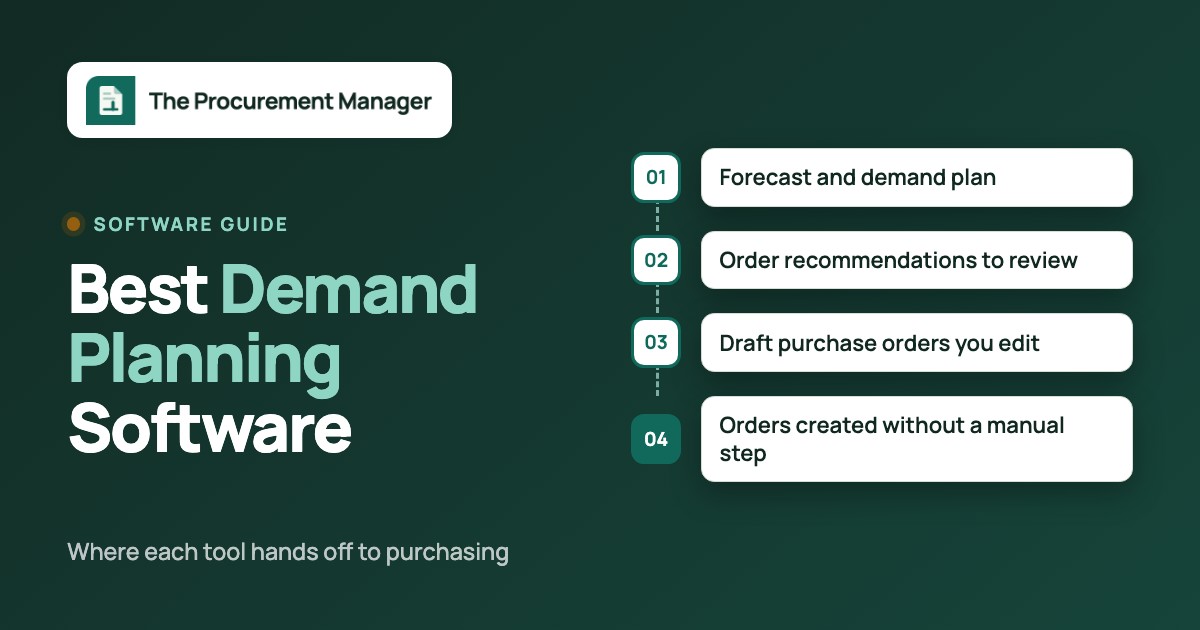
A forecast changes nothing until someone buys against it. The tools stop at different points on the way from forecast to order, and that difference matters more to a buyer than the forecasting method. The flow below places each tool where its documented output ends, based on the vendor pages and help articles we read.
- Stops at the planForecast and demand plan
- Kinaxis Maestro
- SAP IBP
Ask which supply application or ERP step turns the plan into purchase orders - RecommendationOrder recommendations to review
- Netstock
- ToolsGroup
Ask how recommendations reach the ERP, by download, export or integration - Draft PODraft purchase orders you edit
- StockTrim
- Inventory Planner
- Flieber
- GMDH Streamline
Ask which supplier limits are applied: MOQ, case pack, container, budget - AutomaticOrders created without a manual step
- Slimstock
- RELEX
Ask who approves an order before it leaves, because the pages we read show no approval step
Four questions separate the tools in practice, and they are worth putting to every vendor in a demo.
- Which lead time does the order use? Inventory Planner lets you set lead time per variant, vendor or warehouse. Netstock reads supplier lead times from the ERP and recalculates safety stock daily. StockTrim uses lead time to calculate the reorder point.
- What happens to minimum order quantities and multiples? Netstock's help center gives an example: an ideal order of 800 units with a supplier MOQ of 1,000 and an order multiple of 120 becomes an order of 1,080. Flieber adds case packs, container capacity and a cash cap to the same idea.
- Where does the order go next? StockTrim can send a PO into a compatible inventory system or export a PDF or CSV. Flieber can push approved orders to systems such as NetSuite. ToolsGroup's case study shows recommendations executed through SAP MRP.
- Who approves it? Slimstock's pages describe automatic purchase order creation and show no approval step. If you need a buyer to sign off, ask where that happens.
Spreadsheet planning hides these questions because the buyer does the rounding and approval by hand, whereas a tool moves that work into settings. A wrong setting, however, then repeats across every order instead of one.
Demand planning software for small and mid-sized product companies
StockTrim, Inventory Planner and Flieber connect to online stores, marketplaces and inventory systems and are the closest to self-serve among the demand planning tools here. Only StockTrim publishes a price. All three focus on the order a buyer places, and none describes S&OP workflows.
StockTrim
StockTrim is a self-serve forecasting layer for small and mid-size product companies that sells one plan priced by annual revenue band, with unlimited users, SKUs and platform connections. It forecasts 24 months ahead, calculates reorder points from lead time and service level, and builds per-supplier draft POs.
StockTrim is a self-serve forecasting and order-planning tool for small and mid-sized product companies, sold as one plan priced by annual revenue.
StockTrim: how the forecast is made. StockTrim syncs sales, stock and open purchase orders from a connected system or a CSV and forecasts 24 months ahead. The Demand Analysis screen shows the forecast model (set to auto), a seasonality toggle, the history period, growth and excluded outliers, and the planner can override any month by hand or by template upload. The pages we read name no algorithms, safety stock formula or review period, so ask which model runs on your items.
StockTrim: from forecast to purchase order. The reorder point is lead-time demand plus a safety stock set from your service level. The order quantity is the reorder point minus stock on hand and on order, rounded for minimum order quantity and batch size. On the Order Plan, rows that are short on stock turn red and Create Purchase Orders builds one draft PO per supplier. A planner edits lines against container volume, weight or budget limits, approves, and either sends the PO to a compatible inventory system or downloads a PDF or CSV.
StockTrim: stack and limits. It names Shopify, QuickBooks, NetSuite, Unleashed, Fishbowl, Katana, Zoho Inventory, Odoo, Amazon FBA and others, plus API access. The pages describe no S&OP, promotion modelling or multi-echelon planning, and one Capterra reviewer says work orders and transfers can't sync. Raw-material forecasting with multi-level bills of materials is a paid add-on.
- you want a price tied to revenue rather than SKU or user count, with unlimited users, SKUs and connections
- you need supplier POs capped by container volume, weight or budget
- you need S&OP, promotion modelling or consensus planning, because the pages we read describe none of them
- you need work orders or transfers to sync, which one reviewer says they don't
- Users like
- Easy to use and set up, fast and helpful support, forecasts that stopped over-ordering and cut stock-outs, two-way sync of POs back to the ERP.
- Users dislike
- Initial navigation and multi-level BOM setup take time, new-product forecasts can feel off for one-offs, SKU codes must be consistent to avoid duplicates, some work orders and transfers cannot sync.
- Source: Capterra, 14 reviews

Price and what reviewers say
StockTrim's pricing page shows one plan priced by annual revenue band. We could read the $3M to $5M band: $298 per month on annual billing, with unlimited users, SKUs and platform connections and a 14-day trial. The other bands didn't load, so check yours before you budget.
Capterra shows 4.9 from 14 reviews, most from 2021 and mid-2025, and G2 shows no reviews, so the sample is small. Reviewers praise easy setup, fast support and fewer stockouts and less over-ordering, and one describes POs syncing back to the ERP. Their complaints are that navigation and multi-level BOM setup take time, that forecasts for one-off new products can feel off, and that SKU codes must be consistent to avoid duplicates. Pricing and facts checked November 1, 2026.
- Starting price
- From $298 per month on annual billing (the $3M to $5M annual revenue band); priced by revenue
- Limits
- Unlimited users, SKUs and platform connections
- Forecast horizon
- Forecasts 24 months ahead, model set to auto, seasonality toggle, manual monthly overrides and template bulk upload
- Order logic
- Reorder point is lead-time demand plus safety stock from the service level; order quantity is the reorder point minus stock on hand and on order, with optional MOQ and batch rounding
- Price basis
- One plan priced by annual revenue band; unlimited users, SKUs and connections
- Trial
- 14 days
Inventory Planner
Inventory Planner connects to e-commerce, ERP and inventory systems, forecasts demand per SKU and turns it into purchase recommendations and POs. It targets multichannel and multi-warehouse retailers and wholesalers.
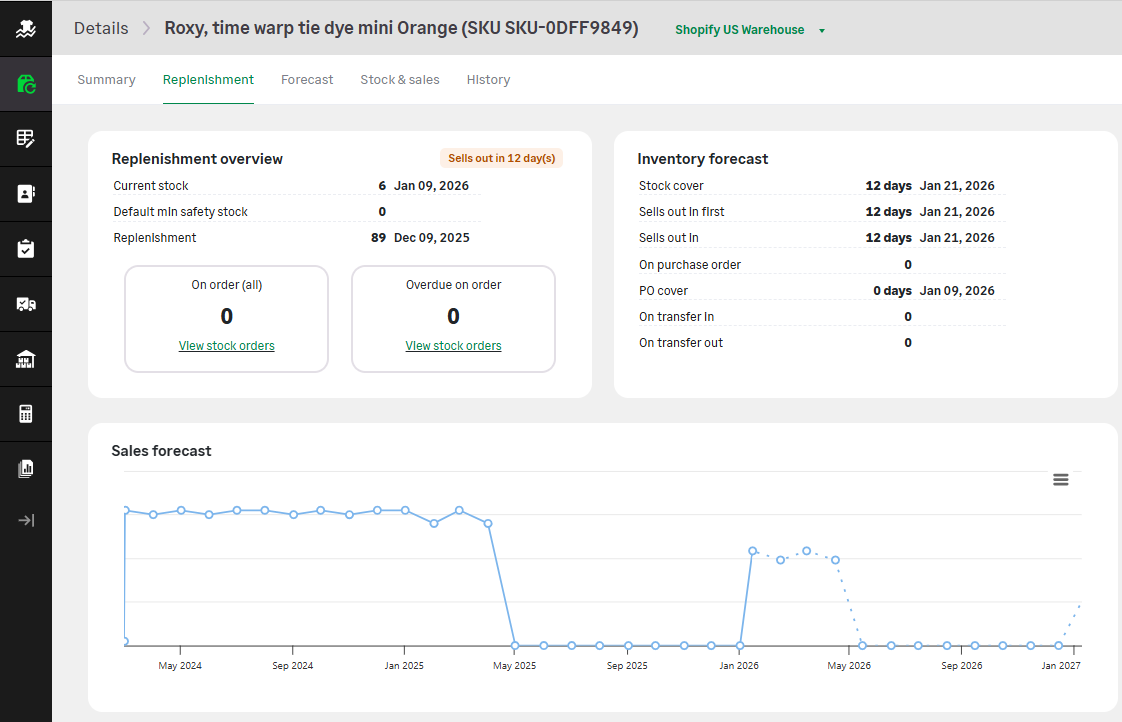
Inventory Planner by Sage connects to your stores, marketplaces and inventory system, forecasts demand per SKU and shows a recommended order quantity and replenish date for each one.
Inventory Planner documents two forecast methods. Last sales averages sales over a set number of days and ignores seasonality. Seasonal uses the same months of earlier years and needs at least 12 months of history. The planner sets one method for the account and overrides it for single variants. Lead time and days of stock can be set per variant, vendor or warehouse, and stockout periods can be left out of sales velocity so a sold-out item doesn't look like a slow seller.
The replenishment report is where a buyer works. It ranks items by forecast lost revenue or by sell-out date, the buyer reviews or edits the forecast and the stockout history, and POs are raised from the recommendations with the supplier's currency, minimum order quantity and payment terms already filled in. That makes it a tool for people who place many small orders across many suppliers.
On the stack side it names Shopify and Shopify Plus, Amazon, WooCommerce, eBay and BigCommerce, plus Brightpearl, Cin7, QuickBooks, Linnworks, NetSuite and Dynamics 365. It is built for retailers, wholesalers and multichannel sellers. The help pages document no statistical safety stock and no material requirements planning, and a reviewer says manufacturing and bill-of-materials workflows need careful configuration.
- you sell on Shopify, Amazon or WooCommerce and run Brightpearl, Cin7, NetSuite or QuickBooks, and need order recommendations with supplier terms pre-filled
- buying, operations and finance all need access, since the vendor says users are unlimited at no extra cost
- you need a published price to budget against, because the vendor shows none and a reviewer criticises revenue-based pricing
- you are a manufacturer with bills of materials and different purchase and stock units
- Users like
- Dashboards give shared visibility of demand and purchasing; forecasting picks up seasonality and replaces spreadsheets; support rated 4.6.
- Users dislike
- Pricing seen as high and revenue-based; reports sometimes need data configuration; forecasting algorithm called improvable by one reviewer; a 2022 review describes slow support during an outage.
- Source: Capterra, 82 reviews
Price and what reviewers say
Inventory Planner publishes no price. The vendor says pricing depends on the volume of inventory you manage and that users are unlimited. Capterra shows 4.6 from 82 reviews and G2 shows 4.4 from 49, though we only read the Capterra review text. G2 users report about a month to get started.
Capterra reviewers value the dashboards that show demand and purchasing in one place, forecasts that pick up seasonality and the end of spreadsheet planning, and rate support 4.6. Their complaints are that pricing is high and tied to revenue, that some reports need data configuration, and, from one reviewer, that the forecasting algorithm could improve. Checked November 1, 2026.
- Starting price
- Custom quote, not published
- G2 rating
- 4.4/5 from 49 reviews (G2 page read, themes not read)
- Pricing basis
- Depends on volume of inventory managed (vendor); users unlimited
- Forecast methods
- Last sales (average over set days, non-seasonal) and Seasonal (same months prior years, needs 12+ months)
- Lead time
- Set per variant, per vendor, per warehouse or in bulk; can differ by location
- Stockouts
- Detected from connection time; stockout periods excluded from velocity if enabled
- Onboarding (G2 users)
- About 1 month
Flieber
Flieber forecasts demand per SKU and channel from stockout- and promo-corrected history, then turns forecasts into replenishment and transfer recommendations with supplier and cash constraints. Built for multichannel e-commerce brands (Amazon, Shopify, Walmart and similar).
Flieber forecasts demand per SKU and channel and turns the forecast into replenishment and transfer plans for brands that sell through several channels.
Flieber corrects its own input before it forecasts. Its False Zero Substitution feature detects periods when an item was out of stock and estimates the true demand, and it adjusts out the spike that follows a restock. The help center describes a custom model built with Nixtla's TimeGPT and blended with a seasonal model at daily and weekly level. Planners review flagged exceptions and override forecasts for promotions, targets and new products at SKU, channel or group level.
The purchasing side is where Flieber stands out. Replenishment recommendations are built from safety stock, target days of cover, lead times and order frequency, which can be set per product, category or channel. In the plan view an AI assistant can rebalance quantities to a target arrival date, a container or pallet type and a cash cap, and shows its reasoning for each edited cell. The result is draft purchase orders grouped by supplier, or an inbound shipment, that respect minimum order quantity and case pack and can be pushed to systems such as NetSuite after approval.
It reads Amazon, Shopify, Walmart, TikTok Shop, eBay, Etsy and BigCommerce, and the help center names Anvyl and NetSuite. Flieber's own page says it isn't a fit for single-channel sellers, for WMS or full ERP needs, or for manufacturing planning.
- you sell across Amazon, Shopify, Walmart and similar channels and need stockout-corrected forecasts per SKU and channel
- you want draft POs grouped by supplier that respect MOQ, case packs, container capacity and a cash cap
- you are a single-channel seller, or you need a WMS, a full ERP or material requirements planning
- you need a published price, because Flieber shows its self-serve price only after onboarding
- Users like
- Customer support, ease of use, forecasting accuracy and inventory management (G2 summary tags); reviewers cite one place for sales, stock and supply data and fewer stockouts/overstock
- Users dislike
- Complexity and a learning curve, plus forecasting limitations (G2 summary tags); one reviewer wants more APIs and channel connections
- Source: G2, 30 reviews
Price and what reviewers say
Flieber publishes no price. The self-serve price appears after onboarding, managed services are quoted per brand, contracts run monthly with unlimited users, and there is a 14-day free trial without a credit card (assisted integrations aren't part of the trial). A third-party listing shows older "starting at" prices that the current pricing page doesn't repeat, so we don't use them.
G2 shows 4.7 from 30 reviews. G2's summary tags list customer support, ease of use, forecast accuracy and inventory management as strengths and complexity, a learning curve and forecasting limitations as weaknesses. One reviewer asks for more APIs and channel connections. Checked November 1, 2026.
- Starting price
- Not published
- Forecast model
- Custom model built with Nixtla on TimeGPT, blended with a seasonal model at daily and weekly level (Flieber help center)
- Stockout handling
- False Zero Substitution detects disruption periods and estimates true demand; post-restock spikes are adjusted out
- Replenishment inputs
- Safety stock, target days of cover, overstock thresholds, lead times and order frequency, settable per product, category or channel
- Users and contract
- Unlimited users on every plan incl. trial; monthly contracts, no annual commitment
- Trial
- 14 days, no credit card; assisted integrations not available in trial
Demand planning software for distributors and manufacturers that plan from an ERP
Netstock, GMDH Streamline and Slimstock read data from an ERP and write recommendations back to it, so they suit companies where the ERP stays the system of record. They cost more and take longer to roll out than the first group, and none publishes a full price list.
Netstock
Netstock sits on top of your ERP and turns raw stock, order and sales data into daily-recalculated safety stock, reorder points and supplier-level order recommendations. Demand planning (hierarchies, promotions, events) is a separate quote-based add-on, and typical implementation is 6-10 weeks.
Netstock sits on top of your ERP and turns stock, order and sales data into daily-recalculated safety stock, reorder points and supplier-level order recommendations.
Netstock: the order logic is documented. This is the best-documented formula in the group. Reorder point is safety stock plus lead time. The order-up-to level adds the replenishment cycle. The recommended order quantity is the order-up-to level minus net stock when net stock is below the reorder point, and MOQ and order multiples then adjust it upward. Safety stock is recalculated daily from your target fill rate, lead time, supplier risk and forecast risk, and planners can override fill rate per item.
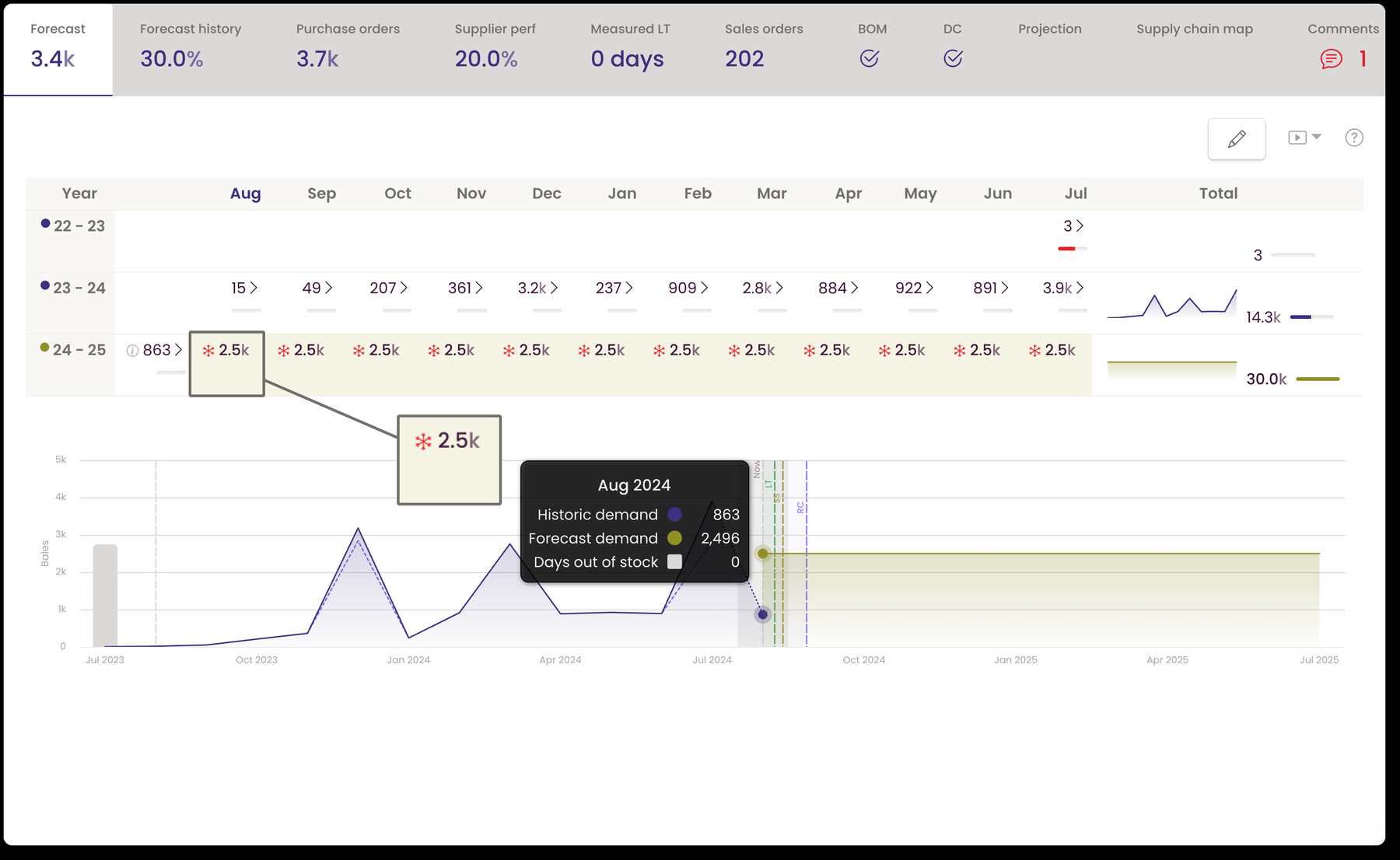
Netstock: how a buyer works in it. The planner reviews forecasts and the Projection tab, opens the Orders screen to generate an order schedule, filters by classification and impact, and uses a Solver to shape orders toward a value, volume or weight target before finalizing. The help center says order status shows whether an order was downloaded to the ERP or exported.
Netstock: forecasting is a separate purchase. The Demand Planning add-on, with top-down, bottom-up and middle-out forecasting by product, channel and customer plus promotions and events, is quoted separately and isn't part of the $900 entry bundle. Netstock names over 60 ERP integrations, including NetSuite, Sage, Acumatica, Microsoft Dynamics, SAP Business One, SYSPRO and Cin7 Core.
- you run one of the 60-plus supported ERPs and want supplier-level order recommendations with daily recalculated safety stock
- you need forecasting by product, channel and customer with promotions and events and will buy the Demand Planning add-on
- you have no ERP or a very small catalog, because the entry bundle alone is $10,800 a year before the Demand Planning add-on
- you run complex units of measure and bills of materials, where one reviewer reports a long implementation and lost trust in the recommendations
- Users like
- Ease of use (18 mentions), inventory management (17) and forecast accuracy (17), per G2's summary of reviews.
- Users dislike
- Missing features (10 mentions), data inaccuracy (8) and data management issues (7); one 2/5 review from a Dynamics NAV manufacturer describes a nine-month implementation and lost trust in recommendations.
- Source: G2, 182 reviews
Price and what reviewers say
Netstock publishes starting prices on annual contracts: Essentials from $900 per month, Advanced from $1,500 and Commercial from $2,000, with the Demand Planning add-on by quote. The vendor says implementation typically takes 6 to 10 weeks, while G2 reviewers report an average of about 3 months.
G2 shows 4.6 from 182 reviews. Its summary counts ease of use (18 mentions), inventory management (17) and forecast accuracy (17) as strengths and missing features (10), data inaccuracy (8) and data management problems (7) as weaknesses. One 2 out of 5 review from a manufacturer on Microsoft Dynamics NAV, dated October 12, 2026, describes a roughly nine-month implementation and users losing trust after an unusable recommendation. Checked November 1, 2026.
- Starting price
- From $900/month (annual contract)
- Entry price
- Pricing starts at $900/month; annual subscriptions only (pricing page, FAQ)
- Bundles
- Essentials $900, Advanced $1,500, Commercial $2,000 per month (starting prices); Demand Planning add-on by custom quote (packages page)
- ROQ logic
- Reorder point = safety stock + lead time; order-up-to = SS + LT + replenishment cycle; ROQ = order-up-to minus net stock when net stock is below reorder point (help center)
- Safety stock
- Recalculated daily from target fill rate, lead time, supplier risk and forecast risk; planners can override fill rate and RC per item
- Supplier constraints
- MOQ and order multiples adjust the ideal order upward (example: ideal 800, MOQ 1,000, multiple 120 gives 1,080)
- G2 implementation time
- About 3 months on average (G2); the vendor says 6 to 10 weeks
- ERP integrations
- Over 60 ERPs; G2 lists 29 vendor-verified
GMDH Streamline
Streamline forecasts demand with time series decomposition, then calculates safety stock and a just-in-time ordering plan from replenishment parameters. It is aimed at retailers, wholesalers, distributors and manufacturers, and also plans transfers and production.
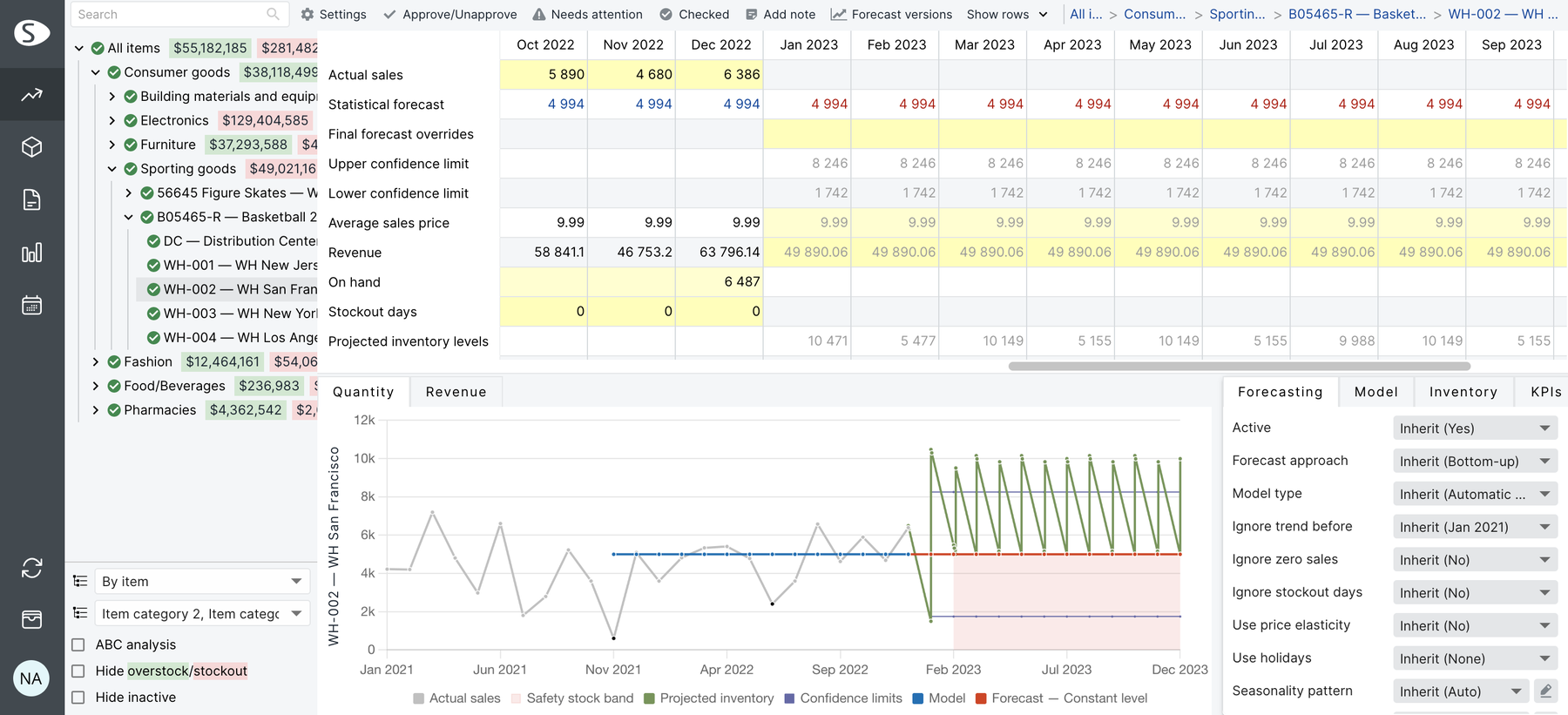
GMDH Streamline forecasts demand with time series decomposition, then calculates safety stock and an ordering plan with order-by dates that a buyer previews before creating purchase orders.
The planner imports sales and stock through built-in connections, a database connection or spreadsheets and updates the project on the data cadence, for example monthly. Streamline recommends at least 24 months of sales history so it can pick up seasonality, estimates true demand from stockout information, and lets the planner adjust forecasts manually for promotions and events, including custom holiday calendars.
Replenishment parameters such as supplier lead time are set once and revised when suppliers change. Streamline then calculates safety stock, shows projected stockouts and overstocks, and recommends what to order now. The buyer edits quantities and items in a purchase order preview, creates the POs, and the tool calculates a next order by date. That preview step is the clearest buyer-facing control in this group. The workflow documentation also covers transfers between locations and material requirements from bills of materials.
G2 lists vendor-verified integrations with Acumatica, NetSuite, SAP Business One, SAP S/4HANA Cloud, Microsoft Dynamics 365 and Shopify. One Capterra reviewer without a direct integration needed a manual twice-monthly import.
- you need safety stock, an ordering plan and POs in one tool, including transfers and bill-of-materials requirements
- you have 24 or more months of sales history and want stockout-corrected demand with manual event adjustments
- you want published pricing or a self-serve trial, because both pricing pages say pricing is tailored and show no plans
- nobody on the team can interpret forecast output, since a Capterra reviewer says skilled staff are needed
- Users like
- Capterra reviewers (4.8 from 11, mostly 2018 to 2020) call projections easy to set up and change, the forecasting models flexible and support strong.
- Users dislike
- Capterra reviewers say skilled staff are needed to read the output and setup is tedious without a direct integration.
- Source: G2, 278 reviews
Price and what reviewers say
GMDH Streamline publishes no price and no plans. G2 shows 4.4 from 278 reviews, but we couldn't read the G2 review text, so the strengths and weaknesses here come from Capterra, which shows 4.8 from 11 reviews, mostly from 2018 to 2020 and therefore dated. Those reviewers say projections are easy to set up and change, the forecasting models are flexible and support is strong. They also say skilled staff are needed to read the output and that setup is tedious without a direct integration. The vendor's pages didn't state an implementation time. Checked November 1, 2026.
- Starting price
- Not published, custom pricing
- Forecast method
- Time series decomposition; recommends 24+ months of sales history for seasonality
- Stockouts
- Uses stockout info to estimate true demand and adjust forecast
- Safety stock
- Calculated automatically; vendor page says from service level, forecast error and lead-time variability (per SKU or company)
- G2 languages
- German, English, French, Italian, Japanese, Polish, Portuguese, Spanish, Turkish, Ukrainian, Chinese (Simplified)
- Integrations (G2, vendor-verified)
- Acumatica, NetSuite, SAP Business One, SAP S/4HANA Cloud, Dynamics 365, Shopify and others
- Capterra
- 4.8 from 11 reviews
Slimstock
Slim4 classifies each SKU by demand behavior, applies a fitting forecast model, and drives automated replenishment and multi-echelon inventory optimization. Aimed at wholesalers, retailers and manufacturers, from private companies to Fortune 500, with consultant-led implementation.
Slimstock's Slim4 classifies each SKU by demand behavior, applies a fitting forecast model and drives replenishment and multi-echelon inventory optimization across a network of locations.
Slimstock doesn't ask you to choose a forecasting method. Slim4 classifies each SKU by how its demand behaves and applies the model that fits, and the vendor doesn't name the model families. Inventory parameters are recalculated from demand volatility, forecasts, supplier lead times and constraints, and the service levels you set. Planners work from exception alerts where real demand departs from the forecast, and customer stories describe planners working from a to-do list rather than reviewing every SKU. Prodalam, a customer with 40 branches and 3 distribution centers, is the vendor's example of balancing stock across a network.
For purchasing, the replenishment module generates recommendations or can create purchase orders automatically for outstanding and future orders, including transfers between branches. The vendor pages we read don't describe an approval step, safety stock formulas or how minimum order quantities are handled. Slimstock says it works alongside your existing ERP rather than replacing it and names SAP, Oracle, Microsoft and Salesforce.
- you run a multi-warehouse or multi-branch network and need inventory parameters and transfers balanced across it
- you want exception-based alerts and a consultant-supported rollout on an SAP, Oracle or Microsoft stack
- you need a quick self-serve start, since G2 reviewers report an average 7-month implementation and there is no trial or published price
- you need transparent mechanics, because the vendor pages leave out safety stock formulas, MOQ handling and approvals
- Users like
- Capterra reviewers (4.7, 26 reviews) praise forecasting that accounts for trends and campaigns, support from consultants, centralized purchasing and a to-do list that prioritizes daily work
- Users dislike
- Capterra reviewers cite need for fuller ERP integration, hard-to-measure forecast accuracy, limited column customization and a clunky campaign module; G2 written themes not readable
- Source: G2, 75 reviews
Price and what reviewers say
Slimstock publishes no price; the pricing page offers a demo. G2 shows 4.8 from 75 reviews and Capterra shows 4.7 from 26. We couldn't read G2's written themes, so the strengths and weaknesses here are from Capterra reviewers. They praise forecasts that account for trends and campaigns, support from consultants, centralized purchasing and a to-do list that prioritizes the day. They cite a need for fuller ERP integration, forecast accuracy that is hard to measure, limited column customization and a clunky campaign module. G2's price insights list a 7-month average implementation. Checked November 1, 2026.
- Starting price
- Not published
- Forecast method
- Classifies each SKU by demand behavior, then applies the most appropriate model per product; specific model families not named
- Demand sensing
- Real-time demand evolution with alerts on significant deviations
- Inventory parameters
- Recalculated dynamically from demand volatility, forecasts, supplier lead times and constraints, desired service levels and history
- Deployment
- Cloud-native
- Implementation (G2 reviewers)
- Average 7 months; ROI 16 months; average discount 17% (G2 price insights)
Enterprise demand planning suites
The four tools below are planning platforms rather than purchasing aids. Demand planning is one module, and the buying team usually meets them through an S&OP or supply chain transformation project. None publishes a standard price, so the useful comparison is scope, ERP fit and rollout effort. Other platforms such as o9 Solutions, Blue Yonder, Logility and Oracle Demand Management turn up in competing shortlists and belong to the same class; we didn't research them for this guide, so they aren't ranked here.
ToolsGroup
Enterprise planning suite built around probabilistic forecasting, multi-echelon inventory optimization and replenishment recommendations. Strongest on intermittent, long-tail and service-parts demand; the vendor's own site targets manufacturers, aftermarket, wholesale distributors and retailers.
ToolsGroup builds probabilistic forecasts for each SKU and location and uses them for multi-echelon inventory optimization and replenishment recommendations, with a particular strength in intermittent demand.
ToolsGroup produces a full probability distribution of demand per SKU and location instead of a single number, and the vendor's case studies show where that matters. Aston Martin plans around 80,000 spare part SKUs with safety stock re-tuned daily, and reports safety stock value down 18% on clustered items while the service measure in the case study reached 97.1%. Safety stock comes from demand, supply and lead-time uncertainty together, which suits slow-moving, long-tail and service parts demand.
For purchasing, the output is purchase, replenishment and production recommendations that planners work mainly by exception. In the fischer Italia case the company runs a monthly consensus forecast and S&OP cycle, adjusts the statistical forecast with commercial input and executes the purchase recommendations through SAP MRP. The pages describe recommendations and ERP execution, and don't document supplier-facing PO transmission. The vendor now markets the platform as Decion, while G2 files its reviews under Service Optimizer 99+.
- you carry many slow-moving, intermittent or spare part SKUs where safety stock is the main cost
- your ERP, for example SAP, stays the system of record and you want a planning layer that feeds purchase recommendations into MRP
- you are a small team without a dedicated planner or implementation budget, since pricing is quote only and all case studies are mid-size to large enterprises
- you want a lightweight tool that sends POs to suppliers by itself
- Users like
- Forecasting and forecast accuracy, inventory management, ease of use, ease of implementation (G2 pros summary).
- Users dislike
- 'Improvement needed', lacking features, poor interface design / UX, complex implementation (G2 cons summary).
- Source: G2, 49 reviews
Price and what reviewers say
ToolsGroup publishes no price; its pricing page returns a 404 and G2 shows only a perceived-cost band from $ to $$$$. G2 shows 4.5 from 49 reviews, filed under Service Optimizer 99+. G2's summary tags list forecast accuracy, inventory management, ease of use and ease of implementation as strengths, and a need for improvement, missing features, poor interface design and complex implementation as weaknesses. The vendor states no implementation time. Checked November 1, 2026.
- Starting price
- Not published (quote only)
- Pricing
- Not published; G2 perceived cost band $ to $$$$
- Forecast method
- Probabilistic forecasts with full probability distribution per SKU-location, self-adaptive AI
- Demand sensing
- Short-term daily signals incl. POS/sell-out, promotions, weather
- Inventory
- Multi-echelon optimization with probabilistic safety stock using demand, supply and lead-time uncertainty
- Orders
- Replenishment and procurement recommendations; purchase recommendations executed via SAP MRP (fischer Italia)
- Scale reference
- 80,000 SKUs (Aston Martin); 100+ stores and ~20,000 SKUs (Kotsovolos)
- Languages (G2)
- German, English, French, Italian, Spanish
RELEX
Retail- and CPG-focused planning platform with ML demand forecasting, probabilistic inventory planning and automatic replenishment on one data model. Built for retailers, wholesalers and manufacturers with large SKU-store volumes and fresh or promotion-driven demand.
RELEX is a retail and supply chain planning platform with machine learning forecasts at product, store and day level, probabilistic inventory planning and daily automatic replenishment.
Sales, inventory and master data arrive from the ERP, point of sale and warehouse systems by batch, the Data API or the SAP connector. The forecast runs per product, location and day and weighs demand drivers such as weekday, price, promotions, cannibalization, holidays, local events and weather. Planners work from dashboards that show how each driver moved a forecast, and correct exceptions rather than every line.
The inventory module sets safety stock, replenishment frequency and order cycles from the forecast and lead times, and the replenishment engine then creates store and distribution center order proposals every day. An AI agent explains the logic behind each order, and the proposals are written back to the ERP through the connector. The SAP connector is documented for S/4HANA on-premise and private cloud and for ECC 6.0 EHP8, with Oracle, Microsoft Dynamics, Visma, IFS and AS400 also named.
- you are a grocery, convenience, DIY or other retailer or wholesaler with fresh, weather- or promotion-driven demand that needs day-level forecasts and automatic daily orders
- you run SAP S/4HANA on premise or private cloud, or ECC 6.0 EHP8, and want a pre-built connector that writes order proposals back
- you run SAP S/4HANA public cloud or an ECC release older than EHP8, which RELEX says its connector doesn't support
- you are a small product company with a few hundred SKUs and no store network, because the positioning and the case studies are retail and consumer goods at scale
- Users like
- Ease of use, features, dashboard and interface design (G2 pros summary).
- Users dislike
- Lacking or missing features, usage challenges, data inaccuracy, data management issues (G2 cons summary).
- Source: G2, 40 reviews
Price and what reviewers say
RELEX publishes no price; its pricing URL is a blog article, and G2 lists no pricing. G2 shows 4.6 from 40 reviews. G2's summary tags list ease of use, features and the dashboard and interface as strengths and missing features, usage challenges, data inaccuracy and data management as weaknesses. We read the tags, not individual reviews. The only implementation timing we found is one SAP case that went from access to production data flows in 5 weeks. Checked November 1, 2026.
- Starting price
- Not published (quote only)
- Pricing
- Not published; G2 shows no pricing info
- Forecast method
- Fully ML-based forecasts at product-store-day level with demand drivers such as weekday, price, promotions, cannibalization, holidays, local events, weather
- Uncertainty
- Probabilistic planning used for safety stock and ordering
- Safety stock
- Calculated per product and location from demand, probabilistic forecasts and lead times
- Orders
- Automatic replenishment; 'hundreds of thousands of accurate orders every day'; SAP connector writes order proposals back
- Integrations
- SAP, Oracle, Microsoft Dynamics, Visma, IFS, AS400, Databricks, Snowflake
- Scale reference
- 600+ customers (site banner); One Stop: 900+ stores
Kinaxis Maestro
Maestro runs demand, supply and inventory planning on one data model, so a demand change recalculates the supply plan and scenarios without a batch run. Kinaxis's own demand-planning brochure shows a six-step flow from sales-data conditioning to an approved consensus demand plan, and the platform is aimed at large multinational manufacturers.
Kinaxis Maestro runs demand, supply and inventory planning on one data model, so a change in demand recalculates the supply plan and its scenarios without a batch run.
The Kinaxis demand planning brochure we read, a 2018 document from the RapidResponse era, so product names have changed since, lays out six steps. Planners condition sales history for outliers and promotions, collect finance, sales and marketing inputs, generate and publish a statistical forecast, define new product introductions and end of life, build a consensus plan and get it approved. The demand dashboard shows forecast value add against a naive forecast, volume error, mean absolute error and bias, which gives you a way to check the forecast later.
The approved unconstrained plan goes to aggregate supply planning in the same platform, which returns a constrained plan to balance. Kinaxis says customers that use demand planning also subscribe to its S&OP application. The material doesn't show how a purchase order or requisition is created from the plan, and Capterra's listing says Maestro doesn't include inventory replenishment. Purchasing teams meet it through the supply applications. Vendor pages name no ERP, and a G2 reviewer at a company with over 1,000 employees says it bridges several ERPs.
- you run several ERPs and need one planning layer over them
- you need to score what-if scenarios across demand, supply and capacity together, and hand the demand plan to supply planning in one platform
- you are a small or mid-sized team without a dedicated planner or administrator, since reviewers describe a steep learning curve and complex workbooks to maintain
- you need replenishment and order-proposal automation, which Capterra says Maestro doesn't include
- Users like
- Real-time visibility linking demand, supply, inventory and capacity; flexible planning workbooks and alerts; scenario planning; strong reporting.
- Users dislike
- Steep learning curve; can be slow; complex workbooks and configuration to maintain; one reviewer reports data not real-time or consistent.
- Source: G2, 14 reviews
Price and what reviewers say
Kinaxis publishes no price; the Maestro page offers a demo request. G2 shows 4.0 from 14 reviews, a small sample, and Capterra shows 4.5 from 26. G2 reviewers praise the visibility that links demand, supply, inventory and capacity, flexible planning workbooks and alerts, scenario planning and reporting. They complain about a steep learning curve, slowness and complex workbooks and configuration, and one reports data that wasn't real-time or consistent. We found no Kinaxis implementation time on the pages we read. Checked November 1, 2026.
- Starting price
- Not published (quote only)
- Pricing
- Not published; kinaxis.com Maestro page only offers a demo request
- Built for
- Industries listed: aerospace and defense, automotive, chemical, consumer products, high-tech, industrial, life sciences, logistics
- Demand process (vendor brochure)
- Condition sales data, collect demand inputs, generate statistical forecast, define NPI/EOL, create consensus plan, approve
- Forecast quality measures
- Forecast Value Add vs. naive forecast, volume error, MAE, bias (MPE) shown in the demand dashboard
- Short-term sensing
- Vendor page says demand sensing uses external signals such as weather and social media; no method detail
- S&OP link
- Brochure: customers using Demand Planning also subscribe to the S&OP application
- Capterra
- 4.5 from 26 reviews; lists Demand Forecasting and S&OP but not Inventory Replenishment
SAP IBP
SAP IBP's demand planning runs statistical forecasting, demand sensing and consensus demand on a time-series planning area, with S&OP and supply planning in the same suite. SAP prices the production base license by customer revenue block, not by seat.
SAP Integrated Business Planning combines statistical forecasting, demand sensing and consensus demand with S&OP and supply planning, and returns the plan to SAP ECC or S/4HANA.
In SAP's documentation an administrator builds forecast models, history is loaded from SAP ECC, S/4HANA or another system, and the planner maps reference items for new products, brings in promotion data, segments items by ABC and XYZ class and runs time-series analysis with change-point detection. The statistical forecast runs interactively in the Excel add-in or in planner workspaces, or as a scheduled background job. The plan feeds consensus demand in IBP or goes to ECC or S/4HANA as planned independent requirements, and demand sensing then refines the near-term forecast.
Forecast error alerts need SAP Supply Chain Control Tower and AI analysis needs Joule Premium, so ask which products your quote includes. A G2 community answer notes there is no built-in automatic replenishment, which fits the handoff above: purchasing gets planned requirements through SAP, not supplier orders from IBP.
- you already run SAP ECC or S/4HANA and want the forecast returned as planned independent requirements
- you want forecast automation at scale with ABC and XYZ segmentation and MAPE-based alerts
- you need a quick, small deployment, because G2 reviewers report an average 7-month implementation and list complexity, setup and training as top complaints
- you want a predictable per-seat price, since the mandatory foundation license is billed in blocks of EUR 500 million of annual revenue
- Users like
- Forecast accuracy (42 mentions), ease of use (37), real-time data and supply chain management (28), unified platform (27), visibility (26).
- Users dislike
- Complexity and difficult setup with heavy training needs (35 mentions); steep learning curve (28, 21); complex setup needing time and expertise (18).
- Source: G2, 301 reviews
Price and what reviewers say
SAP IBP is the only suite here with a published figure, and it is for a non-productive starter edition. That edition is listed at 2,706 per month in US dollars on SAP's price list, with a three-month auto-renewing term, up to 10 users and 5 planning areas, and it is marked non-productive. The mandatory foundation license and the advanced demand add-on are price upon request, billed per block of 500 million euros in annual revenue.
G2 shows 4.3 from 301 reviews. Its summary counts forecast accuracy (42 mentions), ease of use (37) and real-time data (28) as strengths and complexity and difficult setup (35), a steep learning curve (28) and setup that needs time and expertise (18) as weaknesses. G2 users report a 7-month average implementation and a 16-month payback. Checked November 1, 2026.
- Starting price
- Starter USD 2,706/mo; production quote only
- Starter edition
- USD 2,706.00/month, 3-month auto-renewing contract, up to 10 concurrent users, 5 planning areas, 50M planning points, 256 GB, Productive Use: No
- Foundation license
- Price upon request, billed in blocks of EUR 500,000,000 annual revenue; includes 1 production and 1 test tenant; mandatory for all new customers
- Advanced demand add-on
- Price upon request, same revenue-block metric, contract 6 to 60 months
- Implementation (G2 users)
- 7 months average; ROI 16 months; average discount 13%
- Forecast tooling
- Forecast models, ABC/XYZ segmentation, change-point detection, curve clustering, correlation analysis, promotion data, NPI reference products
- ERP link
- History loaded from SAP ECC, S/4HANA or other external system; plan returned as planned independent requirements via SAP Cloud Integration
How to choose demand planning software
To choose demand planning software, start from what you already run and who has to act on the output, because those two answers remove most of the field. The table maps common situations to the tools whose pages and reviews fit them.
| Your situation | Look first at | Why it fits demand planning |
|---|---|---|
| Online brand on Shopify or Amazon, no ERP | StockTrim, Inventory Planner, Flieber | They connect to stores and marketplaces and end in draft purchase orders |
| Distributor or wholesaler on NetSuite, Sage, Acumatica, Dynamics or SAP Business One | Netstock, GMDH Streamline | Both name those ERPs and write recommendations or POs back |
| Many branches or warehouses to balance | Slimstock | Multi-echelon inventory optimization and transfers between branches |
| Many slow-moving or spare part SKUs | ToolsGroup | Probabilistic forecasts and safety stock from demand and lead-time uncertainty |
| Grocery, fresh or store-based retail | RELEX | Product, store and day forecasts with daily order proposals |
| SAP ECC or S/4HANA is the system of record | SAP IBP, or RELEX on supported releases | IBP returns the plan to SAP, RELEX has a documented SAP connector |
| Several ERPs and a global S&OP process | Kinaxis | One data model over demand, supply and inventory |
Industry matters less than item behavior, though it still narrows the field. Steady, fast-moving items do well with a simple seasonal forecast, while intermittent and promotion-driven items need a tool built for them. Count your SKUs and note how many sell fewer than a handful of units a month before you pick.
Then run the same test with every vendor you shortlist.
- Give each vendor the same 12 to 24 months of your sales and stock history and hold back the last 3 months.
- Compare each forecast with what actually sold on the held-back months, item by item, using one error measure such as mean absolute error or bias.
- Ask how stockout periods in your history are treated, so an empty shelf isn't read as low demand.
- Ask for order recommendations on ten items you know well, including one with a supplier minimum order quantity, one with a long lead time and one new product.
- Ask which plan contains the features you tested and what costs extra, as with Netstock's separate Demand Planning add-on.
- Ask for the average time from signature to live use, and what the vendor counts as live.
- Ask where a buyer approves an order, and where the order goes next.
After the forecast: the software contract and its renewal
A planning tool is bought on a term. Netstock's packages are annual subscriptions, SAP IBP's starter edition auto-renews every three months, and Flieber sells monthly contracts. A forecast tool that nobody checks against actuals is easy to renew by default, and the notice date usually passes unnoticed. The demand planning vendors we read don't describe who decides the renewal.
The Procurement Manager is a small tool for that one job. It routes each contract renewal to the business owner, Finance and IT and produces one decision packet with the exact dates and source evidence before the notice deadline. It isn't a demand planning or procurement suite, it doesn't create purchase orders, and it never cancels anything on its own. Our guides to spend management software and supplier management software cover the tools around it.
Frequently asked questions
What is demand planning software?
Demand planning software forecasts how much of each item customers will buy, lets planners adjust the forecast for promotions and new products, and feeds the result into inventory targets and purchasing. Some tools stop at the forecast, while others also suggest or create purchase orders.
What is the difference between demand planning and demand forecasting?
Demand forecasting produces a number from history, usually with a statistical or machine learning model. Demand planning takes that number, adds input from sales, finance and marketing, and agrees the figure the business plans against. Most tools in this guide do both, with different emphasis.
How much does demand planning software cost?
Demand planning software costs a quote at most vendors. The published starting points we found are StockTrim at $298 per month on annual billing for companies with $3M to $5M in revenue, Netstock at $900 per month on an annual contract with demand planning priced separately, and a $2,706 per month non-productive starter edition of SAP IBP. Inventory Planner, Flieber, GMDH Streamline, Slimstock, ToolsGroup, RELEX and Kinaxis publish no amount.
What is the best demand planning software for a small business?
For a small product company, StockTrim is the only tool here with a published price and a trial, and Inventory Planner and Flieber suit online sellers who want a quote. Enterprise suites such as Kinaxis and SAP IBP are built for larger planning teams and take months to roll out.
Does demand planning software create purchase orders?
Some demand planning tools do create purchase orders. StockTrim builds one draft purchase order per supplier, Inventory Planner and GMDH Streamline create POs from recommendations a buyer edits, and Flieber produces supplier-grouped drafts. Slimstock says its replenishment module can create purchase orders automatically. SAP IBP and Kinaxis hand a plan to supply planning or the ERP.
Which ERPs does demand planning software connect to?
Netstock names over 60 ERPs including NetSuite, Sage, Acumatica, Microsoft Dynamics, SAP Business One and SYSPRO. GMDH Streamline lists Acumatica, NetSuite, SAP Business One, SAP S/4HANA Cloud and Dynamics 365. RELEX and SAP IBP document SAP connections, and each connector has release limits, so check yours.