Procurify vs Precoro comes down to how you want to control purchasing and what you'll pay to extend it. Procurify builds a quote around Purchasing, optional accounts payable and expense products, while Precoro publishes starting prices of $499 per month for Core and $999 per month for Automation, both billed annually. Those are starting prices, not full quotes. Precoro's user tiers and add-ons still need scoping, and Procurify doesn't publish a universal base price.
For a procurement lead, the deciding question isn't which dashboard looks nicer. It's whether a request can be approved against the right budget, converted into a purchase order, matched to an invoice and connected to a contract owner before the renewal deadline. Both platforms cover important parts of that chain, but their commercial models and configuration choices differ.
- Choose Procurify when you want a purchasing-first quote with optional AP, expense and card workflows.
- Choose Precoro when published package starting prices and configurable multi-entity procurement matter more.
- Don't compare a Procurify custom quote with Precoro's Core floor without matching users, integrations and add-ons.
- Check renewal notice and data export terms before signing either contract.
Which is better, Procurify or Precoro?
Procurify's a stronger candidate for teams that want to start with a purchasing workflow and add payment or card capabilities through a tailored quote. Precoro's a stronger candidate for buyers who want an advertised package floor and a procurement setup that can be expanded by tier and add-on. Neither's the automatic winner for every business.
The comparison below treats a feature as available only when the vendor's current materials support it. It doesn't treat an add-on as a base-plan entitlement. A feature checklist can make two very different quotes look identical.
 Procurify is worth shortlisting if
- Purchasing is your first workflow and the rest will be phased in.
- You need a quote that reflects Pro users, optional products and integrations.
- You want contract reminders connected to purchase order spend through a Contracts add-on.
 Precoro is worth shortlisting if
- You need a public starting-price reference before the sales call.
- You want to test tier-based licensing and multi-company controls explicitly.
- You need a clear path from Core purchasing to Automation features.
A practical selection should start with a real purchase request, not a product tour. Ask each vendor to show an unauthorized requester, an over-budget request, a partial receipt, an invoice mismatch and an approaching contract notice date. If the workflow can't show who owns each exception, the feature count doesn't rescue it.
How do Procurify and Precoro compare at a glance?
Procurify and Precoro both support purchase requests, purchase orders, approvals and accounting connections. The important differences are packaging, tier rules and how each workflow is demonstrated against your own controls.
| Tool | Published starting price | Base buying workflow | AP expansion | License model | Contracts | Renewal risk |
|---|---|---|---|---|---|---|
| Procurify | Custom quote | Purchasing foundation | Separate AP product | Unlimited Basic users; Pro users affect quote | Contracts add-on | Default auto-renewal terms require early written notice |
| Precoro | Core from $499/month, annual billing | Core procurement package | Automation tier and AP module options | Tier and tariff rules affect counted users | Contract repository in Core; broader tools vary | Published cancellation notice and billing-cycle rules |
The pricing rows are based on vendor pages checked October 31, 2026. Procurify's live pricing page describes a custom quote, while Precoro lists starting package prices. Exact entitlements belong in the order form, especially if a feature is sold separately.
Where do the product boundaries sit?
Procurify's current packaging starts with Purchasing. It includes order requests, purchase orders, catalogs and vendor records, while AP and Expense & Card sit alongside it as additional products. Guided Intake and Contracts are add-ons, not features to assume every buyer gets automatically.
Precoro's Core covers purchase requests, purchase orders, receipts, invoices, matching and approval workflows. Its Automation package adds advanced automation capabilities, while Enterprise is custom-priced. Precoro also offers a separate AP Module. The label on a plan isn't proof that every integration or multi-company feature is included.
How much does Procurify vs Precoro cost?
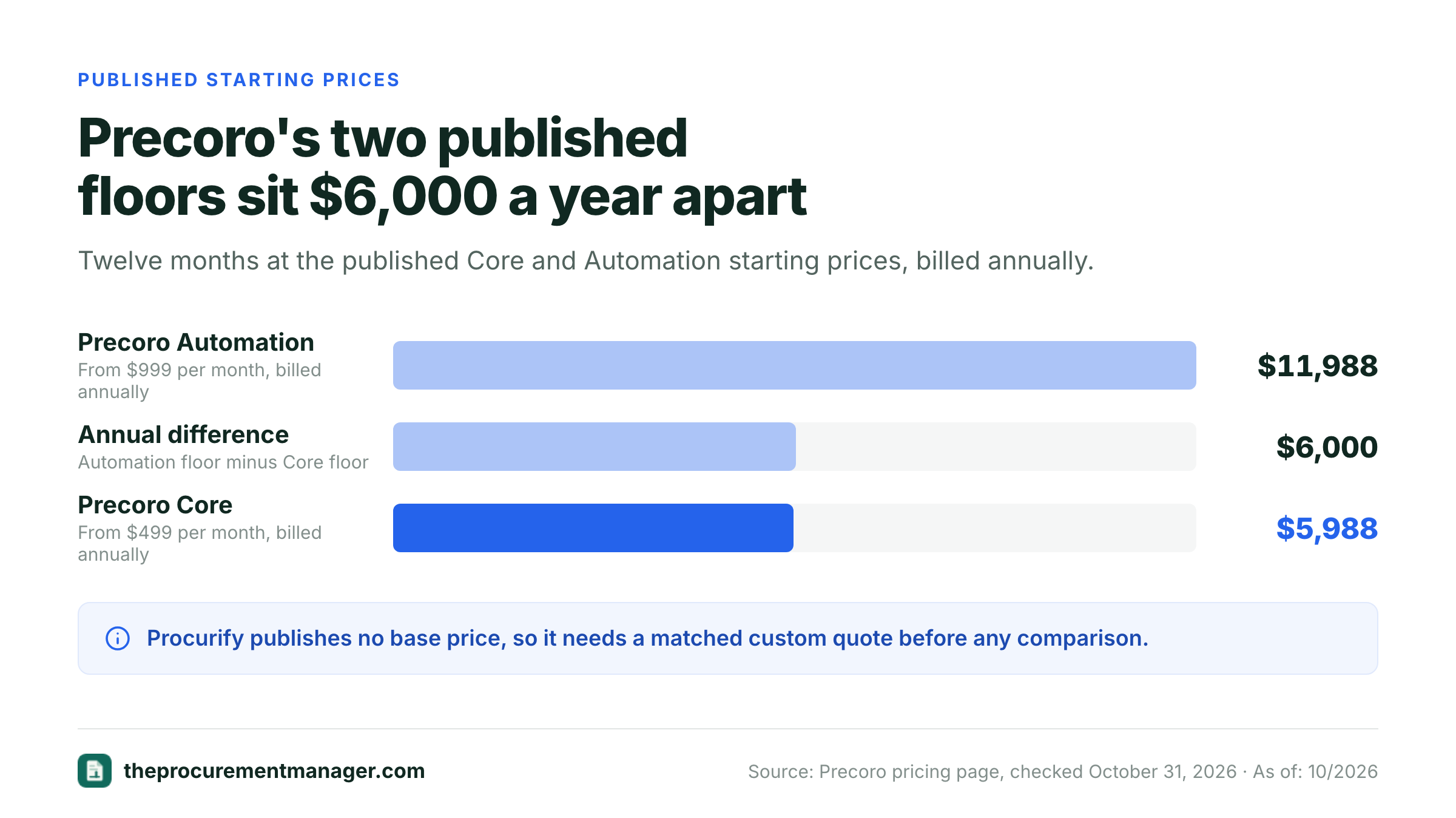
Precoro's published Core starting price is $499 per month billed annually, while Automation starts at $999 per month billed annually. Procurify uses custom quotes based on products, add-ons, users and integrations. It's not accurate to call Procurify cheaper or more expensive without a matched proposal.
- Precoro CoreFrom $499 USD/month, billed annually
- PRs, POs and receipts
- Invoice workflows and matching
- Approvals and vendor records
- Precoro AutomationFrom $999 USD/month, billed annuallyExpanded workflows
- Core capabilities
- Advanced AP automation
- Intake and additional controls
- Precoro EnterpriseCustom quote
- Enterprise-level configuration
- Additional integration and administration options
- Procurify PurchasingCustom quote
- Purchasing and platform foundation
- AP and Expense & Card as optional products
- Guided Intake and Contracts as add-ons
Vendor list prices checked October 31, 2026. Precoro prices are starting points, not fixed all-in quotes.
At those advertised floors, Precoro Core represents $5,988 for twelve months and Automation represents $11,988 for twelve months. The annual difference is $6,000 before extra licenses, add-ons or negotiated terms. That's arithmetic from advertised starting prices, not a prediction of your invoice.
What drives the Procurify quote?
Procurify's quote reflects the selected products, add-ons, users and integrations. The vendor says Basic users are unlimited for requesting or receiving, while Pro users influence the commercial model. That can be useful if many occasional requesters need access but only a smaller group administers purchasing.
Don't assume that unlimited Basic users means unlimited approvers with full permissions. Get a role matrix from sales and identify which staff need Pro access. Ask for the price impact if Finance later adds AP or if operations introduces card spend.
The quote should separate implementation, training, integration work and recurring subscription charges. Procurify's terms also discuss usage true-ups, so procurement needs a defined process for approving growth in licensed usage rather than discovering it after the fact.
What drives the Precoro quote?
Precoro's price depends on the selected plan, tier, tariff and add-ons. Its billing documentation describes eleven tiers, with examples including Tier 2 up to 30 users and Tier 6 up to 100 users. Under its Power/Standard tariff, Power Users count toward the limit and Standard Users are unlimited; under its Basic tariff, all users count.
This distinction changes the buyer's math, and it's easy to miss in a demo. A large employee population with a small procurement team may be priced differently from a similarly sized company where every employee needs a counted role. Precoro's billing page also lists additional options such as Multi Companies, NetSuite SuiteApp Integration, Power BI and Intelligent AP Automation, with different billing methods.
Ask which tariff is being quoted and which people are counted. Then ask whether you'll need a higher tier for your next hiring cycle, not just the people who need access today. Don't budget the starting price until those assumptions are written down.
Which platform handles purchase requests and approvals better?
Both Procurify and Precoro provide structured requests and approval routing, so the better choice depends on your approval rules. Procurify's Purchasing foundation includes order requests and approval routing; Precoro's Core includes purchase requests, custom fields and automated approvals.
Use a controlled test that resembles a purchase your team has already handled. A department manager requests an item, Finance checks available budget and Procurement validates the supplier. Then change the request amount after the initial approval. Watch whether the system reroutes the request, preserves its history and alerts the right person. If it doesn't, you've found a gap early.
Capture the request
Have an employee submit a realistic item or service request with a department, vendor and cost center.
Route budget approval
Set an approval rule and confirm who sees the available budget before committing spend.
Create and send the PO
Approve the request, create the purchase order and record its vendor-facing status.
Test an exception
Change an amount, partially receive goods and submit an invoice that doesn't match.
Verify the audit trail
Export the approvals, owner decisions and timestamps needed by Finance and internal audit.
A polished happy-path demonstration doesn't show how exceptions work. Ask the vendor to leave the screen share on when an approver is absent or a cost center changes. The real workflow should make the next owner obvious rather than leaving the request in an inbox nobody checks.
Which system gives Finance a cleaner budget decision?
Procurify includes Budgets and Spend Insights in its platform packaging. Precoro advertises real-time budget tracking and controls that can vary by plan. Both can give Finance context before a purchase is approved, but the useful question is which budget dimensions your specific deployment supports.
Bring a sample with department, project, location and accounting code. Confirm how each system treats committed but uninvoiced spend, cancelled purchase orders and partially received goods. If the report counts a commitment differently from your ERP, you'll need a documented reconciliation rule.
How do Procurify and Precoro handle invoices, payments and integrations?
Procurify offers Accounts Payable and Expense & Card as separate products, while Precoro includes invoice handling in Core and advertises expanded AP automation through higher packages and options. Both name major accounting integrations, but connector scope must be verified for the documents you use.
Procurify's current pricing materials describe bill capture and matching, vendor payments, expense reports and spending cards. They also name QuickBooks, NetSuite, Sage Intacct and Microsoft Dynamics 365 among accounting connections. These aren't a guarantee that every connector transfers every object in both directions.
Precoro's help center documents separate QuickBooks Online, NetSuite and Xero workflows for purchase orders, invoices and related records. The same documentation lists API and webhook resources. Its billing help page identifies NetSuite SuiteApp Integration as an add-on option, so a generic claim of NetSuite compatibility isn't enough to price the deployment.
What should an ERP integration proof include?
An ERP integration proof should show one approved purchase order, its receipt, its invoice and the resulting accounting record. It should also show what happens when a vendor code or tax field doesn't match. A connector badge isn't evidence that a complete purchasing cycle reconciles correctly.
Ask for a data mapping table that covers supplier identifiers, chart-of-accounts codes, tax, currency, projects, departments and attachments. Record which system owns each field. If both tools can edit the same supplier record, someone's got to own the conflict rule.
The acceptance test needs to include a failed sync. Capture the error message, the responsible team, retry behavior and the expected repair time. Who's alerted matters most. Procurement shouldn't find out during the first month-end close that a failed invoice sync is invisible to the person who can fix it.
Which is better for supplier and contract management?
Precoro is worth a closer look when multi-company supplier processes are central to the buying case, while Procurify is worth testing when you want contract records connected to its Purchasing foundation. Both vendors describe contract-related capabilities, but their scope and packaging aren't identical.
Procurify lists a Contracts add-on for uploading contract documents, tracking purchase order spend against contract values and automated renewal reminders. Precoro lists a contract repository in Core and describes supplier onboarding, renewal reminders and broader contract intelligence in its product materials. Ask which Precoro capabilities are included in the quoted plan rather than assuming every marketing example is part of Core.
A procurement team also needs to decide where the signed contract lives. If Legal's contract repository remains authoritative, the purchasing platform may hold only a reference and key dates. If the procurement platform becomes the record of truth, define who can edit notice periods and who verifies the source clause.
Can either tool replace a renewal decision process?
Neither a contract reminder nor a stored PDF automatically creates an approved renewal decision. Procurement still needs the business owner to confirm demand, Finance to confirm budget and IT or Security to check service and access risks. The final decision must be recorded before the contractual notice deadline.
For a contract due to renew on June 30, 2027, a hypothetical 60-day notice requirement makes May 1, 2027 the calendar cutoff. A 30-day requirement makes May 31, 2027 the cutoff. Those are date calculations, not a substitute for the signed agreement or a legal interpretation of notice delivery.
- ProcurementExtract signed notice clause and renewal date Before review starts
- Business ownerConfirm demand and service performance Before recommendation
- FinanceApprove budget and commercial changes Before decision
- IT and SecurityReview access, integration and supplier risk Before decision
- Authorized signerApprove renew, renegotiate or exit Before notice cutoff
- ProcurementStore evidence of notice delivery when required By contractual deadline
If your biggest problem isn't purchase-order creation but missed renewal decisions, consider keeping the purchasing platform separate from a narrow renewal coordination workflow. A narrow workflow like that can route the evidence packet among owners without replacing contract lifecycle management or the procurement suite, and it's easier to keep honest.
What renewal and cancellation terms should buyers compare?
The public Procurify agreement dated August 1, 2026 provides a concrete default: automatic twelve-month renewals unless a party gives written non-renewal notice at least 60 days before the renewal date, subject to the order form and other exceptions. Its terms also describe price-increase notice and conditions. Precoro's public pricing FAQ says customers can cancel with 30 days' notice, with access through the current billing period.
These are vendor-published terms, not a determination of what your signed contract says. Procurify's agreement expressly gives the order form precedence in conflicts. Precoro's commercial documents may also contain negotiated conditions. Legal should confirm the applicable version, delivery method and notice address before the purchase order is approved.
Procurify's published terms allow a fee increase with at least 90 days' notice, generally capped at 7% for a renewal period unless otherwise agreed. The same section includes exceptions, including certain changes from a multi-year commitment to a shorter term. It's a reason to read the full clause rather than copying a cap into a budget model.
Procurify's terms also address data export after termination. The published provision describes a written request within 90 days after termination or expiry, with standard CSV export without attachments and possible additional charges for custom exports. Before signing, ask both vendors to demonstrate the actual export you'd need to move away.
Precoro's help center shows a Renew Subscription button appearing 60 days before the renewal date. That's a billing interface timing detail, not the same as its cancellation notice policy. Teams shouldn't confuse a payment prompt with the date on which a notice must legally arrive, and nobody's calendar should rely on the button.
What do user reviews say about Procurify and Precoro?
G2's comparison page, checked October 31, 2026, shows Precoro at 4.7 out of 5 from 223 reviews and Procurify at 4.6 from 414 reviews. The samples differ in size, and each rating describes the whole product as reviewers used it, so a 0.1 gap isn't a reason to pick one over the other.
G2's review themes point to different friction. Reviewers of Precoro most often praise ease of use (21 mentions) and efficiency (12), while 5 call it not intuitive and 4 mention missing features. Procurify reviewers also lead with ease of use (62) and time savings (30), while 11 mention missing features and 7 cite insufficient reporting. Those counts are prompts for a demo, not proof that every customer sees the same issue.
G2's comparison also scores setup, administration and support. Reviewers rated Precoro 9.7 for support quality against 9.3 for Procurify, and rated both 9.1 for ease of setup. Ratings are a secondary signal. A team with unusual entity structures or ERP rules can have a difficult rollout even when average setup scores look favorable, so weigh your own acceptance tests above a decimal-point rating difference.
How should a procurement team choose between Procurify and Precoro?
A procurement team should choose Procurify or Precoro using a scored pilot with the same workflows, license assumptions and renewal terms. Price alone isn't a reliable decision rule because one vendor quotes modules while the other advertises package floors with tier and add-on variables.
- You want a published package floor before the sales callPrecoro
- You want a purchasing-first, modular rolloutProcurify
- You need tiered roles and multi-company procurementPrecoro
- You need PO spend tied to contract valuesProcurify
Two more needs have no clear winner, because both vendors need the same test:
- Precise invoice and ERP synchronizationBoth: require an object-by-object integration test
- Renewal decision evidence and deadlinesBoth: pair contract reminders with an owned decision workflow
Run the selection in two rounds. In the first round, confirm non-negotiable requirements such as accounting integration, legal entity structure and audit evidence. In the second, test exceptions and compare the signed commercial terms. A vendor that can't meet a required control should be eliminated before you start negotiating a discount.
- Document current purchasing and invoice volumes
- Count requesters, approvers and administrative users by role
- Get written scope for every plan, product and add-on
- Test approval changes, partial receipts and invoice mismatches
- Verify ERP object mapping and failed-sync alerts
- Confirm supplier onboarding and multi-entity requirements
- Request implementation scope and named support contacts
- Read renewal, notice, price-change and data-export clauses
- Assign a business owner and Finance approver to the final decision
- Store the signed quote and acceptance-test evidence together
A useful final scorecard covers workflow fit, integration fit, commercial clarity, adoption and renewal governance on a simple one-to-five scale. Don't let a total conceal a failed mandatory requirement, though. A vendor that fails a control that could stop a purchase or create an audit problem is out, whatever its score.
Frequently asked questions
Is Procurify cheaper than Precoro?
Procurify's price is custom, so there's no reliable public price comparison. Precoro publishes Core from $499 per month with annual billing, but the final tier and add-ons can change its quote.
Does Precoro have a free plan?
Precoro's current pricing page presents paid Core, Automation and custom Enterprise options, not a permanent free plan. Confirm any evaluation access directly before planning a rollout.
Does Procurify include accounts payable?
Procurify offers Accounts Payable as a separate product beyond its Purchasing foundation. Ask for that product in the quote if invoice matching and payment workflows are required.
Can Precoro handle multiple companies?
Precoro documents a Multi Companies add-on for managing branches and subsidiaries in one account. Check the quoted scope and annual add-on price for your legal entities.
Does Procurify automatically renew?
Procurify's August 2026 public terms describe automatic twelve-month renewals and a default 60-day written non-renewal notice, subject to the order form and exceptions. Your executed contract controls the actual deadline.
Which is better for contract renewals?
Procurify and Precoro both offer contract-related capabilities, but neither feature list replaces an approved renewal decision. Choose the system that makes your contract evidence accessible, then assign owners and track notice dates separately if needed.
Procurement teams choosing between these platforms should leave the buying process with a documented decision, not just a favorite interface. Get the scope in writing, test the exception paths and put the notice date into an owner-reviewed calendar before you're signing.