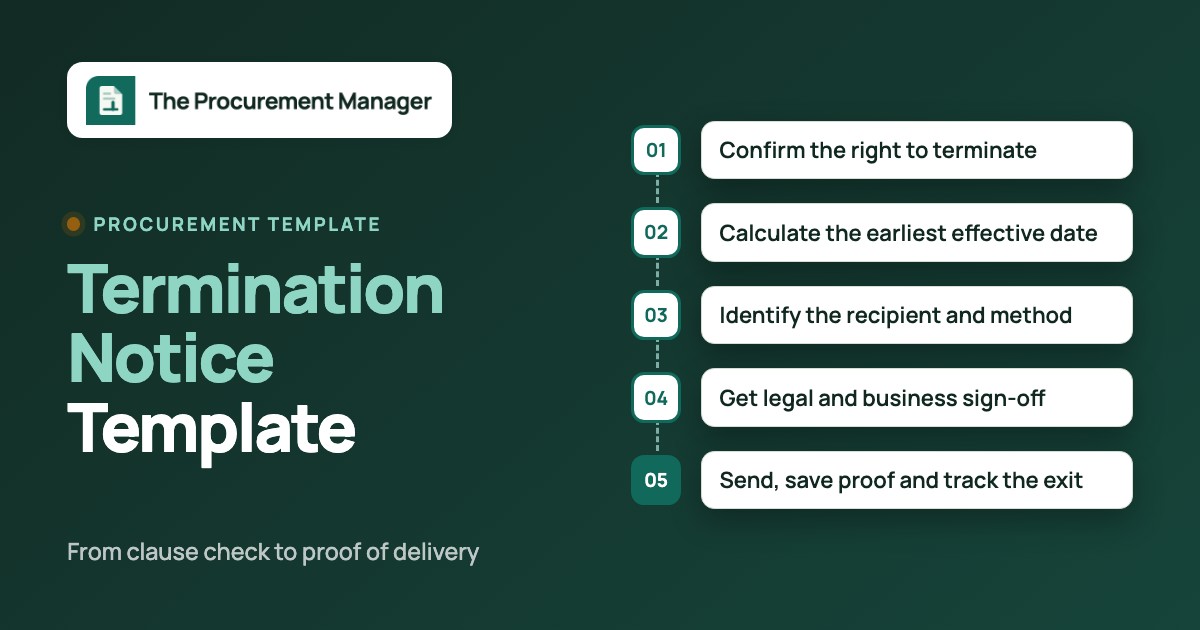
A contract termination notice template gives procurement a neutral starting point for ending a supplier agreement: it names the contract, the clause you rely on, the effective date and what happens to open work. This page has a copyable vendor letter, a fill-in template with downloads, a worked notice-period example and an exit checklist. The letter is for commercial supplier, service and software agreements. It's a general starting point, not legal advice, and it can't replace your signed contract.
- Read the termination clause, notice clause and governing law together before you write a word.
- Name the exact agreement, the clause you rely on and the effective date, nothing more.
- Count the notice period from receipt or dispatch exactly as the contract says, not by habit.
- Send the notice the way the contract requires and keep proof of what was sent and when it arrived.
- Plan the exit alongside the letter: open orders, data export, access removal and the final invoice.
What is a contract termination notice?
A contract termination notice is a dated communication telling the other party that a specified agreement will end under the authority, notice period and process the contract or applicable law provides. In procurement, the letter identifies the exact agreement, the intended effective date, whether all or only part of the arrangement ends, and the transition duties that follow.
A business shouldn't send a one-size-fits-all form without reading the signed contract. A notice that works for a recurring services agreement can fail for a fixed-term purchase commitment, an agreement with cure rights or a government procurement. Read the governing-law provision, notice clause, dispute procedure and termination clause together before you decide which process applies. That's slower than pasting a form, but it's the only way you'll know the letter works.
Notice of termination also isn't the same as notice of nonrenewal. Nonrenewal lets an agreement run to the end of its current term. Termination ends it earlier. If your goal is only to stop an automatic renewal, the better starting point is our guide to the contract renewal notice period, and the auto renewal clause examples show the wording you'll run into. Mixing the two up is common, and it's expensive: a termination letter sent for a contract that you meant to let lapse can trigger fees you wouldn't otherwise owe.
When should a procurement team use this template?
Use it for commercial supplier, service, software or procurement agreements where the organization has already found a contractual basis for terminating or declining to renew. It standardizes what legal review, approvers and the delivery owner need, but it doesn't decide whether you may terminate. It isn't an employment termination letter, a government-issued notice or proof that termination is lawful.
Before you prepare it, inventory the open purchase orders, software access, committed minimum spend, delivery milestones, confidential materials and unpaid invoices. Ask the contract owner and legal team whether termination for convenience, termination for cause or a separate nonrenewal mechanism applies. The right letter language depends on that answer, so settle it before you draft, not after.
Which clauses should I read before drafting?
Start with the signed agreement and every amendment. Look for term and renewal, termination for convenience, termination for cause, breach notice, cure period, force majeure, notice addresses, approved delivery methods, how the effective date is calculated, early termination charges and obligations that survive. Statements of work and purchase orders can carry their own terms, and they sometimes override the master agreement for that order.
Don't rely only on a contract management system's summarized notice deadline. Compare it with the source clause. A reminder can be wrong, though, because the contract counts days differently or requires receipt rather than dispatch. Confirm whether notice must go to a named legal address instead of the usual account manager. Keep the latest signed version on file, since auditors ask for the signed copy rather than a summary. If you can't find it, that's your first finding, and it's better to learn that now.
| Clause to find | Why it changes the letter | What to record |
|---|---|---|
| Term and renewal | Decides whether you're ending early or declining to renew | Current term end, renewal mechanism |
| Termination for convenience | Shows whether you can leave without proving a breach | Clause number, notice length, any fee |
| Termination for cause and cure | May require a default notice first | Cure days, trigger, who must send it |
| Notices clause | Controls address, method and when notice counts as given | Legal address, approved channels |
| Survival and transition | Lists duties that continue after the end date | Data return, confidentiality, final billing |
Termination for convenience versus termination for cause
Termination for convenience means an authorized party ends the relationship without proving a breach, but only where the contract or applicable law permits it. Termination for cause relies on a specified failure or another defined trigger. The second path often requires a written default notice and a chance to cure before any final termination notice.
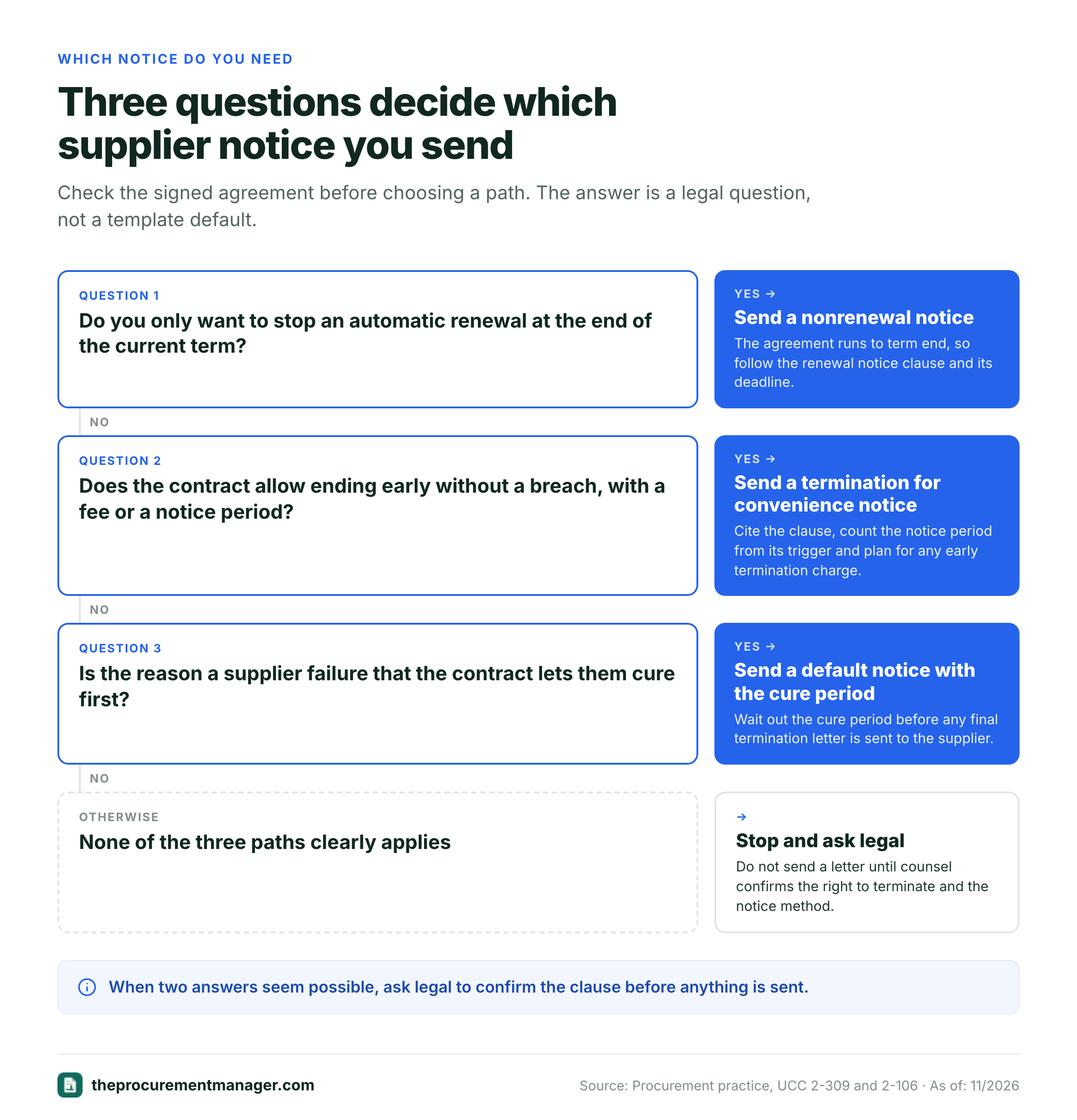
The terms also carry legal weight. Under Article 2 of the US Uniform Commercial Code, termination and cancellation have separate definitions: one ends a contract without breach and the other ends it for breach. Don't assume Article 2 governs every services or SaaS agreement. Its scope and adoption vary, and the governing state law matters, so have counsel confirm which concept applies instead of guessing.
What does UCC Section 2-309 say about notice?
UCC Section 2-309 sets a rule that reasonable notification be received by the other party in certain sale-of-goods situations. Subsection (2) covers contracts with successive performances but indefinite duration, which either party may terminate at any time unless otherwise agreed. Subsection (3) says termination other than on an agreed event requires that reasonable notification be received, and an agreement dispensing with notification is invalid if it would be unconscionable. The rule isn't an automatic thirty-day notice requirement for every B2B agreement, and there's no statutory number hiding behind it.
Read the statute and your state's enacted version when a sale of goods is involved. Don't lean on a summary, because it's easy to miss the unconscionability limit. A contract can set different terms within legal limits, and for service contracts and software licenses the controlling law may be different. Treat "reasonable" as a legal question, not a number you copy from an online letter. It's a judgment about the facts, and a court won't accept a template's default. The primary text is on the Cornell Legal Information Institute page for UCC 2-309.
What should the letter always identify?
A useful notice names the sending legal entity, authorized signatory, recipient legal entity, notice address, issue date, contract title or number and the clause you rely on. State the type of action and an unambiguous effective date. If only one statement of work is ending, list it precisely.
Tell the recipient what to do with outstanding deliverables and information, but don't invent new contractual duties. They'll push back on anything that isn't in the agreement. Reasonable requests include a final status report, a transition contact, export of company data, return of property, access deactivation and instructions for the final invoice, as long as the agreement supports them. Skip inflammatory accusations and any admission of breach that counsel hasn't reviewed.
Contract termination notice template you can copy
The template below is intentionally neutral. Replace every bracketed item with verified contractual information, delete paragraphs that don't apply and have the authorized signatory review it. Never send placeholder text: a letter with a stray bracket looks careless, and it can be read as unauthorized. Use the downloads to keep a blank version in your contract workspace.
Commercial contract termination notice
Fill in each field from the signed agreement. Example values are illustrative only.
- Date of notice
- [Date of notice]Issue date of the letter
- To (supplier legal entity and notice address)
- [Supplier legal entity, legal notice address]Exactly as the notices clause names them
- From (customer legal entity and address)
- [Customer legal entity, address]The contracting entity, not a business unit
- Agreement reference
- Master Services Agreement dated [date], as amended by Amendment [no.]Title, date, amendments and contract number
- Clause relied on
- Section [number], [title]Section number and title
- Scope of termination
- [The agreement / Statement of Work no. X]Whole agreement or a named statement of work
- Basis
- [Termination for convenience / expiration and nonrenewal]Convenience, nonrenewal or another approved reason
- Effective date and time
- [Date], [time], [time zone]Include the time zone if the contract does
- Name a transition contact on both sides
- Request a final status report on open work
- Request export or return of company data in the agreed format
- Confirm access deactivation date
- Ask for the final invoice and any credit or refund statement
- Request written acknowledgment of receipt
- Delivery method
- [Courier / certified mail / approved email address]The method the notices clause allows
- Proof of delivery reference
- [Reference saved in the contract record]Tracking number, receipt or acknowledgment
- Authorized signatory
- [Name, title, company]Name, title, company
If you prefer plain text, this is the letter body that the fields above produce:
Subject: Notice of Termination of [Agreement Name / Contract Number]
We refer to the [full agreement name] dated [effective agreement date], as amended [identify amendments, if any], between [party names].
Pursuant to Section [exact section and title], we provide formal notice that [the agreement / the following specified statement of work] will terminate effective [date and time, including applicable time zone].
The basis for this notice is [termination for convenience under the cited clause / expiration and nonrenewal / another approved reason]. This notice isn't intended to alter any rights or duties that survive termination.
Please coordinate [specific contractually authorized transition items] with [contact]. Deliver outstanding records and final billing details according to the agreement. Confirm receipt of this notice to [contact or address].
Sincerely,
[Authorized name, title, company]
This is a general starting point, not a legal instrument validated for a particular jurisdiction. A procurement manager shouldn't substitute it for the governing document.
How do I fill in the template step by step?
Fill the template in the order below; you'll find it's quicker than it looks. Each step produces a fact you can point to in the contract, which keeps the letter short and defensible.
Confirm the right to terminate
Find the termination clause and the date range in which it can be used. Note any fee, minimum term or cure step that applies first.
Calculate the earliest effective date
Apply the notice length to the trigger the contract names, receipt or dispatch, then add any weekend, holiday or time zone rule.
Identify the recipient and method
Copy the legal entity and notice address from the notices clause. Don't use the account manager's email unless the clause allows it.
Draft the letter and transition requests
Use the template fields. Ask only for transition items the contract supports.
Get legal and business sign-off
Record who approved the clause, the date, the scope and the sending method before anything goes out.
Send, save proof and track the exit
Send by the required channel, save the delivery record with the final signed letter and open the exit checklist.
How should a termination-for-cause notice differ?
For an alleged breach, the facts, default language, evidence and cure provisions matter. A final termination letter shouldn't automatically be the first communication; the cure step usually comes first. Some contracts require a prior notice that specifies the problem and gives a defined number of days to cure. Other triggers work differently, so read the exact wording rather than assume.
Prepare a timeline of events, the contractual obligations at issue, earlier warnings, vendor responses, deadlines and evidence. Ask counsel to confirm that the breach meets the stated threshold and that notice was served correctly. Keep confidential allegations off broad distribution lists; they're rarely needed outside legal and the business owner. A vague claim that the supplier is "noncompliant" invites an argument instead of ending the contract. It doesn't give them anything to cure, and it doesn't give you anything to prove.
How do I count the notice period?
First find out whether the contract uses business days or calendar days, how it defines receipt, and whether holidays, weekends or time zones change the count. If a contract says thirty calendar days from receipt, a letter drafted thirty days before the proposed effective date may arrive too late.
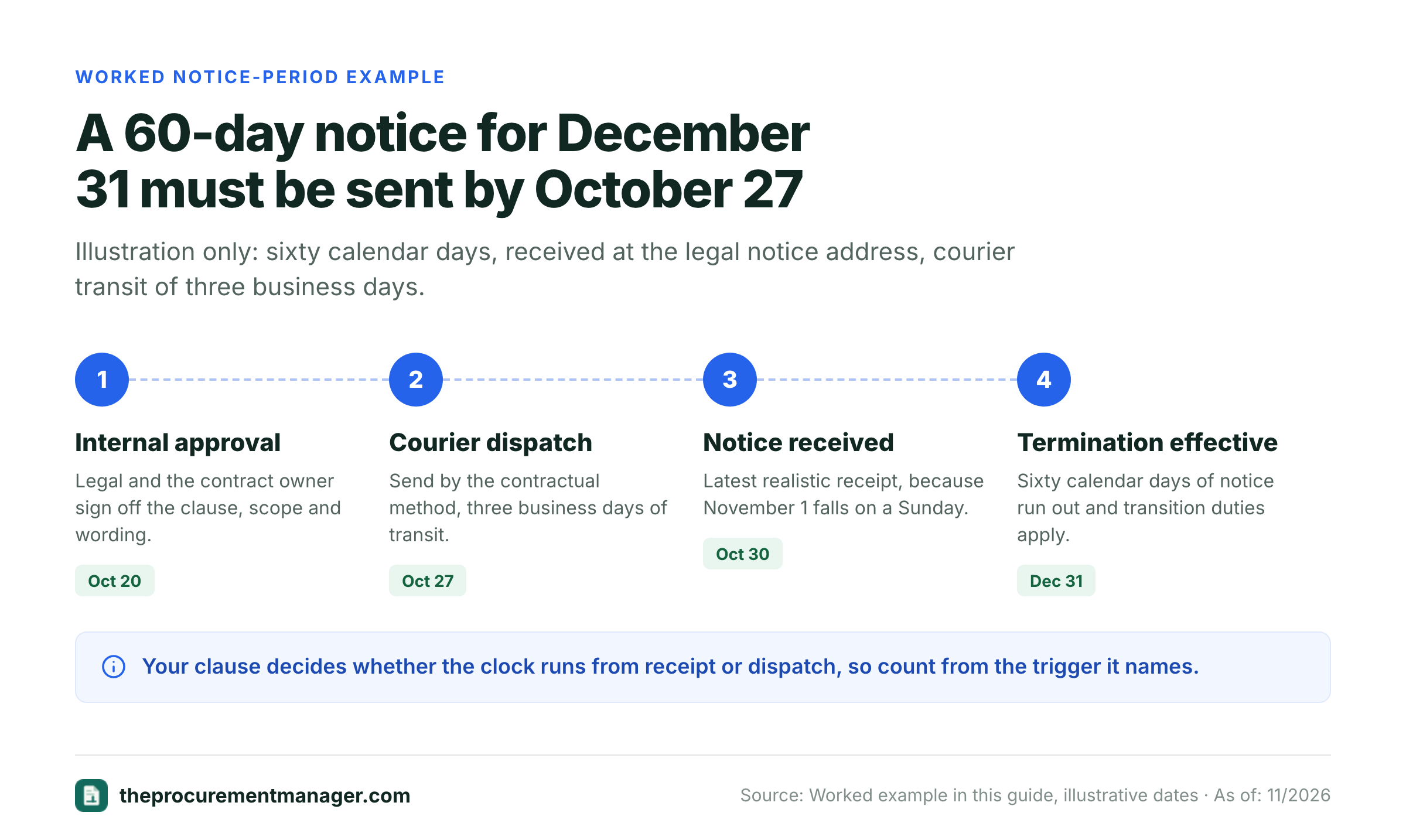
Here's an illustration, not a rule; it's there to show the method, and the numbers aren't yours. Suppose a services agreement requires sixty calendar days of written notice received by the supplier's legal notice address, and you want it to end on December 31. Sixty days before December 31 is November 1, which in 2026 is a Sunday, so treat Friday, October 30 as the latest realistic receipt date. A courier that needs three business days then means dispatch by Tuesday, October 27, ideally earlier to leave a margin for delay. The dates are only an illustration of the arithmetic, not a recommended notice period. If the same clause counted from dispatch, you'd have a few more days, which is why the trigger matters more than the arithmetic.
| Worksheet field | Example entry |
|---|---|
| Clause and trigger | Section 12.2, notice received |
| Required lead time | 60 calendar days |
| Target effective date | December 31 |
| Latest receipt date | October 30 (November 1 is a Sunday) |
| Delivery method and transit time | Courier, 3 business days |
| Latest dispatch date | October 27 |
| Internal approval deadline | October 20 |
Build a worksheet like this for each notice (it's ten minutes of work), have the agreement owner confirm the calculation, record any written extension and send a revised notice if the first one becomes inaccurate. Don't pick a universal thirty-day minimum from this page. It's tempting, since it's what most online letters say, but your contract doesn't care what other letters say.
What counts as valid delivery?
The notices clause governs where and how you send notice. Some agreements accept email to a named address, and that's fine when it's the address the clause lists. Others require registered or certified mail, personal delivery, courier or more than one channel. An email to the usual vendor success manager may not satisfy a formal notice provision.
Keep delivery evidence such as a courier receipt, tracking record, approved email acknowledgment or timestamp. You'll want the record to show which text was sent, by whom, to which contractual recipient and when it was received. Store a copy of the final signed notice in the central contract record, and avoid publishing personal contact details.
What happens to open purchase orders?
Terminating a master agreement doesn't automatically settle every outstanding statement of work, order or acceptance issue, and a supplier will often argue the opposite. Work out which orders stay in force, which deliveries are accepted and whether service continues during transition. The answer follows the real hierarchy of contract documents, and that's where teams get surprised: an order form that's older than the amendment may still win.
Prepare a ledger that lists order number, amount, delivery status, acceptance, invoice, proposed disposition and owner. Confirm how prepaid fees, credits, refunds and termination charges are treated under the signed terms. Finance and procurement should reconcile the totals before the supplier account closes. A notice shouldn't promise a refund or waive a charge unless the signer has authority to do so.
How should data, access and intellectual property be handled?
A SaaS or outsourced-services exit often requires data export, access revocation, retention review, deletion certification and handover of configurations or documents. The contract, data processing agreement, security policy and applicable law can set different duties and dates.
Assign owners for credentials, because nobody's accountable for something that belongs to everyone, service accounts, integrations, administrator access, backups and records retention. Don't put production secrets in the notice or in a transition spreadsheet. Test exports while you still have authorized access, because you won't get a second chance once accounts close. Then decide which information must stay accessible for legal, financial or operational reasons after service ends.
Can the notice terminate only part of a contract?
Some agreements permit partial termination of a statement of work, location, product line or service. Others need a negotiated amendment. When partial termination is allowed, describe exactly which units or deliverables end and which remain.
A vague letter saying "terminate services" can shut down an essential system unnecessarily, and nobody wants that call at midnight. List the affected contract number, service schedule, locations and effective dates, and state whether continuing terms, pricing, data processing and service levels change. Ask both parties to acknowledge the scope when that makes sense, since it's the cheapest way to avoid a dispute later, without assuming acknowledgment is a legal requirement unless the contract says so.
What is different for US government contracts?
Federal procurement contracts follow specialized rules that shouldn't be copied into ordinary private supplier letters. Federal Acquisition Regulation Section 49.102 covers notices of termination and lists what a federal notice must state, including the clause authorizing termination, the effective date, the extent of termination and any special instructions. It's a useful example of structured notice discipline, but it isn't a blanket rule for private companies. Borrow the structure, not the legal force.
FAR 49.102 states that the contracting officer must terminate covered contracts only by a written notice to the contractor. Contracting officers follow specific procedures, approval roles and forms, and they've got no use for a private template. Private procurement teams shouldn't claim FAR compliance unless the contract and procurement context require it. The text is in FAR Part 49.
What should an internal approval checklist contain?
Before anything is sent, the contract owner confirms the legal entity (it's the entity on the signature page, not the brand name) and the complete signed version. Legal confirms the termination right, the triggering facts and the notice method, and it's worth asking them to initial the clause reference. Finance reviews outstanding payments, reserves, credits and possible fees; they'll spot a prepaid balance that procurement doesn't see. IT or operations confirms continuity needs and access implications.
- Signed agreement and all amendments located
- Termination or nonrenewal clause cited by section number
- Notice period counted from the contractual trigger
- Recipient legal entity and notice address copied from the notices clause
- Delivery method matches the contract
- Open purchase orders and statements of work reconciled
- Finance reviewed fees, credits and final invoice
- IT confirmed data export and access removal plan
- Legal approved the final wording
- Authorized signatory identified
- Proof of delivery location agreed
Keep a sign-off register with contract number, type of notice, clause, evidence file, approved effective date, delivery method, signatory, proof of receipt and vendor transition owner. Treat unresolved items as blockers instead of an invitation to guess; nobody's job is to hope the clause says what they remember, and save the final approved PDF or email together with the delivery record. For recurring renewals, the contract renewal checklist uses the same evidence habit.
What mistakes should buyers avoid?
Common errors include using the wrong supplier legal entity, relying on an unsigned order form, counting days from dispatch instead of receipt, confusing nonrenewal with early termination, ignoring cure requirements, copying a federal template into a private contract and misstating the extent of termination.
Another frequent mistake is forgetting the operational exit. A valid notice can still leave the organization unable to retrieve data or complete handover, which is the part that costs real money. Build a transition plan that covers records, security, invoice reconciliation and supplier communication. If the parties dispute the right to terminate, get legal advice before you send a definitive accusation. It's cheaper than defending a bad letter.
Contract termination notice template FAQ
The answers below cover the questions buyers ask most when they prepare a termination letter. None of them replaces a review of your signed agreement.
Can I terminate a supplier contract by email?
Only if the notice provision and applicable law permit that method. Check the required address and how receipt is proved before you rely on email.
Is thirty days' notice always required?
No. The contract and applicable legal rules set the timing. UCC guidance on reasonable notification shouldn't be generalized across all services or software agreements.
Does a termination letter release unpaid invoices?
Not automatically. Surviving obligations and final settlement depend on the agreement and the governing law.
Can I use this form for an employee dismissal?
No. This template is for business supplier contracts, not employment.
Can the supplier challenge the notice?
Yes. Contractual and legal disputes can remain, so keep records of the clause, the count and the delivery, and get legal review when the right to terminate is unclear.
Legal references and limitations
- UCC Section 2-309: notice of termination
- UCC Section 2-106: termination and cancellation
- FAR Part 49, government contracts only
US UCC and FAR excerpts aren't universally controlling terms for every commercial contract. The signed contract, chosen governing law and legal review decide whether a notice is effective. Reference date: November 4, 2026.