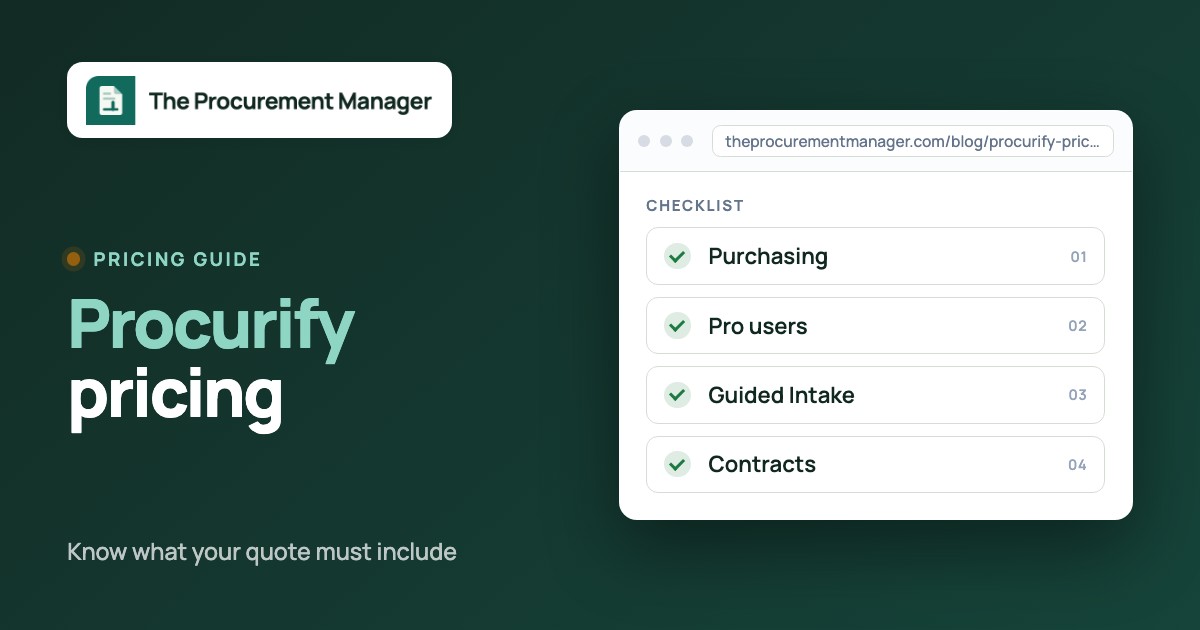
Procurify pricing is custom quoted, not a public per-seat price list. The procurement platform starts with Purchasing, then prices additional products, add-ons, Pro users and integrations around your requirements. The official pricing page doesn't publish a dollar amount, so an exact monthly or annual Procurify cost requires a sales quote.
For budget planning, one independent procurement analysis cites buyer data from Vendr that puts the median Procurify contract at about $15,000 a year. That isn't a Procurify list price or a promise of what your company will pay, and the underlying dataset isn't public. Treat the figure as a tentative reference point, not an approved budget. The more reliable way to compare offers is to get the same role counts, modules, services and renewal terms priced on each proposal.
- No published US subscription price: request a written, itemized quote.
- Purchasing is the required starting product; Accounts Payable and Expense & Card are additional products.
- Unlimited Basic requesters and receivers are available; paid pricing is driven by Pro users plus scope.
- Guided Intake and Contracts are add-ons, not safe assumptions in a base quote.
- Review renewal notice, price increases and implementation scope before signing.
How much does Procurify cost?
Procurify's cost gets set in a customer-specific order form, and its current US website lists no public subscription dollar price. Your quote depends on the Purchasing foundation, the other products and add-ons you choose, the number of Pro users and integration requirements. Clearly, an old directory estimate or a third-party average isn't a current Procurify rate, so don't treat it as one.
The pricing page uses a modular packaging model rather than a fixed Starter, Business and Enterprise rate card. G2's pricing directory lists a single contact-sales edition, but the vendor's own module descriptions are the better guide to scope, because they show which products are separate.
The following table separates what is explicitly part of the starting purchase from what needs a line item in the proposal. Custom quote means there's no public USD figure, not that the feature is expensive.
| Procurify component | Official packaging | Public price (USD) | Budget question |
|---|---|---|---|
| Procurify Purchasing | Required starting product | Custom quote | Which Pro roles and entities are included? |
| Procurify Accounts Payable | Additional product | Custom quote | Does invoice matching and payment scope match our process? |
| Procurify Expense & Card | Additional product | Custom quote | Which expense and card workflows are included? |
| Procurify Guided Intake | Add-on | Custom quote | Can we launch with standard Order Requests first? |
| Procurify Contracts | Add-on | Custom quote | Are renewal reminders and contract-spend tracking in our order form? |
Procurify's current pricing page includes approval routing, budgets, Spend Insights, accounting integrations and the mobile app with the platform. It's the boundary between included capabilities and optional commercial scope that deserves attention.
How Procurify charges for users
Procurify's user model distinguishes unlimited Basic users from Pro users, and its official pricing FAQ says Pro users determine the user-related pricing. Basic users can request orders or receive items. The practical question isn't total employee headcount, it's how many people require Pro permissions to perform their assigned work.
That distinction can matter for organizations with many occasional requesters and a smaller procurement team. A company with widespread purchasing requests shouldn't assume every employee needs a paid Pro license. Equally, it shouldn't assume that an employee who approves budgets, manages suppliers or needs broad reporting can operate as Basic without verifying the permission matrix.
Build a role roster before requesting a quote. Ask Procurify to confirm the minimum role for each task in writing, and don't let job titles decide licensing.
| Procurify user group | Intended work | Role assumption for quote | Evidence to request |
|---|---|---|---|
| Department requester | Submit order requests | Basic candidate | Screenshot of the requester permission set |
| Receiving staff | Record received items | Basic candidate | Receiving permissions and any limits |
| Purchasing manager | Maintain orders and vendors | Ask whether Pro is required | Role matrix and unit cost |
| Finance approver | Approve spend and view budgets | Ask whether Pro is required | Approval and reporting access demonstration |
| AP specialist | Process invoices and payments | Confirm product and Pro needs | AP module scope plus seat count |
| System administrator | Configure roles and integrations | Confirm Pro and admin access | Admin permissions and change controls |
These are buyer-side planning categories, not Procurify's published license entitlements. Get a vendor-verified role export attached to the order form. If an approver can be licensed differently from a purchasing manager, the economics of a broad rollout can change materially.
A useful quote request asks for the unit price of an additional Pro user during the contract, whether the charge is prorated, how true-ups work and whether unused licenses can be reduced at renewal. Procurify's current subscription terms expressly permit usage true-ups against the thresholds in an order form. That makes the initial roster and periodic access reviews part of how you'll control cost.
What is included in Procurify Purchasing?
Procurify Purchasing covers the request-to-order process, with approval routing, budgets, catalogs, vendor records and purchase orders. The shared platform adds reporting, role permissions and listed accounting integrations. It's a reasonable starting scope for teams that want commitments approved before invoices arrive, but the quote should name the workflow and not just the product label.
Requests, approvals and purchase orders
Order Requests give employees a structured path to ask for purchases. Approved requests can become purchase orders, with receiving records and an audit trail. For a procurement manager, the operational value is the link between who requested a purchase, who approved it, what was ordered and whether it was received.
A demonstration should use a realistic request that crosses department and budget boundaries. Ask the seller to show a rejected request, an edited purchase order and a partial receipt. A polished happy-path demo won't reveal how exceptions are handled or who owns the resulting record.
Budgets, analytics and accounting integrations
Procurify's platform page lists budgets, Spend Insights and connections to QuickBooks, NetSuite, Sage Intacct and Microsoft Dynamics 365. Listing an integration isn't a guarantee that your chart of accounts, approval rules or entity structure can be mapped without services. Require the implementation statement of work to describe each integration and the system that owns vendor master data.
The accounting handoff is where a modest-looking subscription can become a costly project. If vendor records or account codes need cleanup, your internal finance team still has to do that work. A fair proposal spells out the tasks Procurify will perform, the tasks your team owns and the acceptance criteria for a successful sync.
Where the starting scope ends
Procurify describes Accounts Payable as an added product for bills and payments, and Expense & Card as another product for expenses and spending cards. Guided Intake and Contracts are separately described as add-ons. If you watch an invoice demo, confirm the Purchasing-only quote actually includes invoice automation.
Ask for a feature-to-line-item map: every workflow you watched in the demonstration should point to a purchased product or an included platform capability. If the seller can't provide that map, the total cost comparison isn't ready for approval.
Which Procurify add-ons can increase the quote?
Procurify add-ons affect cost when you move beyond the Purchasing foundation into invoice processing, expenses, intake or contract records. The decision should follow the workflow you need, not the longest feature list. In procurement, unused modules still consume budget while unclear ownership creates missed renewals and weak audit evidence.
- Route purchase requests and control budgetsStart by quoting Purchasing only.
- Capture and match supplier invoicesQuote Accounts Payable as a separate product.
- Manage employee expenses or spending cardsQuote Expense & Card separately.
- Route more complex requests through guided intakeAsk for Guided Intake add-on pricing and a live routing example.
- Store contract details and track renewalsRequest a Contracts add-on line item and test notice-date ownership.
Accounts Payable and Expense & Card
Accounts Payable can extend the workflow from purchase order to bill and payment. Expense & Card brings employee expense and card activity into the same spend environment. Before adding either, identify the current accounting, expense and card systems they would replace, and which functions would remain elsewhere.
Ask whether implementation covers existing open purchase orders, vendor invoices and accounting codes. A quote for software doesn't automatically include historical data migration or the labor to reconcile an opening balance. Don't pay twice for a card or invoice workflow your existing finance stack already handles well.
Guided Intake and Contracts
Guided Intake is positioned as a conversational request-capture add-on. Contracts supports uploaded contract documents, purchase order spend tracking and renewal reminders. Procurify's help center explains that the Contracts feature can link purchase orders to contracts, but bills are linked indirectly through purchase orders rather than directly to contract records.
That distinction matters for a vendor renewal decision. A procurement manager needs to know the contract's notice deadline, spend against the agreement, business owner, security or IT dependencies and who approved the next term. A reminder is helpful, but it's no proof that Finance, IT and the business owner approved the renewal. Design that decision process explicitly, inside your governance process or in a separate decision workflow.
Procurify's Contracts help article also says the feature isn't visible in the mobile app. If field managers are expected to review renewals on their phones, test the actual screen and permissions before treating mobile access as part of the business case.
What does Procurify implementation cost?
Procurify doesn't publish a standard dollar fee for implementation on its current pricing page, but it does publish implementation packages and timelines, which give buyers a concrete way to scope the work. Ask whether the selected package is included in your subscription, charged separately or expanded through professional services.
Procurify lists the following implementation options on its professional services page. The weeks are vendor package timelines, and they aren't guaranteed go-live dates for your organization.
| Procurify implementation package | Manager hours | Published deployment timeline | Buyer-side consideration |
|---|---|---|---|
| Procurify Basic | 10 | 4 weeks | Simple configuration and limited data cleanup |
| Procurify Standard | 15 | 8 weeks | Department workflows, testing and training |
| Procurify Standard for NetSuite | 25 | 12 weeks | ERP coordination and accounting mapping |
| Procurify Premium | 25+ | 12+ weeks | Larger or custom deployment scope |
The same page's Standard implementation example allocates 33 hours of customer effort (a separate measure from the manager hours above), including self-paced tasks and live sessions. That's internal labor on top of whatever the order form charges for services. It isn't an estimate for every Procurify customer.
Implementation questions that expose hidden work
The most expensive surprise isn't always a module fee. It's a missing responsibility that surfaces when Finance is already busy preparing the next close. Make the proposal state who configures approval hierarchies, imports vendor data, maps the general ledger, trains approvers and resolves integration errors after launch.
Procurify offers professional services and add-on options for custom integrations, API support, training and data import changes. Those offerings show that more complex deployments can require a distinct scope. They don't establish that any particular buyer must purchase extra services, so request the price and inclusions in writing.
How to calculate your real Procurify cost
A usable Procurify budget includes the quoted recurring subscription, one-time implementation, any added products or services and internal effort. Because the vendor doesn't publish subscription rates, the calculator you'll need starts with your actual quote, not a public per-user price.
Use the following worksheet to compare proposals on equal terms. Put the vendor's numbers in the USD fields and keep the internal labor line separate from the software invoice.
| Procurify cost line | Year-one input (USD) | Renewal input (USD) | Owner |
|---|---|---|---|
| Procurify Purchasing subscription | Vendor quote | Renewal order form | Procurement |
| Procurify Pro-user quantity and price | Itemized quote | Confirm true-up and reduction rules | IT and Finance |
| Procurify Accounts Payable or Expense & Card | Optional quoted amount | Contracted renewal amount | Finance |
| Procurify Guided Intake or Contracts | Optional quoted amount | Contracted renewal amount | Procurement |
| Procurify implementation and migration | One-time quoted amount | Only if further work is purchased | Project lead |
| Internal rollout effort | Hours times internal loaded hourly cost | Ongoing admin effort | Finance |
The math's straightforward: year-one cash cost = subscription + priced add-ons + implementation + professional-service charges. Internal project effort is an additional economic cost, though it's not necessarily a vendor invoice. For renewal budgeting, remove one-time charges but add approved user changes, modules and any contractual price adjustment.
Comparing two proposals on equal terms
Suppose Procurify quotes a Purchasing subscription, an AP product and a separately priced implementation package, while a competitor bundles implementation but charges more for the annual subscription. You shouldn't compare just the two recurring subscription lines. Use total first-year cost for the rollout decision, then a separate renewal-year view for long-term affordability.
The same method applies to competing procurement products. Ask each seller to price identical approval roles, requesters, invoice volumes, integrations and contract obligations. A cheap quote missing invoice matching or the required ERP connection isn't a comparable quote.
Procurify contract terms and renewal costs
Procurify's current subscription terms, revised August 1, 2026, contain material renewal provisions. The standard order form renews for 12-month periods unless an exception applies. The terms call for 60 days' written non-renewal notice before the renewal date, and they permit a renewal price increase with at least 90 days' prior notice, generally capped at 7%, with an exception for multi-year commitments covered next.
The cap has an important exception: a buyer moving from a multi-year commitment to a shorter term can lose discounts tied to the longer commitment, and the standard cap may not apply to that reset. Of course, your signed order form and special terms still govern the deal, so counsel should check the actual documents before a non-renewal decision.
Record the renewal date and notice rule
Copy the signed order form's end date and the applicable notice clause into the contract register. Assign a business owner and procurement reviewer.
Set an earlier internal decision deadline
Work backward from the contractual notice date. Reserve time for IT, Finance, the business owner and any required legal review.
Reconcile usage before the price discussion
Compare licensed Pro users with current permissions, unused modules, actual purchase-order activity and outstanding integration issues.
Request the renewal order form in writing
Ask for the proposed new total, any discount changes, seat rights, implementation carryover and the notice contact.
Capture the final decision and proof
Record the approved commercial choice, decision owner, supporting documents and evidence that any notice was delivered.
Don't confuse a contract reminder with a completed renewal decision. If Procurify Contracts holds the source document and renewal date, Procurement still needs an accountable decision owner and a signed-off action. The contract renewal checklist provides a practical owner-and-evidence structure, while the contract renewal notice period guide explains how to plan notice dates.
True-ups, payment and exit planning
Procurify's terms allow a usage true-up when the account exceeds contracted thresholds. The terms also say fees are generally in US dollars and payable in advance unless the order form says otherwise. The fact that an invoice is split into payments doesn't automatically mean the buyer has a cancellable month-to-month commitment.
The exit provision deserves its own review. The current terms describe a written request for the most recent customer-data extraction within 90 days after termination or expiration, and they describe a standard CSV export without attachments. Custom formats or attachment exports may involve extra professional services and charges. Procurement should get the data-exit deliverables and any costs into the negotiation before the relationship becomes contentious.
Is Procurify worth the price?
Procurify is most defensible when a team needs disciplined purchase approvals, real-time budget visibility and a common purchasing record across many requesters. It's harder to justify when the organization only needs a lightweight purchase-order form or can't allocate the people needed to own approvals, account codes and integration testing.
As a directional customer-sentiment check, G2's Procurify reviews showed 4.6 out of 5 across 412 reviews as of October 2026. Reviewers frequently praise ease of use and budget visibility, while at least one reviewer notes that adding extra users who need budget access is expensive, which is why the Pro-user count belongs in your quote review. Review scores describe user experience, not the price you'll be quoted.
The strongest reason to choose Procurify isn't the lowest quote. It's reducing off-system purchasing and giving Finance a clearer view of commitments before the invoice arrives. The strongest reason to pause is uncertainty about which modules and roles are required for your real workflow.
- Request a signed, itemized annual subscription quote in USD.
- Confirm the number and permissions of paid Pro users.
- Identify which employees can use unlimited Basic access.
- Map every demonstrated workflow to Purchasing, an additional product or an add-on.
- Confirm ERP connector scope, mapping ownership and any extra fees.
- List implementation package, deliverables, timeline and customer effort.
- Ask for professional-service rates where applicable.
- Document the true-up process and mid-term seat additions.
- Check renewal notice, price-increase language and discount expiry.
- Document data export, attachment retrieval and termination responsibilities.
- Assign Finance, IT and business-owner sign-off before approval.
For teams whose main problem is the renewal decision itself, a narrower workflow may be a better complement than a full procurement suite. The Procurement Manager product focuses on routing renewal decisions to owners and collecting decision evidence; it isn't a replacement for purchase orders, AP automation or contract lifecycle management.
Procurify pricing FAQs
Procurify pricing questions are best answered from the current quote-based model and the signed order form. The answers below separate published scope from details that only a seller can confirm for your company.
Does Procurify publish a monthly price?
Procurify doesn't publish a current US monthly subscription amount. Its official pricing page directs buyers to request a custom quote based on products, users, add-ons and integrations.
Is Procurify priced per user?
Procurify pricing includes a Pro-user component, but it isn't exclusively a per-user model. The vendor says Basic users who request or receive items are unlimited, while products and integrations also affect the quote.
Does Procurify have a free trial?
G2's pricing directory says Procurify doesn't offer a free trial. Confirm any evaluation or pilot arrangement directly with sales because the official pricing page doesn't advertise a self-serve trial.
Is Procurify Contracts included in Purchasing?
Procurify lists Contracts as an add-on on its current pricing page. Request an explicit Contracts line item if renewal reminders and contract-spend tracking are part of your requirements.
How long does Procurify implementation take?
Procurify publishes implementation package timelines ranging from 4 weeks to 12+ weeks. Actual delivery depends on scope, data readiness and integration work, so the project plan should be part of the proposal.
Can Procurify increase prices at renewal?
Procurify's August 2026 terms permit a renewal price increase with advance notice and describe a general cap with exceptions. Check your signed order form and any multi-year discount provisions before relying on the standard terms.