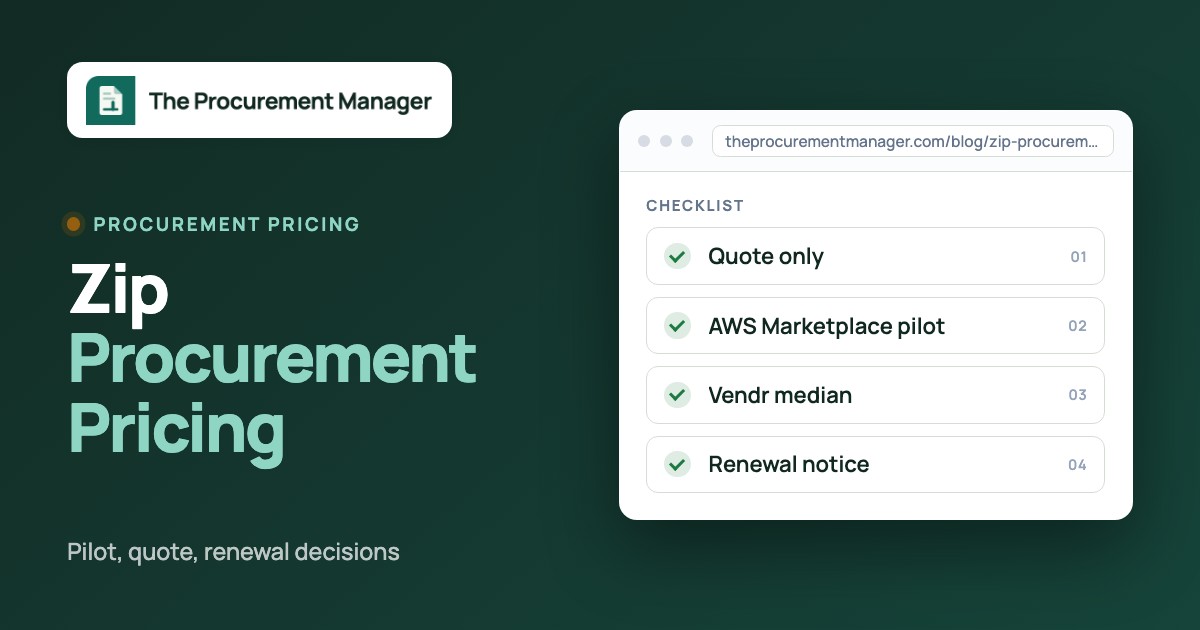
Zip procurement pricing is primarily quote-based, but buyers have two useful public anchors. An AWS Marketplace listing offers a specific Zip Intake-to-Procure pilot for $75,000 over 12 months, while Vendr's observed buyer data shows a $88,000 median annual contract across 75 purchases. Neither number is Zip's universal starting price. Your final cost depends on the products, workflow scope, deployment and commercial terms in your actual order form.
That distinction matters. A team comparing Zip with a purchase-order tool could budget against the wrong product, while an enterprise buyer could mistake a limited marketplace pilot for a full intake-to-pay rollout. The useful question isn't just what Zip costs. It's which procurement decisions, handoffs and renewals the quote will cover, and what remains outside the contract.
How much does Zip procurement software cost?
Zip procurement software doesn't publish a standard self-service price list for its core platform. Its sales path directs buyers to request a demo, and the public AWS Marketplace offer is a specifically scoped pilot, not an open-ended license for every Zip module. Vendr's buyer dataset is a contract benchmark, not a vendor rate card.
- Zip direct enterprise quoteCustom quote Scope and contract terms agreed with sales
- Confirm selected Zip products and modules
- Confirm user and workflow entitlements
- Confirm implementation and support charges
- AWS Marketplace Intake-to-Procure pilot$75,000 12-month prepaid contract
- 100 active users
- 1 workflow
- No refund under the listed policy
AWS Marketplace offer and Zip's demo path checked October 21, 2026. The marketplace pilot is a specific offer, not Zip's general starting price. Vendr's $88,000 median is a separate buyer-data benchmark.
The published numbers answer different questions. Use the marketplace figure to test whether its narrow entitlement could cover your pilot. Use the buyer-data median to sense-check a negotiated subscription, then demand a line-item quote for the actual configuration. Don't use either figure as a guaranteed price for your company.
| Zip pricing evidence | Amount (USD) | What it covers | What it doesn't prove |
|---|---|---|---|
| Zip direct sales | Quote only | A proposal based on agreed scope | A published minimum or fixed seat price |
| Zip AWS Marketplace pilot | $75,000 per 12 months | 100 active users and one workflow | Pricing for a full enterprise rollout |
| Zip contracts in Vendr | $88,000 median per year | Observed buyer contracts across 75 purchases | The quote you'll receive |
| Vendr observed low and high | $26,586 to $214,750 | Range reported for the sample | Formal Zip plan tiers |
Vendr's published summary reports the median and the low-to-high sample range. The spread is useful evidence that contract values vary, but it doesn't explain the complete configuration behind every deal. A buyer can't safely reverse-engineer a per-user list price from it. You won't know whether the sample covers the same modules, and you shouldn't treat a reported median as an offer. It's a negotiation reference, not a contract.
Which Zip products and add-ons can affect a quote?
Zip sells an expanding procurement platform rather than a single identical package for every customer. Its product navigation distinguishes Intake-to-Procure, Procure-to-Pay, Supplier Onboarding, Sourcing, Risk Orchestration, AI Contract Orchestration and AI Procurement Concierge. The same navigation separately labels Global Payments, Vendor Cards, Budgets and App Studio as add-ons. Public product descriptions don't establish the exact commercial bundling in your quote.
The practical pricing question is where each product begins and ends. Intake-to-Procure guides employees through requests and approvals. Procure-to-Pay extends the workflow into purchase orders and invoice handling. A renewal owner needs to know whether contract dates, notices, approval records and the purchasing record will travel together or require another system.
| Zip product or component | Procurement job | Quote question |
|---|---|---|
| Intake-to-Procure | Capture requests and route approvals | Which request types, entities and workflows are included? |
| Procure-to-Pay | Carry purchasing through POs and invoices | Which AP steps and ERP handoffs are in scope? |
| Supplier Onboarding | Gather supplier information and reviews | Are supplier portal and risk checks included? |
| Sourcing | Support RFx and sourcing work | Is sourcing licensed in the proposed package? |
| Risk Orchestration | Coordinate supplier risk assessment | Which data sources and review processes are included? |
| AI Contract Orchestration | Handle contract review workflows | Which contract actions and approval controls are licensed? |
| Global Payments and Vendor Cards | Support payment-related workflows | Are transaction, banking or card fees separate? |
The table describes product boundaries, not a verified pricing schedule. Ask the seller to attach a product-and-entitlement matrix to the order form. You'll see which tasks are included, and you won't have to rely on a demo slide when an approver asks about scope. If an implementation partner says a feature is included, have Zip confirm that inclusion in writing.
Is Zip priced by user, workflow or spend?
Zip's public materials don't establish one universal billing unit for all direct enterprise contracts. Vendr describes a combination of platform fees, seats and optional modules, but that third-party description doesn't replace your commercial proposal. The AWS pilot explicitly limits both active users and workflows.
For a fair quote comparison, request separate definitions of requester, approver, procurement administrator, supplier, workflow and legal entity. Also ask whether occasional employees count against an active-user allowance, how usage is measured and what happens if a workflow needs another approval branch. Those are negotiation questions, not confirmed universal Zip billing rules. If you don't define the counting unit, you can't model growth. That's especially risky when the requester population is much larger than the procurement team.
Do AI agents and integrations cost extra?
Zip announced Superagents, MCP and an AI Spend Automation offering in June 2026. Zip said AI Spend Automation combines platform access, AI consumption credits and forward-deployed engineers. A later Zip recap described Superagents and MCP as included with core products, but public announcements alone can't establish your contracted availability or usage entitlements.
Ask for an AI schedule that lists which agents are available in your environment, any included credits, overage treatment, integration responsibilities and approvals before agents take action. An included feature and unlimited use aren't the same promise. It's reasonable to ask for a worked example of an agent-heavy month. You'll need the credit meter, the approval path and a clear owner for any overage.
What will Zip cost over the contract term?
A Zip total-cost estimate needs the subscription, one-time services, recurring add-ons, internal rollout work and renewal increases on separate lines. A useful starting scenario multiplies Vendr's observed $88,000 annual median by the intended term. It isn't a forecast of your Zip offer and assumes an unchanged subscription rate only for illustration.
This calculator repeats Vendr's $88,000 median for each selected year. It is not a Zip quote, published tier, discount or guaranteed renewal rate.
For example, $88,000 multiplied by three years is $264,000 before implementation, additional modules or any increase. If you receive an annual escalation clause, recalculate each year's subscription separately. A three-year signature shouldn't turn a first-year discount into a surprise renewal cost. Don't assume a renewal quote will preserve a launch discount. You can't compare proposals until the price schedule covers the same term.
What does implementation add?
Implementation is a separate scope question because an intake workflow has to connect employees, approval owners, supplier records and the systems that execute purchases. An intake-to-pay rollout usually touches ERP and procure-to-pay systems, and Zip doesn't give a public universal implementation fee for your deployment.
Get the vendor to price discovery, workflow design, ERP integration, supplier data cleanup, training, testing and post-launch support individually. Specify which work your IT team owns and which work the vendor or a partner owns. A fixed implementation price is more useful when its acceptance criteria are equally specific. If a connector fails a test, you'll want to know whether remediation is included. It isn't enough to say the integration is supported.
Which contract terms change the cost later?
Contract terms can change the cost after go-live even when the initial subscription looks reasonable. Look for price adjustments, auto-renewal, notice dates, unused entitlements, add-on approvals, service credit rules and data export. The relevant terms are your signed order form and current agreement, not a generic website terms page.
An escalation cap belongs beside the price, not buried in a procurement note. The same goes for an agreed process to remove inactive users or decommission workflows. If a vendor offers a discount for a longer term, compare the full obligation and the cost of an early exit rather than focusing on the first invoice. You shouldn't sign until you know who owns the notice calendar. Otherwise, it's easy to miss the decision window.
How should you compare Zip quotes from different vendors?
Compare Zip proposals by normalizing scope and contract economics before comparing their totals. A direct Zip quote, an AWS Marketplace pilot and a competing procurement tool may all cover different work. A lower price is only meaningful if the critical approval, purchasing and renewal handoffs are included. Our Coupa pricing guide covers another quote-based suite, though its product scope differs.
The following evaluation sheet works for a first procurement review or a renewal. Fill each row with exact contract references and ask the seller to confirm every entry.
| Zip quote review field | Required evidence | Decision owner |
|---|---|---|
| Licensed products | Order form product schedule | Procurement |
| Active users and workflows | Written entitlement definitions | IT and procurement |
| ERP and AP integrations | Integration scope and acceptance tests | IT and finance |
| Supplier and contract records | Data ownership and export method | Legal and procurement |
| Subscription and annual adjustments | Price schedule for each contract year | Finance |
| Implementation and training | Statement of work with milestones | Project owner |
| Renewal notice and cancellation | Signed agreement and deadline | Legal and contract owner |
| Security and audit evidence | Current security exhibits and audit rights | Security |
| AI credits and agent controls | Usage schedule and governance description | IT and security |
| Support and escalation | Support exhibit and response commitments | Operations |
A complete quote should leave a clear paper trail. Procurement can then show Finance which amounts are fixed, Legal which obligations need review and IT which integrations will consume staff time. That's stronger than collecting a single headline number in a spreadsheet. You'll also have an audit trail when the approver changes, and you won't need to reconstruct what was promised at renewal.
- Run a narrowly scoped intake pilotCheck the exact AWS Marketplace pilot entitlement, then ask whether its workflow and user limits fit.
- Deploy several procurement modulesRequest a direct Zip quote with a product and add-on schedule.
- Connect complex ERP and AP processesRequire a separate implementation scope with owner, tests and acceptance criteria.
- Prepare a renewal decisionCompare the current order form, actual usage, notice deadline and new quote in one decision packet.
What should you ask Zip before signing?
Ask Zip for a complete commercial and operating package, not just a demo and a total price. Procurement needs enough detail to know what employees can do on day one, who will approve changes and what happens before the next renewal deadline. Finance and IT should sign off on the same scope rather than on separate slide decks. If they don't, the business case can approve a workflow that the implementation plan doesn't cover.
- Identify the exact Zip products, modules and add-ons in the offer.
- Define active users, requesters, approvers, suppliers and workflow limits.
- List the systems of record and the integrations included in implementation.
- Separate subscription, professional services, support, AI credits and payment fees.
- Write the annual price schedule and any renewal escalation formula.
- Confirm the notice deadline, termination process and contract owner.
- Specify the data export method, handover format and transition support.
- Assign Finance, IT, Legal and Procurement reviewers to the same decision packet.
- Document rollout acceptance tests and the owner of each failed test.
- Record the next renewal review date before the contract is signed.
The checklist is also useful when you're replacing an existing tool. For a reusable deadline and approval sequence, see our contract renewal checklist. A vendor can offer a good price while leaving the current purchase-order system, supplier portal or invoice matching workflow untouched. You shouldn't count those capabilities twice in an ROI model. If they're staying in the stack, that's a real operating dependency. Mark those dependencies as explicit exclusions if they aren't being replaced.
How can you negotiate a Zip renewal?
A Zip renewal negotiation works best when procurement brings actual adoption, business outcomes and the contract's notice provisions to the table. Pull the signed order form, identify unused modules and compare the original promised scope with what your teams use. Don't negotiate from a benchmark contract value alone.
For each module, record an owner, a measurable workflow, a reason to retain it and a replacement or reduction option. Ask Finance to verify the spend forecast and IT to verify the real integration footprint. Then ask Zip for a renewal proposal that keeps the unit definitions and module names consistent with the current agreement. You'll spot scope creep faster when the old and new schedules use the same terms. If they don't, ask for a bridge table.
What belongs in a renewal decision packet?
A renewal decision packet should connect the commercial offer to a named business owner and a defensible approval trail. The packet can be a spreadsheet, document or workflow record, provided the decision maker can trace every key date and figure back to its source.
Start with the supplier, the contract owner and the exact product scope from the order form. Add the annual subscription and one-time services in USD, then copy the renewal date and notice deadline from the signed contract. Finish with each Finance, IT and Legal response, the final decision (renew, renegotiate or cancel) and the place where the evidence is stored.
A contract repository can store the signed terms, but the decision still needs an accountable owner. A notification that arrives after the notice deadline isn't a working renewal process. You'll need a decision owner before the date arrives, and you can't rely on an unassigned inbox to protect the option to exit.
When is Zip worth the price compared with alternatives?
Zip is a stronger candidate when the hard part of purchasing is coordinating requests across procurement, Finance, Legal, IT and supplier review rather than generating purchase orders alone. Zip's product materials emphasize intake, conditional routing, supplier information and downstream purchasing. A smaller team that only needs a basic request-to-PO flow should also compare simpler published-price products.
Precoro, for example, publishes a Core starting price of $499 per month billed annually and an Automation starting price of $999 per month billed annually (roughly $5,988 and $11,988 a year). Those are starting package prices, not equivalent enterprise Zip configurations. Precoro's public feature list also distinguishes Core procurement from higher-tier intake and AP automation features. Don't treat the lower number as proof that it will cover the same workflows.
| Procurement buying option | Public price (USD) | Best use of the number | Important limitation |
|---|---|---|---|
| Zip direct enterprise package | Quote only | Ask for matched scope and commercial terms | No universal list price |
| Zip AWS Marketplace pilot | $75,000 per 12 months | Assess a specified pilot | Limited active users and workflows |
| Precoro Core | From $499 per month, billed annually | Compare a smaller published package | Scope differs from Zip enterprise orchestration |
| Precoro Automation | From $999 per month, billed annually | Compare broader purchasing and AP features | Add-ons and enterprise needs may alter quote |
The better choice depends on where your approvals break. You'll get more value from a product that fixes the actual handoff than from a longer feature list. Don't pay for modules that no team owns. If requests arrive through email, stall in security review and lose their contract context, the intake and handoff layer may justify a higher spend. If approvals already work and the missing feature is invoice matching, start by testing that narrower requirement instead of buying an orchestration layer outright.
For teams whose immediate problem is contract renewal decisions, The Procurement Manager focuses on routing a renewal to its business owner, Finance and IT, then preparing a dated decision packet with supporting evidence. It's not a substitute for Zip's purchasing platform or a full contract lifecycle management suite.
Zip procurement pricing FAQ
Zip procurement pricing has a public pilot offer and a third-party contract benchmark, but its full enterprise packages require an individualized proposal. The answers below separate verified public amounts from decisions that need a signed quote.
How much does Zip procurement cost per year?
Zip procurement doesn't publish one standard annual price for direct enterprise deals. AWS Marketplace lists a $75,000 pilot for 12 months, while Vendr reports an $88,000 median annual contract across 75 purchases.
Does Zip offer a free procurement plan?
Zip's public enterprise buying path asks prospects to book a demo rather than displaying a free self-service plan. Ask sales about evaluation access and its terms instead of assuming a free trial is available.
Is Zip priced per employee?
Zip's public sources don't establish a single per-employee price for all direct contracts. The AWS Marketplace pilot specifies 100 active users and one workflow, so request written entitlement definitions for your proposal.
Does Zip charge separately for implementation?
Zip doesn't publish a universal implementation price for every rollout. Ask for a separate statement of work that prices integrations, configuration, migration and training.
Are Zip AI agents included in the price?
Zip has described Superagents and MCP as included with core products, while its AI Spend Automation offering bundles credits and engineering services. Your order form should confirm availability, credits and any usage limits.
Can Zip help with contract renewals?
Zip's Intake-to-Procure materials describe proactive renewal notifications and supplier records. Confirm the exact renewal workflow, notice dates and included module scope in the proposal.
A Zip price is actionable only when it matches the workflows you're buying and the obligations you're signing. Keep the public benchmark as a reference, but make the signed scope, annual cost schedule and renewal decision owner the non-negotiable parts of the purchase.